O07639
Gene name |
ftsW (ylaO, BSU14850) |
Protein name |
Probable peptidoglycan glycosyltransferase FtsW |
Names |
PGT, Cell division protein FtsW, Cell wall polymerase, Peptidoglycan polymerase, PG polymerase |
Species |
Bacillus subtilis (strain 168) |
KEGG Pathway |
bsu:BSU14850 |
EC number |
2.4.1.129: Hexosyltransferases |
Protein Class |
|
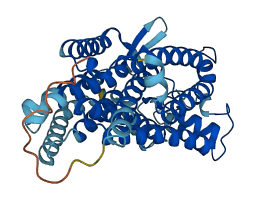
Descriptions
The autoinhibited protein was predicted that may have potential autoinhibitory elements via cis-regPred.
Autoinhibitory domains (AIDs)
Target domain |
|
Relief mechanism |
|
Assay |
cis-regPred |
Accessory elements
No accessory elements
Autoinhibited structure

Activated structure
1 structures for O07639
| Entry ID | Method | Resolution | Chain | Position | Source |
|---|---|---|---|---|---|
| AF-O07639-F1 | Predicted | AlphaFoldDB |
No variants for O07639
| Variant ID(s) | Position | Change | Description | Diseaes Association | Provenance |
|---|---|---|---|---|---|
| No variants for O07639 | |||||
No associated diseases with O07639
9 regional properties for O07639
| Type | Name | Position | InterPro Accession |
|---|---|---|---|
| domain | Elongation factor EFG, domain V-like | 599 - 686 | IPR000640 |
| domain | Translational (tr)-type GTP-binding domain | 8 - 282 | IPR000795 |
| domain | Translation elongation factor EFTu-like, domain 2 | 323 - 390 | IPR004161 |
| domain | Small GTP-binding protein domain | 9 - 180 | IPR005225 |
| domain | Translation elongation factor EFG/EF2, domain IV | 478 - 597 | IPR005517 |
| domain | Elongation factor G, domain III | 404 - 479 | IPR009022 |
| conserved_site | Tr-type G domain, conserved site | 51 - 66 | IPR031157 |
| domain | EFG, domain V | 602 - 679 | IPR035649 |
| domain | Elongation Factor G, domain II | 403 - 476 | IPR041095 |
Functions
| Description | ||
|---|---|---|
| EC Number | 2.4.1.129 | Hexosyltransferases |
| Subcellular Localization |
|
|
| PANTHER Family | ||
| PANTHER Subfamily | ||
| PANTHER Protein Class | ||
| PANTHER Pathway Category | No pathway information available | |
2 GO annotations of cellular component
| Name | Definition |
|---|---|
| cell division site | The eventual plane of cell division (also known as cell cleavage or cytokinesis) in a dividing cell. In Eukaryotes, the cleavage apparatus, composed of septin structures and the actomyosin contractile ring, forms along this plane, and the mitotic, or meiotic, spindle is aligned perpendicular to the division plane. In bacteria, the cell division site is generally located at mid-cell and is the site at which the cytoskeletal structure, the Z-ring, assembles. |
| integral component of plasma membrane | The component of the plasma membrane consisting of the gene products and protein complexes having at least some part of their peptide sequence embedded in the hydrophobic region of the membrane. |
2 GO annotations of molecular function
| Name | Definition |
|---|---|
| lipid-linked peptidoglycan transporter activity | Enables the directed movement of lipid-linked peptidoglycans into, out of or within a cell, or between cells. |
| peptidoglycan glycosyltransferase activity | Catalysis of the reaction: [GlcNAc-(1,4)-Mur2Ac(oyl-L-Ala-gamma-D-Glu-L-Lys-D-Ala-D-Ala)](n)-diphosphoundecaprenol + GlcNAc-(1,4)-Mur2Ac(oyl-L-Ala-gamma-D-Glu-L-Lys-D-Ala-D-Ala)-diphosphoundecaprenol = [GlcNAc-(1,4)-Mur2Ac(oyl-L-Ala-gamma-D-Glu-L-Lys-D-Ala-D-Ala)](n+1)-diphosphoundecaprenol + undecaprenyl diphosphate. |
5 GO annotations of biological process
| Name | Definition |
|---|---|
| cell cycle | The progression of biochemical and morphological phases and events that occur in a cell during successive cell replication or nuclear replication events. Canonically, the cell cycle comprises the replication and segregation of genetic material followed by the division of the cell, but in endocycles or syncytial cells nuclear replication or nuclear division may not be followed by cell division. |
| cell division | The process resulting in division and partitioning of components of a cell to form more cells; may or may not be accompanied by the physical separation of a cell into distinct, individually membrane-bounded daughter cells. |
| cell wall organization | A process that results in the assembly, arrangement of constituent parts, or disassembly of the cell wall, the rigid or semi-rigid envelope lying outside the cell membrane of plant, fungal and most prokaryotic cells, maintaining their shape and protecting them from osmotic lysis. |
| peptidoglycan biosynthetic process | The chemical reactions and pathways resulting in the formation of peptidoglycans, any of a class of glycoconjugates found in bacterial cell walls. |
| regulation of cell shape | Any process that modulates the surface configuration of a cell. |
No homologous proteins in AiPD
| UniProt AC | Gene Name | Protein Name | Species | Evidence Code |
|---|---|---|---|---|
| No homologous proteins | ||||
| 10 | 20 | 30 | 40 | 50 | 60 |
| MLKKMLKSYD | YSLIFAIVLL | CGFGLVMVYS | SSMITAVSRY | GVSSNFFFMR | QLFALIAGGA |
| 70 | 80 | 90 | 100 | 110 | 120 |
| LFILMALFPY | KALAHQKFQK | GILLVSVLAL | ISLFVFGHVA | GNAQSWFKIG | GMSIQPGEFV |
| 130 | 140 | 150 | 160 | 170 | 180 |
| KLVVILYLAA | VYAKKQSYID | HLLTGVAPPV | VMTLIICGLI | AMQPDFGTAM | IIGLIATCMI |
| 190 | 200 | 210 | 220 | 230 | 240 |
| LCSGFSGKTL | VRLVILGGIV | FILVSPIIYL | NQDKILTEGR | LARFESLEDP | FKYANSSGLQ |
| 250 | 260 | 270 | 280 | 290 | 300 |
| VINSYYAISS | GGIFGLGLGE | SIQKYGYLPE | SHTDFIMAVI | AEELGIFGVL | FVIFLLGFVV |
| 310 | 320 | 330 | 340 | 350 | 360 |
| IKGFYIARKC | EDPFGSLLAI | GISSMIAIQS | FINLGGVSGL | IPITGVTLPF | ISYGGSSLVL |
| 370 | 380 | 390 | 400 | ||
| LLGSMGILAN | ISMFVKYSEN | KKKKEPLAPK | GMKKKQLKKT | VYL |