O06582
Gene name |
prpD (Rv1130, RVBD_1130, P425_01179) |
Protein name |
2-methylcitrate dehydratase |
Names |
2-MC dehydratase, Aconitate hydratase, ACN, Aconitase |
Species |
Mycobacterium tuberculosis (strain ATCC 25618 / H37Rv) |
KEGG Pathway |
mtv:RVBD_1130 |
EC number |
4.2.1.3: Hydro-lyases |
Protein Class |
|
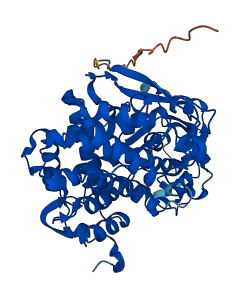
Descriptions
The autoinhibited protein was predicted that may have potential autoinhibitory elements via cis-regPred.
Autoinhibitory domains (AIDs)
Target domain |
|
Relief mechanism |
|
Assay |
cis-regPred |
Accessory elements
No accessory elements
Autoinhibited structure

Activated structure
1 structures for O06582
| Entry ID | Method | Resolution | Chain | Position | Source |
|---|---|---|---|---|---|
| AF-O06582-F1 | Predicted | AlphaFoldDB |
No variants for O06582
| Variant ID(s) | Position | Change | Description | Diseaes Association | Provenance |
|---|---|---|---|---|---|
| No variants for O06582 | |||||
No associated diseases with O06582
Functions
| Description | ||
|---|---|---|
| EC Number | 4.2.1.3 | Hydro-lyases |
| Subcellular Localization |
|
|
| PANTHER Family | ||
| PANTHER Subfamily | ||
| PANTHER Protein Class | ||
| PANTHER Pathway Category | No pathway information available | |
2 GO annotations of cellular component
| Name | Definition |
|---|---|
| cytosol | The part of the cytoplasm that does not contain organelles but which does contain other particulate matter, such as protein complexes. |
| peptidoglycan-based cell wall | A protective structure outside the cytoplasmic membrane composed of peptidoglycan (also known as murein), a molecule made up of a glycan (sugar) backbone of repetitively alternating N-acetylglucosamine and N-acetylmuramic acid with short, attached, cross-linked peptide chains containing unusual amino acids. An example of this component is found in Escherichia coli. |
3 GO annotations of molecular function
| Name | Definition |
|---|---|
| 2-methylcitrate dehydratase activity | Catalysis of the reaction: (2S,3S)-2-methylcitrate = cis-2-methylaconitate + H(2)O. |
| aconitate hydratase activity | Catalysis of the reaction: citrate = isocitrate. The reaction occurs in two steps: (1) citrate = cis-aconitate + H2O, (2) cis-aconitate + H2O = isocitrate. This reaction is the interconversion of citrate and isocitrate via the labile, enzyme-bound intermediate cis-aconitate. Water is removed from one part of the citrate molecule and added back to a different atom to form isocitrate. |
| citrate dehydratase activity | Catalysis of the reaction: citrate = cis-aconitate + H2O. |
4 GO annotations of biological process
| Name | Definition |
|---|---|
| cholesterol metabolic process | The chemical reactions and pathways involving cholesterol, cholest-5-en-3 beta-ol, the principal sterol of vertebrates and the precursor of many steroids, including bile acids and steroid hormones. It is a component of the plasma membrane lipid bilayer and of plasma lipoproteins and can be found in all animal tissues. |
| propionate catabolic process, 2-methylcitrate cycle | The chemical reactions and pathways resulting in the breakdown of propionate that occurs in the 2-methylcitrate cycle. |
| response to acidic pH | Any process that results in a change in state or activity of a cell or an organism (in terms of movement, secretion, enzyme production, gene expression, etc.) as a result of a pH stimulus with pH < 7. pH is a measure of the acidity or basicity of an aqueous solution. |
| tricarboxylic acid cycle | A nearly universal metabolic pathway in which the acetyl group of acetyl coenzyme A is effectively oxidized to two CO2 and four pairs of electrons are transferred to coenzymes. The acetyl group combines with oxaloacetate to form citrate, which undergoes successive transformations to isocitrate, 2-oxoglutarate, succinyl-CoA, succinate, fumarate, malate, and oxaloacetate again, thus completing the cycle. In eukaryotes the tricarboxylic acid is confined to the mitochondria. See also glyoxylate cycle. |
No homologous proteins in AiPD
| UniProt AC | Gene Name | Protein Name | Species | Evidence Code |
|---|---|---|---|---|
| No homologous proteins | ||||
| 10 | 20 | 30 | 40 | 50 | 60 |
| MPDQDTKVRF | FRVFCWCPVL | RMVRIMLMHA | VRAWRSADDF | PCTEHMAYKI | AQVAADPVDV |
| 70 | 80 | 90 | 100 | 110 | 120 |
| DPEVADMVCN | RIIDNAAVSA | ASMVRRPVTV | ARHQALAHPV | RHGAKVFGVE | GSYSADWAAW |
| 130 | 140 | 150 | 160 | 170 | 180 |
| ANGVAARELD | FHDTFLAADY | SHPADNIPPL | VAVAQQLGVC | GAELIRGLVT | AYEIHIDLTR |
| 190 | 200 | 210 | 220 | 230 | 240 |
| GICLHEHKID | HVAHLGPAVA | AGIGTMLRLD | QETIYHAIGQ | ALHLTTSTRQ | SRKGAISSWK |
| 250 | 260 | 270 | 280 | 290 | 300 |
| AFAPAHAGKV | GIEAVDRAMR | GEGSPAPIWE | GEDGVIAWLL | AGPEHTYRVP | LPAPGEPKRA |
| 310 | 320 | 330 | 340 | 350 | 360 |
| ILDSYTKQHS | AEYQSQAPID | LACRLRERIG | DLDQIASIVL | HTSHHTHVVI | GTGSGDPQKF |
| 370 | 380 | 390 | 400 | 410 | 420 |
| DPDASRETLD | HSLPYIFAVA | LQDGCWHHER | SYAPERARRS | DTVALWHKIS | TVEDPEWTRR |
| 430 | 440 | 450 | 460 | 470 | 480 |
| YHCADPAKKA | FGARAEVTLH | SGEVIVDELA | VADAHPLGTR | PFERKQYVEK | FTELADGVVE |
| 490 | 500 | 510 | 520 | ||
| PVEQQRFLAV | VESLADLESG | AVGGLNVLVD | PRVLDKAPVI | PPGIFR |