O02824
Gene name |
ADRA1A (ADRA1C) |
Protein name |
Alpha-1A adrenergic receptor |
Names |
Alpha-1A adrenoreceptor, Alpha-1A adrenoceptor, Alpha-1C adrenergic receptor |
Species |
Oryctolagus cuniculus (Rabbit) |
KEGG Pathway |
ocu:100009237 |
EC number |
|
Protein Class |
|
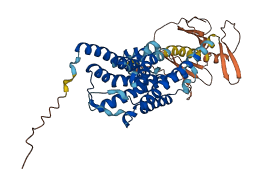
Descriptions
The autoinhibited protein was predicted that may have potential autoinhibitory elements via cis-regPred.
Autoinhibitory domains (AIDs)
Target domain |
|
Relief mechanism |
|
Assay |
cis-regPred |
Accessory elements
No accessory elements
Autoinhibited structure

Activated structure
1 structures for O02824
| Entry ID | Method | Resolution | Chain | Position | Source |
|---|---|---|---|---|---|
| AF-O02824-F1 | Predicted | AlphaFoldDB |
No variants for O02824
| Variant ID(s) | Position | Change | Description | Diseaes Association | Provenance |
|---|---|---|---|---|---|
| No variants for O02824 | |||||
No associated diseases with O02824
Functions
8 GO annotations of cellular component
| Name | Definition |
|---|---|
| caveola | A membrane raft that forms small pit, depression, or invagination that communicates with the outside of a cell and extends inward, indenting the cytoplasm and the cell membrane. Examples include flask-shaped invaginations of the plasma membrane in adipocytes associated with caveolin proteins, and minute pits or incuppings of the cell membrane formed during pinocytosis. Caveolae may be pinched off to form free vesicles within the cytoplasm. |
| cytoplasm | The contents of a cell excluding the plasma membrane and nucleus, but including other subcellular structures. |
| cytosol | The part of the cytoplasm that does not contain organelles but which does contain other particulate matter, such as protein complexes. |
| integral component of membrane | The component of a membrane consisting of the gene products and protein complexes having at least some part of their peptide sequence embedded in the hydrophobic region of the membrane. |
| nuclear membrane | Either of the lipid bilayers that surround the nucleus and form the nuclear envelope; excludes the intermembrane space. |
| nucleoplasm | That part of the nuclear content other than the chromosomes or the nucleolus. |
| nucleus | A membrane-bounded organelle of eukaryotic cells in which chromosomes are housed and replicated. In most cells, the nucleus contains all of the cell's chromosomes except the organellar chromosomes, and is the site of RNA synthesis and processing. In some species, or in specialized cell types, RNA metabolism or DNA replication may be absent. |
| plasma membrane | The membrane surrounding a cell that separates the cell from its external environment. It consists of a phospholipid bilayer and associated proteins. |
2 GO annotations of molecular function
| Name | Definition |
|---|---|
| alpha1-adrenergic receptor activity | Combining with epinephrine or norepinephrine to initiate a change in cell activity via activation of a G protein, with pharmacological characteristics of alpha1-adrenergic receptors; the activity involves transmitting the signal to the Gq alpha subunit of a heterotrimeric G protein. |
| protein heterodimerization activity | Binding to a nonidentical protein to form a heterodimer. |
18 GO annotations of biological process
| Name | Definition |
|---|---|
| adult heart development | The process whose specific outcome is the progression of the adult heart over time, from its formation to the mature structure. |
| cell growth involved in cardiac muscle cell development | The growth of a cardiac muscle cell, where growth contributes to the progression of the cell over time from its initial formation to its mature state. |
| MAPK cascade | An intracellular protein kinase cascade containing at least a MAPK, a MAPKK and a MAP3K. The cascade can also contain an additional tiers: the upstream MAP4K. The kinases in each tier phosphorylate and activate the kinase in the downstream tier to transmit a signal within a cell. |
| multicellular organism aging | An aging process that has as participant a whole multicellular organism. Multicellular organism aging includes loss of functions such as resistance to disease, homeostasis, and fertility, as well as wear and tear. Multicellular organisms aging includes processes like cellular senescence and organ senescence, but is more inclusive. May precede death (GO:0016265) of an organism and may succeed developmental maturation (GO:0021700). |
| negative regulation of autophagy | Any process that stops, prevents, or reduces the frequency, rate or extent of autophagy. Autophagy is the process in which cells digest parts of their own cytoplasm. |
| negative regulation of heart rate involved in baroreceptor response to increased systemic arterial blood pressure | Any process that stops, prevents, or reduces the frequency, rate or extent of heart contraction as a result of the baroreceptor response to increased blood pressure. |
| neuron-glial cell signaling | Cell-cell signaling that mediates the transfer of information from a neuron to a glial cell. This signalling has been shown to be mediated by various molecules released by different types of neurons, e.g. glutamate, gamma-amino butyric acid (GABA), noradrenaline, acetylcholine, dopamine and adenosine. |
| norepinephrine-epinephrine vasoconstriction involved in regulation of systemic arterial blood pressure | A process that results in a decrease in the diameter of an artery during the norepinephrine-epinephrine response to decreased blood pressure. |
| phospholipase C-activating G protein-coupled receptor signaling pathway | A G protein-coupled receptor signaling pathway in which the signal is transmitted via the activation of phospholipase C (PLC) and a subsequent increase in the intracellular concentration of inositol trisphosphate (IP3) and diacylglycerol (DAG). |
| pilomotor reflex | The reflex process in which the arrectores pilorum (hair follicle) muscles contract and cause the hair to stand erect. |
| positive regulation of cardiac muscle hypertrophy | Any process that increases the rate, frequency or extent of the enlargement or overgrowth of all or part of the heart due to an increase in size (not length) of individual cardiac muscle fibers, without cell division. |
| positive regulation of heart rate by epinephrine-norepinephrine | The process in which the presence of epinephrine or norepinephrine in the bloodstream activates, maintains or increases the rate of heart contraction. |
| positive regulation of MAPK cascade | Any process that activates or increases the frequency, rate or extent of signal transduction mediated by the MAPK cascade. |
| positive regulation of non-membrane spanning protein tyrosine kinase activity | Any process that activates or increases the frequency, rate or extent of non-membrane spanning protein tyrosine kinase activity. |
| positive regulation of smooth muscle contraction | Any process that activates or increases the frequency, rate or extent of smooth muscle contraction. |
| positive regulation of the force of heart contraction by epinephrine-norepinephrine | Any process that increases the force with which the cardiac muscles of the heart pump blood through the circulatory system as a result of the presence of epinephrine or norepinephrine in the bloodstream or released from the nerve endings. |
| regulation of cardiac muscle contraction | Any process that modulates the frequency, rate or extent of cardiac muscle contraction. |
| regulation of vasoconstriction | Any process that modulates the frequency, rate or extent of reductions in the diameter of blood vessels. |
No homologous proteins in AiPD
| UniProt AC | Gene Name | Protein Name | Species | Evidence Code |
|---|---|---|---|---|
| No homologous proteins | ||||
| 10 | 20 | 30 | 40 | 50 | 60 |
| MVFLSGNASD | SSNCTHPPAP | VNISKAILLG | VILGGLILFG | VLGNILVILS | VACHRHLHSV |
| 70 | 80 | 90 | 100 | 110 | 120 |
| THYYIVNLAV | ADLLLTSTVL | PFSAIFEILG | YWAFGRVFCN | IWAAVDVLCC | TASIISLCVI |
| 130 | 140 | 150 | 160 | 170 | 180 |
| SIDRYIGVSY | PLRYPTIVTQ | RRGLRALLCV | WAFSLVISVG | PLFGWRQPAP | DDETICQINE |
| 190 | 200 | 210 | 220 | 230 | 240 |
| EPGYVLFSAL | GSFYVPLTII | LAMYCRVYVV | AKRESRGLKS | GLKTDKSDSE | QVTLRIHRKN |
| 250 | 260 | 270 | 280 | 290 | 300 |
| APAGGSGVAS | AKNKTHFSVR | LLKFSREKKA | AKTLGIVVGC | FVLCWLPFFL | VMPIGSFFPD |
| 310 | 320 | 330 | 340 | 350 | 360 |
| FKPPETVFKI | VFWLGYLNSC | INPIIYPCSS | QEFKKAFQNV | LKIQCLRRKQ | SSKHALGYTL |
| 370 | 380 | 390 | 400 | 410 | 420 |
| HAPSQALEGQ | HKDMVRIPVG | SGETFYKISK | TDGVCEWKFF | SSMPRGSARI | TVPKDQSACT |
| 430 | 440 | 450 | 460 | ||
| TARVRSKSFL | QVCCCVGPST | PNPGENHQVP | TIKIHTISLS | ENGEEV |