H8F3R6
Gene name |
aceAb (ERDMAN_2108) |
Protein name |
Isocitrate lyase 2 |
Names |
ICL2, Isocitrase, Isocitratase, Methylisocitrate lyase, MICA |
Species |
Mycobacterium tuberculosis (strain ATCC 35801 / TMC 107 / Erdman) |
KEGG Pathway |
mtn:ERDMAN_2108 |
EC number |
4.1.3.1: Oxo-acid-lyases |
Protein Class |
|
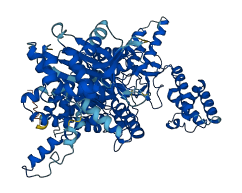
Descriptions
The autoinhibited protein was predicted that may have potential autoinhibitory elements via cis-regPred.
Autoinhibitory domains (AIDs)
Target domain |
|
Relief mechanism |
|
Assay |
cis-regPred |
Accessory elements
No accessory elements
Autoinhibited structure

Activated structure
1 structures for H8F3R6
| Entry ID | Method | Resolution | Chain | Position | Source |
|---|---|---|---|---|---|
| AF-H8F3R6-F1 | Predicted | AlphaFoldDB |
No variants for H8F3R6
| Variant ID(s) | Position | Change | Description | Diseaes Association | Provenance |
|---|---|---|---|---|---|
| No variants for H8F3R6 | |||||
No associated diseases with H8F3R6
Functions
| Description | ||
|---|---|---|
| EC Number | 4.1.3.1 | Oxo-acid-lyases |
| Subcellular Localization |
|
|
| PANTHER Family | ||
| PANTHER Subfamily | ||
| PANTHER Protein Class | ||
| PANTHER Pathway Category | No pathway information available | |
No GO annotations of cellular component
| Name | Definition |
|---|---|
| No GO annotations for cellular component |
3 GO annotations of molecular function
| Name | Definition |
|---|---|
| isocitrate lyase activity | Catalysis of the reaction: isocitrate = glyoxylate + succinate. |
| metal ion binding | Binding to a metal ion. |
| methylisocitrate lyase activity | Catalysis of the reaction: (2S,3R)-3-hydroxybutane-1,2,3-tricarboxylate = pyruvate + succinate. |
2 GO annotations of biological process
| Name | Definition |
|---|---|
| glyoxylate cycle | A modification of the TCA cycle occurring in some plants and microorganisms, in which isocitrate is cleaved to glyoxylate and succinate. Glyoxylate can then react with acetyl-CoA to form malate. |
| tricarboxylic acid cycle | A nearly universal metabolic pathway in which the acetyl group of acetyl coenzyme A is effectively oxidized to two CO2 and four pairs of electrons are transferred to coenzymes. The acetyl group combines with oxaloacetate to form citrate, which undergoes successive transformations to isocitrate, 2-oxoglutarate, succinyl-CoA, succinate, fumarate, malate, and oxaloacetate again, thus completing the cycle. In eukaryotes the tricarboxylic acid is confined to the mitochondria. See also glyoxylate cycle. |
No homologous proteins in AiPD
| UniProt AC | Gene Name | Protein Name | Species | Evidence Code |
|---|---|---|---|---|
| No homologous proteins | ||||
| 10 | 20 | 30 | 40 | 50 | 60 |
| MAIAETDTEV | HTPFEQDFEK | DVAATQRYFD | SSRFAGIIRL | YTARQVVEQR | GTIPVDHIVA |
| 70 | 80 | 90 | 100 | 110 | 120 |
| REAAGAFYER | LRELFAARKS | ITTFGPYSPG | QAVSMKRMGI | EAIYLGGWAT | SAKGSSTEDP |
| 130 | 140 | 150 | 160 | 170 | 180 |
| GPDLASYPLS | QVPDDAAVLV | RALLTADRNQ | HYLRLQMSER | QRAATPAYDF | RPFIIADADT |
| 190 | 200 | 210 | 220 | 230 | 240 |
| GHGGDPHVRN | LIRRFVEVGV | PGYHIEDQRP | GTKKCGHQGG | KVLVPSDEQI | KRLNAARFQL |
| 250 | 260 | 270 | 280 | 290 | 300 |
| DIMRVPGIIV | ARTDAEAANL | IDSRADERDQ | PFLLGATKLD | VPSYKSCFLA | MVRRFYELGV |
| 310 | 320 | 330 | 340 | 350 | 360 |
| KELNGHLLYA | LGDSEYAAAG | GWLERQGIFG | LVSDAVNAWR | EDGQQSIDGI | FDQVESRFVA |
| 370 | 380 | 390 | 400 | 410 | 420 |
| AWEDDAGLMT | YGEAVADVLE | FGQSEGEPIG | MAPEEWRAFA | ARASLHAARA | KAKELGADPP |
| 430 | 440 | 450 | 460 | 470 | 480 |
| WDCELAKTPE | GYYQIRGGIP | YAIAKSLAAA | PFADILWMET | KTADLADARQ | FAEAIHAEFP |
| 490 | 500 | 510 | 520 | 530 | 540 |
| DQMLAYNLSP | SFNWDTTGMT | DEEMRRFPEE | LGKMGFVFNF | ITYGGHQIDG | VAAEEFATAL |
| 550 | 560 | 570 | 580 | 590 | 600 |
| RQDGMLALAR | LQRKMRLVES | PYRTPQTLVG | GPRSDAALAA | SSGRTATTKA | MGKGSTQHQH |
| 610 | 620 | 630 | 640 | 650 | 660 |
| LVQTEVPRKL | LEEWLAMWSG | HYQLKDKLRV | QLRPQRAGSE | VLELGIHGES | DDKLANVIFQ |
| 670 | 680 | 690 | 700 | 710 | 720 |
| PIQDRRGRTI | LLVRDQNTFG | AELRQKRLMT | LIHLWLVHRF | KAQAVHYVTP | TDDNLYQTSK |
| 730 | 740 | 750 | 760 | ||
| MKSHGIFTEV | NQEVGEIIVA | EVNHPRIAEL | LTPDRVALRK | LITKEA |