H1AFJ7
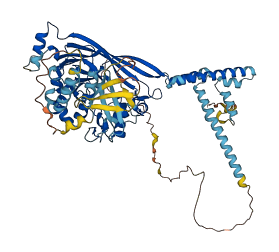
Descriptions
The autoinhibited protein was predicted that may have potential autoinhibitory elements via cis-regPred.
Autoinhibitory domains (AIDs)
Target domain |
|
Relief mechanism |
|
Assay |
cis-regPred |
Accessory elements
No accessory elements
Autoinhibited structure

Activated structure
1 structures for H1AFJ7
| Entry ID | Method | Resolution | Chain | Position | Source |
|---|---|---|---|---|---|
| AF-H1AFJ7-F1 | Predicted | AlphaFoldDB |
No variants for H1AFJ7
| Variant ID(s) | Position | Change | Description | Diseaes Association | Provenance |
|---|---|---|---|---|---|
| No variants for H1AFJ7 | |||||
No associated diseases with H1AFJ7
1 regional properties for H1AFJ7
| Type | Name | Position | InterPro Accession |
|---|---|---|---|
| conserved_site | Epithelial sodium channel, conserved site | 396 - 416 | IPR020903 |
2 GO annotations of cellular component
| Name | Definition |
|---|---|
| apical plasma membrane | The region of the plasma membrane located at the apical end of the cell. |
| sodium channel complex | An ion channel complex through which sodium ions pass. |
1 GO annotations of molecular function
| Name | Definition |
|---|---|
| ligand-gated sodium channel activity | Enables the transmembrane transfer of a sodium ion by a channel that opens when a specific ligand has been bound by the channel complex or one of its constituent parts. |
3 GO annotations of biological process
| Name | Definition |
|---|---|
| response to stimulus | Any process that results in a change in state or activity of a cell or an organism (in terms of movement, secretion, enzyme production, gene expression, etc.) as a result of a stimulus. The process begins with detection of the stimulus and ends with a change in state or activity or the cell or organism. |
| sensory perception of taste | The series of events required for an organism to receive a gustatory stimulus, convert it to a molecular signal, and recognize and characterize the signal. Gustation involves the direct detection of chemical composition, usually through contact with chemoreceptor cells. This is a neurological process. |
| sodium ion transmembrane transport | A process in which a sodium ion is transported from one side of a membrane to the other by means of some agent such as a transporter or pore. |
No homologous proteins in AiPD
| UniProt AC | Gene Name | Protein Name | Species | Evidence Code |
|---|---|---|---|---|
| No homologous proteins | ||||
| 10 | 20 | 30 | 40 | 50 | 60 |
| MGHGRRISES | IKKQLPVTGP | EAPTVKNLMD | WYLNNTNTHG | CRRIAVSRGY | LRRWIWICFT |
| 70 | 80 | 90 | 100 | 110 | 120 |
| VSSVGMIFWQ | WTLLLMSYYT | VSVSVTVQFQ | TLPFPAVTIC | NINPYRKNAT | SALLEELDKQ |
| 130 | 140 | 150 | 160 | 170 | 180 |
| TKLILKELYT | SCTGCSNRKL | RSVLLNEAPE | EDSGVAKLLQ | DMPLMKFEVI | KEDHVIVSEL |
| 190 | 200 | 210 | 220 | 230 | 240 |
| SSNRQYRINN | TFITRMYNNM | DLATVGEQVG | FKICDANKSN | CIIYTFNSGV | TAILEWYRLN |
| 250 | 260 | 270 | 280 | 290 | 300 |
| YLNIMAQIPN | EKKLEMGYSA | DDLIVTCMYD | GQSCDSRNFT | LFQHPLHGNC | YTFNSGDDGN |
| 310 | 320 | 330 | 340 | 350 | 360 |
| ILQTLTGGSE | YGLKLTLYLE | NDDYNPYLFT | SMGAKIIVHD | QTEYPLVDDV | GLEIQTATET |
| 370 | 380 | 390 | 400 | 410 | 420 |
| LIGLQVTTSA | KLSKPYSDCT | MDGSDVLEQN | LYNTSYSLQI | CLHSCFQTEM | ISNCGCAYYE |
| 430 | 440 | 450 | 460 | 470 | 480 |
| QPLPSGAEYC | YYEKYPGWIY | CYYQLQDKFV | NERLACQDIC | KETCNSKDWD | LTKSLARWPS |
| 490 | 500 | 510 | 520 | 530 | 540 |
| VASKDWVLNL | LNWERGLNNT | LNKNDLASIA | IFYQDLNLRS | LSESPANSIA | TLLSNMGGQL |
| 550 | 560 | 570 | 580 | 590 | 600 |
| GLWMSCSIVC | FLEMWEVFLV | DILTIIARYW | LHRGRQWWRK | RKERQMQQPS | PPDHDTGHHN |
| 610 | 620 | 630 | 640 | 650 | |
| PVCIDDEDPP | TFHTAMQLPC | VQTGPVPSTP | PPQYNALRIQ | SVFDEQVSDT | EVN |