G1UB61
Gene name |
CDC11 (CAALFM_C500070WA, CaO19.5691) |
Protein name |
Septin CDC11 |
Names |
Cell division control protein 11 |
Species |
Candida albicans (strain SC5314 / ATCC MYA-2876) (Yeast) |
KEGG Pathway |
cal:CAALFM_C500070WA |
EC number |
|
Protein Class |
|
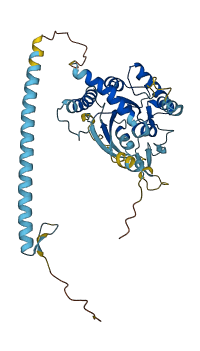
Descriptions
The autoinhibited protein was predicted that may have potential autoinhibitory elements via cis-regPred.
Autoinhibitory domains (AIDs)
Target domain |
|
Relief mechanism |
|
Assay |
cis-regPred |
Accessory elements
No accessory elements
Autoinhibited structure

Activated structure
1 structures for G1UB61
| Entry ID | Method | Resolution | Chain | Position | Source |
|---|---|---|---|---|---|
| AF-G1UB61-F1 | Predicted | AlphaFoldDB |
No variants for G1UB61
| Variant ID(s) | Position | Change | Description | Diseaes Association | Provenance |
|---|---|---|---|---|---|
| No variants for G1UB61 | |||||
No associated diseases with G1UB61
1 regional properties for G1UB61
| Type | Name | Position | InterPro Accession |
|---|---|---|---|
| domain | Septin-type guanine nucleotide-binding (G) domain | 21 - 309 | IPR030379 |
17 GO annotations of cellular component
| Name | Definition |
|---|---|
| ascospore wall | The specialized cell wall of the ascospore (spore), which is the product of meiotic division. Examples of this component are found in Fungi. |
| cell division site | The eventual plane of cell division (also known as cell cleavage or cytokinesis) in a dividing cell. In Eukaryotes, the cleavage apparatus, composed of septin structures and the actomyosin contractile ring, forms along this plane, and the mitotic, or meiotic, spindle is aligned perpendicular to the division plane. In bacteria, the cell division site is generally located at mid-cell and is the site at which the cytoskeletal structure, the Z-ring, assembles. |
| cellular bud neck | The constriction between the mother cell and daughter cell (bud) in an organism that reproduces by budding. |
| cellular bud neck septin ring | A ring-shaped structure that forms at the site of cytokinesis in the bud neck of a budding cell; composed of members of the conserved family of filament forming proteins called septins as well as septin-associated proteins. In S. cerevisiae, this structure forms at the time of bud emergence and the septins show a high rate of exchange. |
| cellular bud neck septin structure | Any of a series of septin structures that are localized in the bud neck of a budding fungal cell during the cell cycle. |
| cytoplasmic microtubule | Any microtubule in the cytoplasm of a cell. |
| Gin4 complex | A protein complex involved in septin ring formation during mitosis. In Saccharomyces cerevisiae it consists of BNI5, CDC3, CDC10, CDC11, CDC12, GIN4, NAP1 and SHS1. At least 2 GIN4 molecules are involved. |
| hyphal septin ring | A tight ring-shaped structure that forms in the division plane within hyphae of filamentous fungi at sites where a septum will form; composed of septins as well as septin-associated proteins. |
| hyphal tip | The end, or tip, of a fungal hypha, where polarized growth occurs during hyphal elongation. |
| mating projection base | The region where the mating projection meets the bulk of the cell, in unicellular fungi exposed to mating pheromone. |
| meiotic spindle | A spindle that forms as part of meiosis. Several proteins, such as budding yeast Spo21p, fission yeast Spo2 and Spo13, and C. elegans mei-1, localize specifically to the meiotic spindle and are absent from the mitotic spindle. |
| microtubule cytoskeleton | The part of the cytoskeleton (the internal framework of a cell) composed of microtubules and associated proteins. |
| prospore membrane | The prospore membrane is a double-membraned structure that extends from the cytoplasmic face of the spindle pole bodies to encompass the spindle pole bodies and the four nuclear lobes that are formed during meiosis. It helps isolate the meiotic nuclei from the cytoplasm during spore formation and serves as a foundation for the formation of the spore walls. An example of this component is found in Schizosaccharomyces pombe. |
| septin complex | A protein complex containing septins. Typically, these complexes contain multiple septins and are oligomeric. |
| septin filament array | Arrays of septin filaments, or bars, found in a series of filamentous structures. Such structures have been observed in the prospore membrane during spore formation in S. cerevisiae and in the chlamydospore membrane during chlamydospore formation in C. albicans. |
| septin ring | A tight ring-shaped structure that forms in the division plane at the site of cytokinesis; composed of members of the conserved family of filament-forming proteins called septins as well as septin-associated proteins. This type of septin structure is observed at the bud neck of budding fungal cells, at the site of cell division in animal cells, at the junction between the mother cell and a pseudohyphal projection, and also within hyphae of filamentous fungi at sites where a septum will form. |
| spindle microtubule | Any microtubule that is part of a mitotic or meiotic spindle; anchored at one spindle pole. |
7 GO annotations of molecular function
| Name | Definition |
|---|---|
| GTP binding | Binding to GTP, guanosine triphosphate. |
| GTPase activity | Catalysis of the reaction: GTP + H2O = GDP + H+ + phosphate. |
| identical protein binding | Binding to an identical protein or proteins. |
| molecular adaptor activity | The binding activity of a molecule that brings together two or more molecules through a selective, non-covalent, often stoichiometric interaction, permitting those molecules to function in a coordinated way. |
| phosphatidylinositol-4-phosphate binding | Binding to phosphatidylinositol-4-phosphate, a derivative of phosphatidylinositol in which the inositol ring is phosphorylated at the 4' position. |
| phosphatidylinositol-5-phosphate binding | Binding to phosphatidylinositol-5-phosphate, a derivative of phosphatidylinositol in which the inositol ring is phosphorylated at the 5' position. |
| structural constituent of cytoskeleton | The action of a molecule that contributes to the structural integrity of a cytoskeletal structure. |
14 GO annotations of biological process
| Name | Definition |
|---|---|
| actomyosin contractile ring assembly | The process of assembly of a ring composed of actin, myosin, and associated proteins that will function in cytokinesis. |
| cellular bud neck septin ring organization | Control of the formation, spatial distribution, and breakdown of a septin ring located at the bud neck. |
| chitin localization | A process in which chitin is transported to, or maintained in, a specific location. |
| chlamydospore formation | The process whose specific outcome is the progression of the chlamydospore over time, from its formation to the mature structure. A chlamydospores is a mitotic (asexual) one-celled spore, produced primarily for survival, not dispersal, originating endogenously and singly within part of a pre-existing cell and possessing an inner secondary and often thickened cell wall. An example of this is found in Candida albicans. |
| cytoskeleton-dependent cytokinesis | A cytokinesis that involves the function of a set of proteins that are part of the microfilament or microtubule cytoskeleton. |
| division septum assembly | The assembly and arrangement of a septum that spans the plasma membrane interface between progeny cells following cytokinesis. The progeny cells that form a division septum are not able to exchange intracellular material. |
| growth of unicellular organism as a thread of attached cells | A filamentous growth process in which cells remain attached after division and form thread-like filaments that may penetrate into a solid growth medium such as an agar plate, exhibited by unicellular fungi under certain growth conditions. |
| hyphal growth | Growth of fungi as threadlike, tubular structures that may contain multiple nuclei and may or may not be divided internally by septa, or cross-walls. |
| maintenance of cell polarity | The maintenance of established anisotropic intracellular organization or cell growth patterns. |
| nuclear migration | The directed movement of the nucleus to a specific location within a cell. |
| positive regulation of protein serine/threonine kinase activity | Any process that increases the rate, frequency, or extent of protein serine/threonine kinase activity. |
| protein localization | Any process in which a protein is transported to, or maintained in, a specific location. |
| protein localization to bud neck | A process in which a protein is transported to, or maintained at, a location within a cellular bud neck. |
| septin ring assembly | The aggregation, arrangement and bonding together of septins and associated proteins to form an organized structure resembling a ring at the cell cortex. |
No homologous proteins in AiPD
| UniProt AC | Gene Name | Protein Name | Species | Evidence Code |
|---|---|---|---|---|
| No homologous proteins | ||||
| 10 | 20 | 30 | 40 | 50 | 60 |
| MNYSTENVSS | AALRKRKTLK | KSINFSIMII | GESGSGRSTL | INTLCGGNSI | VPTSSTATQD |
| 70 | 80 | 90 | 100 | 110 | 120 |
| PFTKKLTLRH | ENVELEDNEG | HKISLNIIDT | PNFANSINCD | DDFKIIVDFI | RHQFDEVLLE |
| 130 | 140 | 150 | 160 | 170 | 180 |
| ESRVKRNPRF | KDGRIHVLIY | MINPTGHGLS | DIDVKFLQHV | NNLVNIIPII | SKADSLTPKE |
| 190 | 200 | 210 | 220 | 230 | 240 |
| LKLNKELILE | DLNNYGINFY | KFNEYDYEQD | YIDEEIIEYN | KYLNSLIPFA | IIGANEYRSN |
| 250 | 260 | 270 | 280 | 290 | 300 |
| PNGSEDEDDI | LKLRILNKDF | KPIDIDNAEI | NDFTILKNVL | LVTHLNEFKD | ITHDSIYENY |
| 310 | 320 | 330 | 340 | 350 | 360 |
| RTEALSGKQF | QYVNKDSAKQ | EISESDYLMK | EEQIKLEEER | LRKFEERVHQ | DLINKRKELL |
| 370 | 380 | 390 | 400 | ||
| ERENELKEIE | KRLLAEGLKF | DENGDVVKVH | EEESSENEVK | VI |