G0S616
Gene name |
CTHT_0025680 |
Protein name |
Ribosome assembly factor mrt4 |
Names |
mRNA turnover protein 4 |
Species |
Chaetomium thermophilum (strain DSM 1495 / CBS 144.50 / IMI 039719) (Thermochaetoides thermophila) |
KEGG Pathway |
cthr:CTHT_0025680 |
EC number |
|
Protein Class |
|
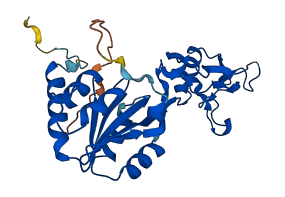
Descriptions
The autoinhibited protein was predicted that may have potential autoinhibitory elements via cis-regPred.
Autoinhibitory domains (AIDs)
Target domain |
|
Relief mechanism |
|
Assay |
cis-regPred |
Accessory elements
No accessory elements
Autoinhibited structure

Activated structure
19 structures for G0S616
| Entry ID | Method | Resolution | Chain | Position | Source |
|---|---|---|---|---|---|
| 4NWB | X-ray | 180 A | A | 1-270 | PDB |
| 8I9T | EM | 360 A | CF | 1-270 | PDB |
| 8I9V | EM | 310 A | CF | 1-270 | PDB |
| 8I9W | EM | 310 A | CF | 1-270 | PDB |
| 8I9X | EM | 280 A | CF | 1-270 | PDB |
| 8I9Y | EM | 310 A | CF | 1-270 | PDB |
| 8I9Z | EM | 270 A | CF | 1-270 | PDB |
| 8IA0 | EM | 270 A | CF | 1-270 | PDB |
| 8PV1 | EM | 256 A | CF | 1-270 | PDB |
| 8PV2 | EM | 263 A | CF | 1-270 | PDB |
| 8PV3 | EM | 280 A | CF | 1-270 | PDB |
| 8PV4 | EM | 290 A | CF | 1-270 | PDB |
| 8PV5 | EM | 286 A | CF | 1-270 | PDB |
| 8PV6 | EM | 294 A | CF | 1-270 | PDB |
| 8PV7 | EM | 212 A | CF | 1-270 | PDB |
| 8PV8 | EM | 291 A | CF | 1-270 | PDB |
| 8PVK | EM | 255 A | CF | 1-270 | PDB |
| 8PVL | EM | 219 A | CF | 1-270 | PDB |
| AF-G0S616-F1 | Predicted | AlphaFoldDB |
No variants for G0S616
| Variant ID(s) | Position | Change | Description | Diseaes Association | Provenance |
|---|---|---|---|---|---|
| No variants for G0S616 | |||||
No associated diseases with G0S616
1 regional properties for G0S616
| Type | Name | Position | InterPro Accession |
|---|---|---|---|
| domain | 60S ribosomal protein L10P, insertion domain | 125 - 214 | IPR040637 |
4 GO annotations of cellular component
| Name | Definition |
|---|---|
| cytoplasm | The contents of a cell excluding the plasma membrane and nucleus, but including other subcellular structures. |
| nucleolus | A small, dense body one or more of which are present in the nucleus of eukaryotic cells. It is rich in RNA and protein, is not bounded by a limiting membrane, and is not seen during mitosis. Its prime function is the transcription of the nucleolar DNA into 45S ribosomal-precursor RNA, the processing of this RNA into 5.8S, 18S, and 28S components of ribosomal RNA, and the association of these components with 5S RNA and proteins synthesized outside the nucleolus. This association results in the formation of ribonucleoprotein precursors; these pass into the cytoplasm and mature into the 40S and 60S subunits of the ribosome. |
| ribonucleoprotein complex | A macromolecular complex that contains both RNA and protein molecules. |
| ribosome | An intracellular organelle, about 200 A in diameter, consisting of RNA and protein. It is the site of protein biosynthesis resulting from translation of messenger RNA (mRNA). It consists of two subunits, one large and one small, each containing only protein and RNA. Both the ribosome and its subunits are characterized by their sedimentation coefficients, expressed in Svedberg units (symbol: S). Hence, the prokaryotic ribosome (70S) comprises a large (50S) subunit and a small (30S) subunit, while the eukaryotic ribosome (80S) comprises a large (60S) subunit and a small (40S) subunit. Two sites on the ribosomal large subunit are involved in translation, namely the aminoacyl site (A site) and peptidyl site (P site). Ribosomes from prokaryotes, eukaryotes, mitochondria, and chloroplasts have characteristically distinct ribosomal proteins. |
No GO annotations of molecular function
| Name | Definition |
|---|---|
| No GO annotations for molecular function |
1 GO annotations of biological process
| Name | Definition |
|---|---|
| ribosomal large subunit assembly | The aggregation, arrangement and bonding together of constituent RNAs and proteins to form the large ribosomal subunit. |
No homologous proteins in AiPD
| UniProt AC | Gene Name | Protein Name | Species | Evidence Code |
|---|---|---|---|---|
| No homologous proteins | ||||
| 10 | 20 | 30 | 40 | 50 | 60 |
| MPKSKRARVY | HLTQVNKKGR | EAKERLFSNI | RETIPKYQHC | FVFSVDNMRN | NYLKDVRHEL |
| 70 | 80 | 90 | 100 | 110 | 120 |
| NDCRIFFGKT | KLMARALGTT | PEEEQADGLH | RLTRYLTGTV | GLLFTNRDPA | DIESYFSNLS |
| 130 | 140 | 150 | 160 | 170 | 180 |
| QVDFARAGTV | APRTVTVPPG | IVYSTGGEVP | PEHDVPVSHT | LEPELRRLGM | PVRMIKGKVC |
| 190 | 200 | 210 | 220 | 230 | 240 |
| LGDEKGEASE | GYTICKEGEV | LDSRQTRLLK | LFSICLSEFK | VSLLGYWSSA | SGEVTELEAG |
| 250 | 260 | ||||
| KTRPKREGNR | RQAMNGDEMD | EDQSSDEDSD |