E5ABQ8
Gene name |
AMPP (Lema_P022290) |
Protein name |
Probable Xaa-Pro aminopeptidase P |
Names |
AMPP, Aminopeptidase P, Aminoacylproline aminopeptidase, Prolidase |
Species |
Leptosphaeria maculans (strain JN3 / isolate v23.1.3 / race Av1-4-5-6-7-8) (Blackleg fungus) (Phoma lingam) |
KEGG Pathway |
|
EC number |
3.4.11.9: Aminopeptidases |
Protein Class |
|
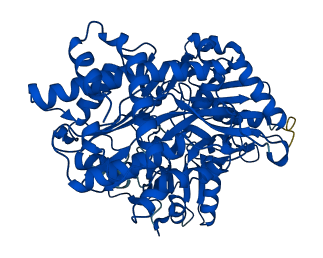
Descriptions
The autoinhibited protein was predicted that may have potential autoinhibitory elements via cis-regPred.
Autoinhibitory domains (AIDs)
Target domain |
|
Relief mechanism |
|
Assay |
cis-regPred |
Accessory elements
No accessory elements
Autoinhibited structure

Activated structure
1 structures for E5ABQ8
| Entry ID | Method | Resolution | Chain | Position | Source |
|---|---|---|---|---|---|
| AF-E5ABQ8-F1 | Predicted | AlphaFoldDB |
No variants for E5ABQ8
| Variant ID(s) | Position | Change | Description | Diseaes Association | Provenance |
|---|---|---|---|---|---|
| No variants for E5ABQ8 | |||||
No associated diseases with E5ABQ8
5 regional properties for E5ABQ8
| Type | Name | Position | InterPro Accession |
|---|---|---|---|
| domain | Creatinase, N-terminal | 9 - 127 | IPR000587 |
| domain | Peptidase M24 | 313 - 532 | IPR000994 |
| conserved_site | Peptidase M24B, X-Pro dipeptidase/aminopeptidase P, conserved site | 472 - 484 | IPR001131 |
| domain | Peptidase M24, C-terminal domain | 543 - 604 | IPR032416 |
| domain | Aminopeptidase P | 314 - 540 | IPR033740 |
Functions
| Description | ||
|---|---|---|
| EC Number | 3.4.11.9 | Aminopeptidases |
| Subcellular Localization |
|
|
| PANTHER Family | ||
| PANTHER Subfamily | ||
| PANTHER Protein Class | ||
| PANTHER Pathway Category | No pathway information available | |
1 GO annotations of cellular component
| Name | Definition |
|---|---|
| cellular anatomical entity | A part of a cellular organism that is either an immaterial entity or a material entity with granularity above the level of a protein complex but below that of an anatomical system. Or, a substance produced by a cellular organism with granularity above the level of a protein complex. |
2 GO annotations of molecular function
| Name | Definition |
|---|---|
| metal ion binding | Binding to a metal ion. |
| metalloaminopeptidase activity | Catalysis of the hydrolysis of a single N-terminal amino acid residue from a polypeptide chain by a mechanism in which water acts as a nucleophile, one or two metal ions hold the water molecule in place, and charged amino acid side chains are ligands for the metal ions. |
1 GO annotations of biological process
| Name | Definition |
|---|---|
| proteolysis | The hydrolysis of proteins into smaller polypeptides and/or amino acids by cleavage of their peptide bonds. |
No homologous proteins in AiPD
| UniProt AC | Gene Name | Protein Name | Species | Evidence Code |
|---|---|---|---|---|
| No homologous proteins | ||||
| 10 | 20 | 30 | 40 | 50 | 60 |
| MAKVDTTERL | AELRKLMKER | NVDIYMVPSE | DSHQSEYIAP | CDARRGSAGY | AVITHDKAAL |
| 70 | 80 | 90 | 100 | 110 | 120 |
| ATDGRYFNQA | EKQLDGNWEL | LKQGIQDVPT | IQDWTADQVE | GGKVVAVDPS | VVTAADARKL |
| 130 | 140 | 150 | 160 | 170 | 180 |
| ADKIKKKGGE | YKAVDDNLVD | KIWSDRPSRP | HEKVIVQPIE | FSGKSFEDKI | EDLRKELEKK |
| 190 | 200 | 210 | 220 | 230 | 240 |
| KSLGFVVSML | DEIAWLFNLR | GSDIPYNPVF | FSYAVVTPTT | VTLYVDDHKL | PEEVKKHLGD |
| 250 | 260 | 270 | 280 | 290 | 300 |
| KVTIRPYNAI | FEELTTLSKE | AFTKDKADAT | SKFLTSSRAS | WALNKALGGE | DRVEETRSPV |
| 310 | 320 | 330 | 340 | 350 | 360 |
| GDAKAVKNEV | ELEGMRQCHL | RDGAALSEYF | AWLEDQLINK | KAELDEVDGA | DKLEAIRKKH |
| 370 | 380 | 390 | 400 | 410 | 420 |
| DKFMGLSFDT | ISSTGANAAV | IHYKPEKGEC | AVIDAKAIYL | CDSGAQYRDG | TTDTTRTVHF |
| 430 | 440 | 450 | 460 | 470 | 480 |
| TEPTEMEKKA | YTLVLKGNMA | LERVKFPKGT | TGFALDSLAR | QFLWAEGLDY | RHGTGHGVGS |
| 490 | 500 | 510 | 520 | 530 | 540 |
| FLNVHEGPIG | IGTRVQYSEV | SLAVGNVVSD | EPGYYEDGKF | GIRIENMIMV | KEVETSHKFG |
| 550 | 560 | 570 | 580 | 590 | 600 |
| DKPYLGFEHV | TMTPHCRNLV | DMSLLGEDEK | QFINDYHKEV | YEKTSGYFED | DALTLKWLKR |
| ETAPY |