E5A7I6
Gene name |
CPYA (Lema_P088200) |
Protein name |
Carboxypeptidase Y homolog A |
Names |
|
Species |
Leptosphaeria maculans (strain JN3 / isolate v23.1.3 / race Av1-4-5-6-7-8) (Blackleg fungus) (Phoma lingam) |
KEGG Pathway |
|
EC number |
3.4.16.5: Serine-type carboxypeptidases |
Protein Class |
|
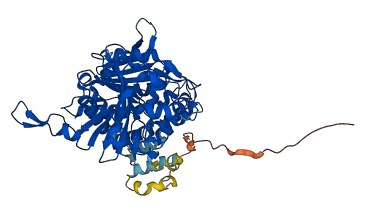
Descriptions
The autoinhibited protein was predicted that may have potential autoinhibitory elements via cis-regPred.
Autoinhibitory domains (AIDs)
Target domain |
|
Relief mechanism |
|
Assay |
cis-regPred |
Accessory elements
No accessory elements
Autoinhibited structure

Activated structure
1 structures for E5A7I6
| Entry ID | Method | Resolution | Chain | Position | Source |
|---|---|---|---|---|---|
| AF-E5A7I6-F1 | Predicted | AlphaFoldDB |
No variants for E5A7I6
| Variant ID(s) | Position | Change | Description | Diseaes Association | Provenance |
|---|---|---|---|---|---|
| No variants for E5A7I6 | |||||
No associated diseases with E5A7I6
No regional properties for E5A7I6
| Type | Name | Position | InterPro Accession |
|---|---|---|---|
| No domain, repeats, and functional sites for E5A7I6 | |||
Functions
| Description | ||
|---|---|---|
| EC Number | 3.4.16.5 | Serine-type carboxypeptidases |
| Subcellular Localization |
|
|
| PANTHER Family | ||
| PANTHER Subfamily | ||
| PANTHER Protein Class | ||
| PANTHER Pathway Category | No pathway information available | |
1 GO annotations of cellular component
| Name | Definition |
|---|---|
| vacuole | A closed structure, found only in eukaryotic cells, that is completely surrounded by unit membrane and contains liquid material. Cells contain one or several vacuoles, that may have different functions from each other. Vacuoles have a diverse array of functions. They can act as a storage organelle for nutrients or waste products, as a degradative compartment, as a cost-effective way of increasing cell size, and as a homeostatic regulator controlling both turgor pressure and pH of the cytosol. |
1 GO annotations of molecular function
| Name | Definition |
|---|---|
| serine-type carboxypeptidase activity | Catalysis of the hydrolysis of a single C-terminal amino acid residue from the C-terminus of a polypeptide chain by a catalytic mechanism that involves a catalytic triad consisting of a serine nucleophile that is activated by a proton relay involving an acidic residue (e.g. aspartate or glutamate) and a basic residue (usually histidine). |
1 GO annotations of biological process
| Name | Definition |
|---|---|
| proteolysis | The hydrolysis of proteins into smaller polypeptides and/or amino acids by cleavage of their peptide bonds. |
No homologous proteins in AiPD
| UniProt AC | Gene Name | Protein Name | Species | Evidence Code |
|---|---|---|---|---|
| No homologous proteins | ||||
| 10 | 20 | 30 | 40 | 50 | 60 |
| MKVATSALLV | GAVSASVGPQ | QQVLKFPDSF | SELKEGAWSK | PLHKLEESLK | TLTGEARAVW |
| 70 | 80 | 90 | 100 | 110 | 120 |
| DEVAMMFPES | FEKAAFFSEP | KPHTRKHDSE | WDHIIKGADI | QNVWVENKNG | DKEREIDGKL |
| 130 | 140 | 150 | 160 | 170 | 180 |
| ENYSMRTKKV | DPSVLGVDKV | KQYSGYLDDE | EEDKHLFYWF | FESRNDPKND | PVVLWLNGGP |
| 190 | 200 | 210 | 220 | 230 | 240 |
| GCSSLTGLFM | ELGPASITKD | GKIKHNPYSW | NSNASVIFLD | QPVNVGYSYS | SGQVSNTVAA |
| 250 | 260 | 270 | 280 | 290 | 300 |
| GKDIYALLTL | FFKQFPEYAE | QSFHISGESY | AGHYIPVFAS | EILSHKKRNI | NLQSVLIGNG |
| 310 | 320 | 330 | 340 | 350 | 360 |
| LTDGLTQYEY | YRPMACGEGG | WPAVLDESQC | KAMDNAYPRC | ASLIENCYNS | ESVWSCVPAS |
| 370 | 380 | 390 | 400 | 410 | 420 |
| IYCNNAMIGP | YQRTGQNVYD | IRKPCGSNSL | CYDELDWIQA | YLNKKEVMKA | VGAEISSYES |
| 430 | 440 | 450 | 460 | 470 | 480 |
| CNFDINRNFL | LQGDWMKPFH | RIVPGLLAEI | PVLIYAGDAD | YICNWLGNKA | WTEALEWPGQ |
| 490 | 500 | 510 | 520 | 530 | 540 |
| KDYNKAEMED | FKIDGKGEAV | GQVKSSGNFT | FLKIHAGGHM | VPYDQPEASL | TMLNRWLAGD |
| FWA |