E4QP00
Gene name |
MPQ_0130 |
Protein name |
5-(hydroxymethyl)furfural oxidase |
Names |
5-hydroxymethylfurfural oxidase, HMFO, Thiol oxidase |
Species |
Methylovorus sp (strain MP688) |
KEGG Pathway |
mep:MPQ_0130 |
EC number |
1.1.3.47: With oxygen as acceptor |
Protein Class |
|
Descriptions
The autoinhibited protein was predicted that may have potential autoinhibitory elements via cis-regPred.
Autoinhibitory domains (AIDs)
Target domain |
|
Relief mechanism |
|
Assay |
cis-regPred |
Accessory elements
No accessory elements
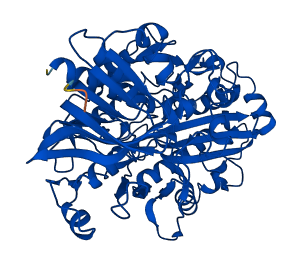
Autoinhibited structure

Activated structure
5 structures for E4QP00
| Entry ID | Method | Resolution | Chain | Position | Source |
|---|---|---|---|---|---|
| 4UDP | X-ray | 190 A | A/B | 1-531 | PDB |
| 4UDQ | X-ray | 160 A | A/B | 1-531 | PDB |
| 4UDR | X-ray | 160 A | A/B | 1-531 | PDB |
| 6F97 | X-ray | 190 A | A/B | 1-531 | PDB |
| AF-E4QP00-F1 | Predicted | AlphaFoldDB |
No variants for E4QP00
| Variant ID(s) | Position | Change | Description | Diseaes Association | Provenance |
|---|---|---|---|---|---|
| No variants for E4QP00 | |||||
No associated diseases with E4QP00
Functions
| Description | ||
|---|---|---|
| EC Number | 1.1.3.47 | With oxygen as acceptor |
| Subcellular Localization |
|
|
| PANTHER Family | ||
| PANTHER Subfamily | ||
| PANTHER Protein Class | ||
| PANTHER Pathway Category | No pathway information available | |
No GO annotations of cellular component
| Name | Definition |
|---|---|
| No GO annotations for cellular component |
3 GO annotations of molecular function
| Name | Definition |
|---|---|
| FAD binding | Binding to the oxidized form, FAD, of flavin-adenine dinucleotide, the coenzyme or the prosthetic group of various flavoprotein oxidoreductase enzymes. |
| oxidoreductase activity, acting on a sulfur group of donors, oxygen as acceptor | Catalysis of an oxidation-reduction (redox) reaction in which a sulfur-containing group acts as a hydrogen or electron donor and reduces oxygen. |
| oxidoreductase activity, acting on the CH-OH group of donors, oxygen as acceptor | Catalysis of an oxidation-reduction (redox) reaction in which a CH-OH group acts as a hydrogen or electron donor and reduces an oxygen molecule. |
No GO annotations of biological process
| Name | Definition |
|---|---|
| No GO annotations for biological process |
No homologous proteins in AiPD
| UniProt AC | Gene Name | Protein Name | Species | Evidence Code |
|---|---|---|---|---|
| No homologous proteins | ||||
| 10 | 20 | 30 | 40 | 50 | 60 |
| MTDTIFDYVI | VGGGTAGSVL | ANRLSARPEN | RVLLIEAGID | TPENNIPPEI | HDGLRPWLPR |
| 70 | 80 | 90 | 100 | 110 | 120 |
| LSGDKFFWPN | LTIHRAAEHP | GITREPQFYE | QGRLLGGGSS | VNMVVSNRGL | PRDYDEWQAL |
| 130 | 140 | 150 | 160 | 170 | 180 |
| GADGWDWQGV | LPYFIKTERD | ADYGDDPLHG | NAGPIPIGRV | DSRHWSDFTV | AATQALEAAG |
| 190 | 200 | 210 | 220 | 230 | 240 |
| LPNIHDQNAR | FDDGYFPPAF | TLKGEERFSA | ARGYLDASVR | VRPNLSLWTE | SRVLKLLTTG |
| 250 | 260 | 270 | 280 | 290 | 300 |
| NAITGVSVLR | GRETLQVQAR | EVILTAGALQ | SPAILLRTGI | GPAADLHALG | IPVLADRPGV |
| 310 | 320 | 330 | 340 | 350 | 360 |
| GRNLWEHSSI | GVVAPLTEQA | RADASTGKAG | SRHQLGIRAS | SGVDPATPSD | LFLHIGADPV |
| 370 | 380 | 390 | 400 | 410 | 420 |
| SGLASAVFWV | NKPSSTGWLK | LKDADPFSYP | DVDFNLLSDP | RDLGRLKAGL | RLITHYFAAP |
| 430 | 440 | 450 | 460 | 470 | 480 |
| SLAKYGLALA | LSRFAAPQPG | GPLLNDLLQD | EAALERYLRT | NVGGVWHASG | TARIGRADDS |
| 490 | 500 | 510 | 520 | 530 | |
| QAVVDKAGRV | YGVTGLRVAD | ASIMPTVPTA | NTNLPTLMLA | EKIADAILTQ | A |