E3VWK2
Gene name |
penF |
Protein name |
1-deoxy-11-beta-hydroxypentalenate dehydrogenase |
Names |
Pentalenolactone biosynthesis protein F |
Species |
Streptomyces exfoliatus (Streptomyces hydrogenans) |
KEGG Pathway |
|
EC number |
1.1.1.340: With NAD(+) or NADP(+) as acceptor |
Protein Class |
|
Descriptions
The autoinhibited protein was predicted that may have potential autoinhibitory elements via cis-regPred.
Autoinhibitory domains (AIDs)
Target domain |
|
Relief mechanism |
|
Assay |
cis-regPred |
Accessory elements
No accessory elements
Autoinhibited structure

Activated structure
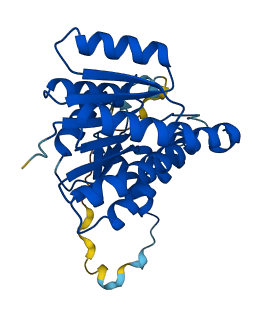
1 structures for E3VWK2
| Entry ID | Method | Resolution | Chain | Position | Source |
|---|---|---|---|---|---|
| AF-E3VWK2-F1 | Predicted | AlphaFoldDB |
No variants for E3VWK2
| Variant ID(s) | Position | Change | Description | Diseaes Association | Provenance |
|---|---|---|---|---|---|
| No variants for E3VWK2 | |||||
No associated diseases with E3VWK2
1 regional properties for E3VWK2
| Type | Name | Position | InterPro Accession |
|---|---|---|---|
| conserved_site | Short-chain dehydrogenase/reductase, conserved site | 144 - 172 | IPR020904 |
Functions
| Description | ||
|---|---|---|
| EC Number | 1.1.1.340 | With NAD(+) or NADP(+) as acceptor |
| Subcellular Localization |
|
|
| PANTHER Family | ||
| PANTHER Subfamily | ||
| PANTHER Protein Class | ||
| PANTHER Pathway Category | No pathway information available | |
No GO annotations of cellular component
| Name | Definition |
|---|---|
| No GO annotations for cellular component |
1 GO annotations of molecular function
| Name | Definition |
|---|---|
| oxidoreductase activity | Catalysis of an oxidation-reduction (redox) reaction, a reversible chemical reaction in which the oxidation state of an atom or atoms within a molecule is altered. One substrate acts as a hydrogen or electron donor and becomes oxidized, while the other acts as hydrogen or electron acceptor and becomes reduced. |
1 GO annotations of biological process
| Name | Definition |
|---|---|
| antibiotic biosynthetic process | The chemical reactions and pathways resulting in the formation of an antibiotic, a substance produced by or derived from certain fungi, bacteria, and other organisms, that can destroy or inhibit the growth of other microorganisms. |
No homologous proteins in AiPD
| UniProt AC | Gene Name | Protein Name | Species | Evidence Code |
|---|---|---|---|---|
| No homologous proteins | ||||
| 10 | 20 | 30 | 40 | 50 | 60 |
| MHLQTRAAVV | TGAASGIGLA | LSARFARAGA | GVVMADVDGD | ALHRRAAELT | ARGAQVTAVT |
| 70 | 80 | 90 | 100 | 110 | 120 |
| ADLTDPEVVE | RLADTAFDQL | GDIDVVCNNA | GVLGPVGQPL | WEVPLERMRQ | VFEVNHWAHV |
| 130 | 140 | 150 | 160 | 170 | 180 |
| LVARAFVPRL | LERGRPAHLI | HTASMSAFVV | GAGSAAYAAS | KHADLAVARS | LRADLRGTGV |
| 190 | 200 | 210 | 220 | 230 | 240 |
| RVSVLCPGRV | DTPMVQGLTA | PRGAGGDTSV | SAEDVAGLVW | EALGSDRFYL | FSNSDARIRL |
| 250 | 260 | 270 | |||
| RDQFDDVWRH | VSLPPPSPEE | ELWPAPKATT | VTMNH |