E2IUK4
Gene name |
HORMAD1 |
Protein name |
HORMA domain-containing protein 1 |
Names |
|
Species |
Sus scrofa (Pig) |
KEGG Pathway |
ssc:100499502 |
EC number |
|
Protein Class |
|
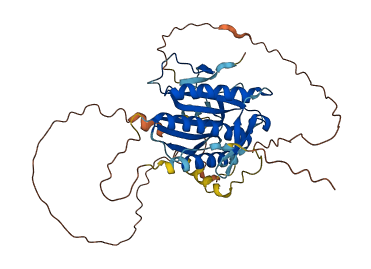
Descriptions
The autoinhibited protein was predicted that may have potential autoinhibitory elements via cis-regPred.
Autoinhibitory domains (AIDs)
Target domain |
|
Relief mechanism |
|
Assay |
cis-regPred |
Accessory elements
No accessory elements
Autoinhibited structure

Activated structure
1 structures for E2IUK4
| Entry ID | Method | Resolution | Chain | Position | Source |
|---|---|---|---|---|---|
| AF-E2IUK4-F1 | Predicted | AlphaFoldDB |
No variants for E2IUK4
| Variant ID(s) | Position | Change | Description | Diseaes Association | Provenance |
|---|---|---|---|---|---|
| No variants for E2IUK4 | |||||
No associated diseases with E2IUK4
1 regional properties for E2IUK4
| Type | Name | Position | InterPro Accession |
|---|---|---|---|
| domain | HORMA domain | 24 - 226 | IPR003511 |
Functions
2 GO annotations of cellular component
| Name | Definition |
|---|---|
| chromosome | A structure composed of a very long molecule of DNA and associated proteins (e.g. histones) that carries hereditary information. |
| nucleus | A membrane-bounded organelle of eukaryotic cells in which chromosomes are housed and replicated. In most cells, the nucleus contains all of the cell's chromosomes except the organellar chromosomes, and is the site of RNA synthesis and processing. In some species, or in specialized cell types, RNA metabolism or DNA replication may be absent. |
No GO annotations of molecular function
| Name | Definition |
|---|---|
| No GO annotations for molecular function |
9 GO annotations of biological process
| Name | Definition |
|---|---|
| blastocyst development | The process whose specific outcome is the progression of the blastocyst over time, from its formation to the mature structure. The mammalian blastocyst is a hollow ball of cells containing two cell types, the inner cell mass and the trophectoderm. |
| meiotic cell cycle | Progression through the phases of the meiotic cell cycle, in which canonically a cell replicates to produce four offspring with half the chromosomal content of the progenitor cell via two nuclear divisions. |
| meiotic DNA double-strand break formation | The cell cycle process in which double-strand breaks are generated at defined hotspots throughout the genome during meiosis I. This results in the initiation of meiotic recombination. |
| meiotic recombination checkpoint signaling | A signaling process that contributes to a meiotic recombination checkpoint, that acts during late prophase I (pachytene) and prevents segregation of homologous chromosomes until recombination is completed, ensuring proper distribution of the genetic material to the gametes. |
| meiotic sister chromatid cohesion | The cell cycle process in which sister chromatids of a replicated chromosome are joined along the entire length of the chromosome during meiosis. |
| oogenesis | The complete process of formation and maturation of an ovum or female gamete from a primordial female germ cell. Examples of this process are found in Mus musculus and Drosophila melanogaster. |
| regulation of homologous chromosome segregation | Any process that modulates the rate, frequency, or extent of homologous chromosome segregation, the cell cycle process in which replicated homologous chromosomes are organized and then physically separated and apportioned to two sets during the first division of the meiotic cell cycle. Each replicated chromosome, composed of two sister chromatids, aligns at the cell equator, paired with its homologous partner; this pairing off, referred to as synapsis, permits genetic recombination. One homolog (both sister chromatids) of each morphologic type goes into each of the resulting chromosome sets. |
| spermatogenesis | The developmental process by which male germ line stem cells self renew or give rise to successive cell types resulting in the development of a spermatozoa. |
| synaptonemal complex assembly | The cell cycle process in which the synaptonemal complex is formed. This is a structure that holds paired chromosomes together during prophase I of meiosis and that promotes genetic recombination. |
No homologous proteins in AiPD
| UniProt AC | Gene Name | Protein Name | Species | Evidence Code |
|---|---|---|---|---|
| No homologous proteins | ||||
| 10 | 20 | 30 | 40 | 50 | 60 |
| MATAQLQRTS | MSALVFPNKI | STEQQSLVLV | KRLLAVSVSC | ITYLRGIFPE | CAYGTRYLDD |
| 70 | 80 | 90 | 100 | 110 | 120 |
| LCVKILREDK | NCPGSTQLVK | WMLGCYDALQ | KKYLRMVVLA | VYTNPEDPQT | ISECYQFKFK |
| 130 | 140 | 150 | 160 | 170 | 180 |
| YTSNGPIMDF | ISKNQSSESS | MSSADTKKAS | ILLIRKIYIL | MQNLGPLPND | VCLTMKLFYY |
| 190 | 200 | 210 | 220 | 230 | 240 |
| DEVTPPDYQP | PGFKDGDCEG | VIFEGEPMYL | NVGEVPTPFH | TFKVKVTTEK | ERMENIYSGI |
| 250 | 260 | 270 | 280 | 290 | 300 |
| LSPKQIKTPL | QKILMDKDDL | EDEQEHYIND | DFDIETKMEE | QKKKLGSSEL | GEPNLVCEED |
| 310 | 320 | 330 | 340 | 350 | 360 |
| EIMRSKESPE | LSISHSQVEQ | LVSKTSELDV | SESKTRSGKI | FQNKMANGNQ | QIKSKESRKR |
| 370 | 380 | 390 | |||
| SQLESGKTVL | HHFDSSSQDS | VPKRRKFSEP | KEHI |