Descriptions
The autoinhibited protein was predicted that may have potential autoinhibitory elements via cis-regPred.
Autoinhibitory domains (AIDs)
Target domain |
|
Relief mechanism |
|
Assay |
cis-regPred |
Accessory elements
No accessory elements
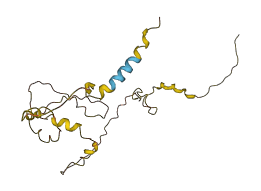
Autoinhibited structure

Activated structure
1 structures for D9IX98
| Entry ID | Method | Resolution | Chain | Position | Source |
|---|---|---|---|---|---|
| AF-D9IX98-F1 | Predicted | AlphaFoldDB |
No variants for D9IX98
| Variant ID(s) | Position | Change | Description | Diseaes Association | Provenance |
|---|---|---|---|---|---|
| No variants for D9IX98 | |||||
No associated diseases with D9IX98
1 regional properties for D9IX98
| Type | Name | Position | InterPro Accession |
|---|---|---|---|
| conserved_site | Natriuretic peptide, conserved site | 83 - 99 | IPR030480 |
1 GO annotations of cellular component
| Name | Definition |
|---|---|
| extracellular region | The space external to the outermost structure of a cell. For cells without external protective or external encapsulating structures this refers to space outside of the plasma membrane. This term covers the host cell environment outside an intracellular parasite. |
2 GO annotations of molecular function
| Name | Definition |
|---|---|
| hormone activity | The action characteristic of a hormone, any substance formed in very small amounts in one specialized organ or group of cells and carried (sometimes in the bloodstream) to another organ or group of cells in the same organism, upon which it has a specific regulatory action. The term was originally applied to agents with a stimulatory physiological action in vertebrate animals (as opposed to a chalone, which has a depressant action). Usage is now extended to regulatory compounds in lower animals and plants, and to synthetic substances having comparable effects; all bind receptors and trigger some biological process. |
| toxin activity | Interacting selectively with one or more biological molecules in another (target) organism, initiating pathogenesis (leading to an abnormal, generally detrimental state) in the target organism. The activity should refer to an evolved function of the active gene product, i.e. one that was selected for. Examples include the activity of botulinum toxin, and snake venom. |
2 GO annotations of biological process
| Name | Definition |
|---|---|
| regulation of blood pressure | Any process that modulates the force with which blood travels through the circulatory system. The process is controlled by a balance of processes that increase pressure and decrease pressure. |
| vasodilation | An increase in the internal diameter of blood vessels, especially arterioles or capillaries, due to relaxation of smooth muscle cells that line the vessels, and usually resulting in a decrease in blood pressure. |
No homologous proteins in AiPD
| UniProt AC | Gene Name | Protein Name | Species | Evidence Code |
|---|---|---|---|---|
| No homologous proteins | ||||
| 10 | 20 | 30 | 40 | 50 | 60 |
| MVGPSRLAGG | GLLLLLLALL | PVALDGKPAP | PSQALHKAPA | GGTKASQIMQ | VLLPESKKSW |
| 70 | 80 | 90 | 100 | 110 | 120 |
| AARDRMVGPY | NPAGGGGGHP | SSCFGHKIDR | ISHSSGMGCG | RRPNAPAGGT | KASQIMQVLL |
| 130 | 140 | 150 | 160 | 170 | 180 |
| PESKKSRAAR | DRMVGPDNRA | GGGGGGGGGD | SSRQQELAKK | DQHNNCFGRR | IDRISHSTDL |
| 190 | 200 | ||||
| GCRRRPNPPP | APTAAPLAVA | QFNSKSSQVA |