D6VTK4
Gene name |
STE2 (YFL026W) |
Protein name |
Pheromone alpha factor receptor |
Names |
|
Species |
Saccharomyces cerevisiae (strain ATCC 204508 / S288c) (Baker's yeast) |
KEGG Pathway |
sce:YFL026W |
EC number |
|
Protein Class |
|
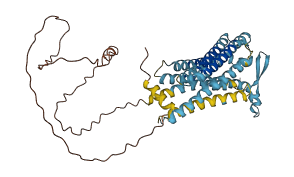
Descriptions
The autoinhibited protein was predicted that may have potential autoinhibitory elements via cis-regPred.
Autoinhibitory domains (AIDs)
Target domain |
|
Relief mechanism |
|
Assay |
cis-regPred |
Accessory elements
No accessory elements
Autoinhibited structure

Activated structure
11 variants for D6VTK4
| Variant ID(s) | Position | Change | Description | Diseaes Association | Provenance |
|---|---|---|---|---|---|
| s06-82673 | 32 | N>K | No | SGRP | |
| s06-82677 | 34 | S>T | No | SGRP | |
| s06-83027 | 150 | I>M | No | SGRP | |
| s06-83103 | 176 | A>T | No | SGRP | |
| s06-83179 | 201 | D>G | No | SGRP | |
| s06-83231 | 218 | M>I | No | SGRP | |
| s06-83637 | 354 | T>A | No | SGRP | |
| s06-83658 | 361 | E>K | No | SGRP | |
| s06-83662 | 362 | R>K | No | SGRP | |
| s06-83685 | 370 | D>N | No | SGRP | |
| s06-83718 | 381 | P>S | No | SGRP |
No associated diseases with D6VTK4
No regional properties for D6VTK4
| Type | Name | Position | InterPro Accession |
|---|---|---|---|
| No domain, repeats, and functional sites for D6VTK4 | |||
Functions
2 GO annotations of cellular component
| Name | Definition |
|---|---|
| G protein-coupled receptor homodimeric complex | A protein complex that contains two G protein-coupled receptors (GPCRs) of the same subtype. Formation of a GPCR homodimer may be important for the transport of newly formed receptors to the cell surface, and the function of the receptor. |
| integral component of plasma membrane | The component of the plasma membrane consisting of the gene products and protein complexes having at least some part of their peptide sequence embedded in the hydrophobic region of the membrane. |
3 GO annotations of molecular function
| Name | Definition |
|---|---|
| mating-type alpha-factor pheromone receptor activity | Combining with the mating-type alpha-factor pheromone to initiate a change in cell activity. |
| mating-type factor pheromone receptor activity | Combining with a mating-type factor pheromone to initiate a change in cell activity. |
| pheromone binding | Binding to a pheromone, a substance, or characteristic mixture of substances, that is secreted and released by an organism and detected by a second organism of the same or a closely related species, in which it causes a specific reaction, such as a definite behavioral reaction or a developmental process. |
3 GO annotations of biological process
| Name | Definition |
|---|---|
| cell projection assembly | Formation of a prolongation or process extending from a cell, e.g. a flagellum or axon. |
| cytogamy | During conjugation with cellular fusion, the process resulting in creating a single cell from complementary mating types. The localized remodeling and dissolution of external protective structures allow the fusion of the plasma membranes and cytoplasmic mixing. An example of this process is found in Saccharomyces cerevisiae. |
| pheromone-dependent signal transduction involved in conjugation with cellular fusion | A signal transduction process resulting in the relay, amplification or dampening of a signal generated in response to pheromone exposure in organisms that undergo conjugation with cellular fusion. An example of this process is found in Saccharomyces cerevisiae. |
No homologous proteins in AiPD
| UniProt AC | Gene Name | Protein Name | Species | Evidence Code |
|---|---|---|---|---|
| No homologous proteins | ||||
| 10 | 20 | 30 | 40 | 50 | 60 |
| MSDAAPSLSN | LFYDPTYNPG | QSTINYTSIY | GNGSTITFDE | LQGLVNSTVT | QAIMFGVRCG |
| 70 | 80 | 90 | 100 | 110 | 120 |
| AAALTLIVMW | MTSRSRKTPI | FIINQVSLFL | IILHSALYFK | YLLSNYSSVT | YALTGFPQFI |
| 130 | 140 | 150 | 160 | 170 | 180 |
| SRGDVHVYGA | TNIIQVLLVA | SIETSLVFQI | KVIFTGDNFK | RIGLMLTSIS | FTLGIATVTM |
| 190 | 200 | 210 | 220 | 230 | 240 |
| YFVSAVKGMI | VTYNDVSATQ | DKYFNASTIL | LASSINFMSF | VLVVKLILAI | RSRRFLGLKQ |
| 250 | 260 | 270 | 280 | 290 | 300 |
| FDSFHILLIM | SCQSLLVPSI | IFILAYSLKP | NQGTDVLTTV | ATLLAVLSLP | LSSMWATAAN |
| 310 | 320 | 330 | 340 | 350 | 360 |
| NASKTNTITS | DFTTSTDRFY | PGTLSSFQTD | SINNDAKSSL | RSRLYDLYPR | RKETTSDKHS |
| 370 | 380 | 390 | 400 | 410 | 420 |
| ERTFVSETAD | DIEKNQFYQL | PTPTSSKNTR | IGPFADASYK | EGEVEPVDMY | TPDTAADEEA |
| 430 | |||||
| RKFWTEDNNN | L |