D4AWC9
Gene name |
LAP2 (ARB_00494) |
Protein name |
Probable leucine aminopeptidase 2 |
Names |
Leucyl aminopeptidase 2, LAP2 |
Species |
Arthroderma benhamiae (strain ATCC MYA-4681 / CBS 112371) (Trichophyton mentagrophytes) |
KEGG Pathway |
abe:ARB_00494 |
EC number |
|
Protein Class |
|
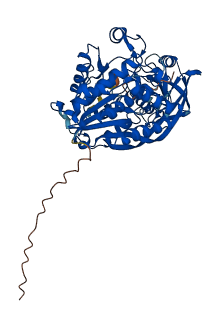
Descriptions
The autoinhibited protein was predicted that may have potential autoinhibitory elements via cis-regPred.
Autoinhibitory domains (AIDs)
Target domain |
|
Relief mechanism |
|
Assay |
cis-regPred |
Accessory elements
No accessory elements
Autoinhibited structure

Activated structure
1 structures for D4AWC9
| Entry ID | Method | Resolution | Chain | Position | Source |
|---|---|---|---|---|---|
| AF-D4AWC9-F1 | Predicted | AlphaFoldDB |
No variants for D4AWC9
| Variant ID(s) | Position | Change | Description | Diseaes Association | Provenance |
|---|---|---|---|---|---|
| No variants for D4AWC9 | |||||
No associated diseases with D4AWC9
3 regional properties for D4AWC9
| Type | Name | Position | InterPro Accession |
|---|---|---|---|
| domain | Helix-hairpin-helix DNA-binding motif, class 1 | 70 - 89 | IPR003583-1 |
| domain | Helix-hairpin-helix DNA-binding motif, class 1 | 104 - 123 | IPR003583-2 |
| domain | DNA helicase, Holliday junction RuvA type, domain I, bacterial | 1 - 59 | IPR013849 |
1 GO annotations of cellular component
| Name | Definition |
|---|---|
| extracellular region | The space external to the outermost structure of a cell. For cells without external protective or external encapsulating structures this refers to space outside of the plasma membrane. This term covers the host cell environment outside an intracellular parasite. |
3 GO annotations of molecular function
| Name | Definition |
|---|---|
| aminopeptidase activity | Catalysis of the hydrolysis of a single N-terminal amino acid residue from a polypeptide chain. |
| metal ion binding | Binding to a metal ion. |
| metalloexopeptidase activity | Catalysis of the hydrolysis of a peptide bond not more than three residues from the N- or C-terminus of a polypeptide chain by a mechanism in which water acts as a nucleophile, one or two metal ions hold the water molecule in place, and charged amino acid side chains are ligands for the metal ions. |
1 GO annotations of biological process
| Name | Definition |
|---|---|
| proteolysis | The hydrolysis of proteins into smaller polypeptides and/or amino acids by cleavage of their peptide bonds. |
No homologous proteins in AiPD
| UniProt AC | Gene Name | Protein Name | Species | Evidence Code |
|---|---|---|---|---|
| No homologous proteins | ||||
| 10 | 20 | 30 | 40 | 50 | 60 |
| MKSQLLSLAV | AVTTISQGVV | GQEPFGWPFK | PMVTQDDLQN | KIKLKDIMAG | VEKLQSFSDA |
| 70 | 80 | 90 | 100 | 110 | 120 |
| HPEKNRVFGG | NGHKDTVEWI | YNEIKATGYY | DVKKQEQVHL | WSHAEAAVSA | NGKELKASAM |
| 130 | 140 | 150 | 160 | 170 | 180 |
| SYSPPASKIM | AELVVAKNNG | CNATDYPENT | QGKIVLVERG | VCSFGEKSSQ | AGDAKAAGAI |
| 190 | 200 | 210 | 220 | 230 | 240 |
| VYNNVPGSLA | GTLGGLDKRH | VPTAGLSQED | GKNLATLIAS | GKVDVTMNVI | SLFENRTTWN |
| 250 | 260 | 270 | 280 | 290 | 300 |
| VIAETKGGDH | NNVVMLGAHS | DSVDAGPGIN | DNGSGSIGIM | TVAKALTNFK | LNNAVRFAWW |
| 310 | 320 | 330 | 340 | 350 | 360 |
| TAEEFGLLGS | TFYVNSLDDR | ELHKVKLYLN | FDMIGSPNFA | NQIYDGDGSA | YNMTGPAGSA |
| 370 | 380 | 390 | 400 | 410 | 420 |
| EIEYLFEKFF | DDQGIPHQPT | AFTGRSDYSA | FIKRNVPAGG | LFTGAEVVKT | PEQVKLFGGE |
| 430 | 440 | 450 | 460 | 470 | 480 |
| AGVAYDKNYH | GKGDTVANIN | KGAIFLNTRA | IAYAIAEYAR | SLKGFPTRPK | TGKRDVNPQY |
| 490 | |||||
| SKMPGGGCGH | HTVFM |