D3ZDI6
Gene name |
Mylip |
Protein name |
E3 ubiquitin-protein ligase MYLIP |
Names |
Inducible degrader of the LDL-receptor, Idol, Myosin regulatory light chain interacting protein, MIR, RING-type E3 ubiquitin transferase MYLIP |
Species |
Rattus norvegicus (Rat) |
KEGG Pathway |
rno:306825 |
EC number |
2.3.2.27: Aminoacyltransferases |
Protein Class |
|
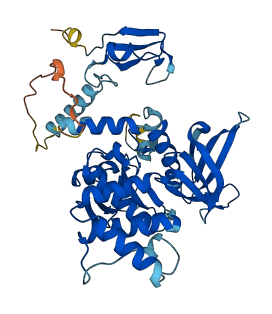
Descriptions
The autoinhibited protein was predicted that may have potential autoinhibitory elements via cis-regPred.
Autoinhibitory domains (AIDs)
Target domain |
|
Relief mechanism |
|
Assay |
cis-regPred |
Accessory elements
No accessory elements
Autoinhibited structure

Activated structure
1 structures for D3ZDI6
| Entry ID | Method | Resolution | Chain | Position | Source |
|---|---|---|---|---|---|
| AF-D3ZDI6-F1 | Predicted | AlphaFoldDB |
2 variants for D3ZDI6
| Variant ID(s) | Position | Change | Description | Diseaes Association | Provenance |
|---|---|---|---|---|---|
| rs199400766 | 202 | I>L | No | EVA | |
| rs198108214 | 354 | S>F | No | EVA |
No associated diseases with D3ZDI6
7 regional properties for D3ZDI6
| Type | Name | Position | InterPro Accession |
|---|---|---|---|
| domain | FERM domain | 1 - 279 | IPR000299 |
| domain | Zinc finger, RING-type | 387 - 422 | IPR001841 |
| domain | FERM, N-terminal | 5 - 67 | IPR018979 |
| domain | FERM, C-terminal PH-like domain | 194 - 283 | IPR018980 |
| domain | FERM central domain | 84 - 190 | IPR019748 |
| domain | Band 4.1 domain | 1 - 190 | IPR019749 |
| domain | MYLIP, FERM domain C-lobe | 185 - 295 | IPR041790 |
Functions
| Description | ||
|---|---|---|
| EC Number | 2.3.2.27 | Aminoacyltransferases |
| Subcellular Localization |
|
|
| PANTHER Family | ||
| PANTHER Subfamily | ||
| PANTHER Protein Class | ||
| PANTHER Pathway Category | No pathway information available | |
3 GO annotations of cellular component
| Name | Definition |
|---|---|
| cytoplasm | The contents of a cell excluding the plasma membrane and nucleus, but including other subcellular structures. |
| cytoskeleton | A cellular structure that forms the internal framework of eukaryotic and prokaryotic cells. The cytoskeleton includes intermediate filaments, microfilaments, microtubules, the microtrabecular lattice, and other structures characterized by a polymeric filamentous nature and long-range order within the cell. The various elements of the cytoskeleton not only serve in the maintenance of cellular shape but also have roles in other cellular functions, including cellular movement, cell division, endocytosis, and movement of organelles. |
| plasma membrane | The membrane surrounding a cell that separates the cell from its external environment. It consists of a phospholipid bilayer and associated proteins. |
4 GO annotations of molecular function
| Name | Definition |
|---|---|
| cytoskeletal protein binding | Binding to a protein component of a cytoskeleton (actin, microtubule, or intermediate filament cytoskeleton). |
| metal ion binding | Binding to a metal ion. |
| ubiquitin protein ligase activity | Catalysis of the transfer of ubiquitin to a substrate protein via the reaction X-ubiquitin + S -> X + S-ubiquitin, where X is either an E2 or E3 enzyme, the X-ubiquitin linkage is a thioester bond, and the S-ubiquitin linkage is an amide bond: an isopeptide bond between the C-terminal glycine of ubiquitin and the epsilon-amino group of lysine residues in the substrate or, in the linear extension of ubiquitin chains, a peptide bond the between the C-terminal glycine and N-terminal methionine of ubiquitin residues. |
| ubiquitin-protein transferase activity | Catalysis of the transfer of ubiquitin from one protein to another via the reaction X-Ub + Y --> Y-Ub + X, where both X-Ub and Y-Ub are covalent linkages. |
9 GO annotations of biological process
| Name | Definition |
|---|---|
| cholesterol homeostasis | Any process involved in the maintenance of an internal steady state of cholesterol within an organism or cell. |
| negative regulation of low-density lipoprotein particle clearance | Any process that decreases the rate, frequency or extent of low-density lipoprotein particle clearance. Low-density lipoprotein particle clearance is the process in which a low-density lipoprotein particle is removed from the blood via receptor-mediated endocytosis and its constituent parts degraded. |
| negative regulation of neuron projection development | Any process that decreases the rate, frequency or extent of neuron projection development. Neuron projection development is the process whose specific outcome is the progression of a neuron projection over time, from its formation to the mature structure. A neuron projection is any process extending from a neural cell, such as axons or dendrites (collectively called neurites). |
| nervous system development | The process whose specific outcome is the progression of nervous tissue over time, from its formation to its mature state. |
| positive regulation of protein catabolic process | Any process that activates or increases the frequency, rate or extent of the chemical reactions and pathways resulting in the breakdown of a protein by the destruction of the native, active configuration, with or without the hydrolysis of peptide bonds. |
| protein destabilization | Any process that decreases the stability of a protein, making it more vulnerable to degradative processes or aggregation. |
| protein ubiquitination | The process in which one or more ubiquitin groups are added to a protein. |
| regulation of low-density lipoprotein particle receptor catabolic process | Any process that modulates the frequency, rate or extent of the chemical reactions and pathways resulting in the breakdown of low-density lipoprotein particle receptors. |
| ubiquitin-dependent protein catabolic process | The chemical reactions and pathways resulting in the breakdown of a protein or peptide by hydrolysis of its peptide bonds, initiated by the covalent attachment of a ubiquitin group, or multiple ubiquitin groups, to the protein. |
1 homologous proteins in AiPD
| UniProt AC | Gene Name | Protein Name | Species | Evidence Code |
|---|---|---|---|---|
| Q9WTP0 | Epb41l1 | Band 4.1-like protein 1 | Rattus norvegicus (Rat) | PR |
| 10 | 20 | 30 | 40 | 50 | 60 |
| MLCYVTRPDA | VLMEVEVEAK | ANGEDCLNQV | CRRLGIIEVD | YFGLQFTGSK | GESLWLNLRN |
| 70 | 80 | 90 | 100 | 110 | 120 |
| RISQQMDGLA | PYRLKLRVKF | FVEPHLILQE | QTRHIFFLHI | KESLLAGHLQ | CSPEQAVELS |
| 130 | 140 | 150 | 160 | 170 | 180 |
| ALLAQTKFGD | YNQNTAQYSY | EDLCEKELSS | STLNSIVGKH | KELEGISQAS | AEYQVLQIVS |
| 190 | 200 | 210 | 220 | 230 | 240 |
| AMENYGIEWH | AVRDSEGQKL | LIGVGPEGIS | ICKEDFSPIN | RIAYPVVQMA | TQSGKNVYLT |
| 250 | 260 | 270 | 280 | 290 | 300 |
| VTKESGNSIV | LLFKMISTRA | ASGLYRAITE | THAFYRCDTV | TSAVMMQYSR | DLKGHLASLF |
| 310 | 320 | 330 | 340 | 350 | 360 |
| LNENINLGKK | YVFDIKRTSK | EVYDHARRAL | YNAGVVDLVS | RNDQSPPSSP | LKSSDSSMSC |
| 370 | 380 | 390 | 400 | 410 | 420 |
| SSCEGLSCQQ | TRVLQEKLRK | LKEAMLCMVC | CEEEINSTFC | PCGHTVCCES | CAAQLQSCPV |
| 430 | 440 | ||||
| CRSRVEHVQH | VYLPTHTSLL | NLTVI |