D0VMR8
Gene name |
C4 |
Protein name |
Delta-guaiene synthase 3 |
Names |
|
Species |
Aquilaria crassna (Eagle wood) |
KEGG Pathway |
ag:ACY38197 |
EC number |
4.2.3.87: Acting on phosphates |
Protein Class |
|
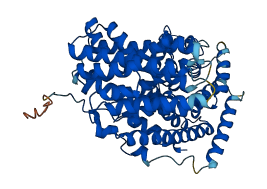
Descriptions
The autoinhibited protein was predicted that may have potential autoinhibitory elements via cis-regPred.
Autoinhibitory domains (AIDs)
Target domain |
|
Relief mechanism |
|
Assay |
cis-regPred |
Accessory elements
No accessory elements
Autoinhibited structure

Activated structure
1 structures for D0VMR8
| Entry ID | Method | Resolution | Chain | Position | Source |
|---|---|---|---|---|---|
| AF-D0VMR8-F1 | Predicted | AlphaFoldDB |
No variants for D0VMR8
| Variant ID(s) | Position | Change | Description | Diseaes Association | Provenance |
|---|---|---|---|---|---|
| No variants for D0VMR8 | |||||
No associated diseases with D0VMR8
Functions
| Description | ||
|---|---|---|
| EC Number | 4.2.3.87 | Acting on phosphates |
| Subcellular Localization |
|
|
| PANTHER Family | ||
| PANTHER Subfamily | ||
| PANTHER Protein Class | ||
| PANTHER Pathway Category | No pathway information available | |
No GO annotations of cellular component
| Name | Definition |
|---|---|
| No GO annotations for cellular component |
2 GO annotations of molecular function
| Name | Definition |
|---|---|
| magnesium ion binding | Binding to a magnesium (Mg) ion. |
| sesquiterpene synthase activity | Catalysis of the reaction: trans,trans-farnesyl diphosphate = a sesquiterpene + diphosphate. Sesquiterpenes are terpenes containing three isoprene units, i.e. 15 carbons. |
4 GO annotations of biological process
| Name | Definition |
|---|---|
| diterpenoid biosynthetic process | The chemical reactions and pathways resulting in the formation of diterpenoid compounds, terpenoids with four isoprene units. |
| farnesyl diphosphate metabolic process | The chemical reactions and pathways involving farnesyl diphosphate, an intermediate in carotenoid, sesquiterpene, squalene and sterol biosynthesis, as well as a substrate in protein farnesylation. |
| response to jasmonic acid | Any process that results in a change in state or activity of a cell or an organism (in terms of movement, secretion, enzyme production, gene expression, etc.) as a result of a jasmonic acid stimulus. |
| sesquiterpene biosynthetic process | The chemical reactions and pathways resulting in the formation of sesquiterpenes, any of a class of terpenes of the formula C15H24 or a derivative of such a terpene. |
No homologous proteins in AiPD
| UniProt AC | Gene Name | Protein Name | Species | Evidence Code |
|---|---|---|---|---|
| No homologous proteins | ||||
| 10 | 20 | 30 | 40 | 50 | 60 |
| MSSAKLGSAS | EDVSRRDANY | HPTVWGDFFL | THSSDFLENN | DSILEKHEEL | KQEVRNLLVV |
| 70 | 80 | 90 | 100 | 110 | 120 |
| ETSDLPSKIQ | LTDDIIRLGV | GYHFETEIKA | QLEKLHDHQL | HLNFDLLTTS | VWFRLLRGHG |
| 130 | 140 | 150 | 160 | 170 | 180 |
| FSISSDVFKR | FKNTKGEFET | EDARTLWCLY | EATHLRVDGE | DILEEAIQFS | RKKLEALLPE |
| 190 | 200 | 210 | 220 | 230 | 240 |
| LSFPLNECVR | DALHIPYHRN | VQRLAARQYI | PQYDAEPTKI | ESLSLFAKID | FNMLQALHQR |
| 250 | 260 | 270 | 280 | 290 | 300 |
| ELREASRWWK | EFDFPSKLPY | ARDRIAEGYY | WMMGAHFEPK | FSLSRKFLNR | IIGITSLIDD |
| 310 | 320 | 330 | 340 | 350 | 360 |
| TYDVYGTLEE | VTLFTEAVER | WDIEAVKDIP | KYMQVIYIGM | LGIFEDFKDN | LINARGKDYC |
| 370 | 380 | 390 | 400 | 410 | 420 |
| IDYAIEVFKE | IVRSYQREAE | YFHTGYVPSY | DEYMENSIIS | GGYKMFIILM | LIGRGEFELK |
| 430 | 440 | 450 | 460 | 470 | 480 |
| ETLDWASTIP | EMVKASSLIA | RYIDDLQTYK | AEEERGETVS | AVRCYMREYD | VSEEEACKKM |
| 490 | 500 | 510 | 520 | 530 | 540 |
| REMIEIEWKR | LNKTTLEADE | VSSSVVIPSL | NFTRVLEVMY | DKGDGYSDSQ | GVTKDRIAAL |
| LRHAIEI |