C7ZA26
Gene name |
GUF1 |
Protein name |
Translation factor GUF1, mitochondrial |
Names |
Elongation factor 4 homolog, EF-4, GTPase GUF1, Ribosomal back-translocase |
Species |
Fusarium vanettenii (strain ATCC MYA-4622 / CBS 123669 / FGSC 9596 / NRRL 45880 / 77-13-4) (Fusarium solani subsp. pisi) |
KEGG Pathway |
nhe:NECHADRAFT_94619 |
EC number |
|
Protein Class |
|
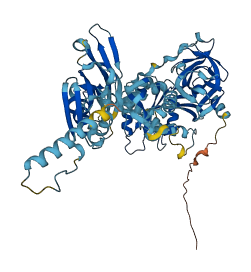
Descriptions
The autoinhibited protein was predicted that may have potential autoinhibitory elements via cis-regPred.
Autoinhibitory domains (AIDs)
Target domain |
|
Relief mechanism |
|
Assay |
cis-regPred |
Accessory elements
No accessory elements
Autoinhibited structure

Activated structure
1 structures for C7ZA26
| Entry ID | Method | Resolution | Chain | Position | Source |
|---|---|---|---|---|---|
| AF-C7ZA26-F1 | Predicted | AlphaFoldDB |
No variants for C7ZA26
| Variant ID(s) | Position | Change | Description | Diseaes Association | Provenance |
|---|---|---|---|---|---|
| No variants for C7ZA26 | |||||
No associated diseases with C7ZA26
6 regional properties for C7ZA26
| Type | Name | Position | InterPro Accession |
|---|---|---|---|
| domain | Elongation factor EFG, domain V-like | 443 - 529 | IPR000640 |
| domain | Translational (tr)-type GTP-binding domain | 40 - 221 | IPR000795 |
| domain | Small GTP-binding protein domain | 42 - 207 | IPR005225 |
| domain | GTP-binding protein LepA, C-terminal | 532 - 622 | IPR013842 |
| conserved_site | Tr-type G domain, conserved site | 80 - 95 | IPR031157 |
| domain | Elongation factor 4, domain IV | 445 - 524 | IPR035654 |
2 GO annotations of cellular component
| Name | Definition |
|---|---|
| mitochondrial inner membrane | The inner, i.e. lumen-facing, lipid bilayer of the mitochondrial envelope. It is highly folded to form cristae. |
| mitochondrial matrix | The gel-like material, with considerable fine structure, that lies in the matrix space, or lumen, of a mitochondrion. It contains the enzymes of the tricarboxylic acid cycle and, in some organisms, the enzymes concerned with fatty acid oxidation. |
3 GO annotations of molecular function
| Name | Definition |
|---|---|
| GTP binding | Binding to GTP, guanosine triphosphate. |
| GTPase activity | Catalysis of the reaction: GTP + H2O = GDP + H+ + phosphate. |
| mitochondrial ribosome binding | Binding to a mitochondrial ribosome. |
2 GO annotations of biological process
| Name | Definition |
|---|---|
| positive regulation of translation | Any process that activates or increases the frequency, rate or extent of the chemical reactions and pathways resulting in the formation of proteins by the translation of mRNA or circRNA. |
| translation | The cellular metabolic process in which a protein is formed, using the sequence of a mature mRNA or circRNA molecule to specify the sequence of amino acids in a polypeptide chain. Translation is mediated by the ribosome, and begins with the formation of a ternary complex between aminoacylated initiator methionine tRNA, GTP, and initiation factor 2, which subsequently associates with the small subunit of the ribosome and an mRNA or circRNA. Translation ends with the release of a polypeptide chain from the ribosome. |
No homologous proteins in AiPD
| UniProt AC | Gene Name | Protein Name | Species | Evidence Code |
|---|---|---|---|---|
| No homologous proteins | ||||
| 10 | 20 | 30 | 40 | 50 | 60 |
| MSLAWSAGRA | WSRQSYAAPP | AAAKTPPSEL | EARIAAIPIE | RYRNFCIVAH | IDHGKSTLSD |
| 70 | 80 | 90 | 100 | 110 | 120 |
| RLLEYTGTIS | ASDANKQILD | KLDVERERGI | TVKAQTCTMI | HNHEGEDYLL | HLVDTPGHVD |
| 130 | 140 | 150 | 160 | 170 | 180 |
| FRAEVTRSYA | SCGGALLLVD | ATQGIQAQTV | SNFHLAFAQD | LALVPVVNKI | DMPAADIPRV |
| 190 | 200 | 210 | 220 | 230 | 240 |
| LEQMQNSFEL | DPKDAIMLSA | KTGKGVPNVL | PAVIERIPHP | VGDEKKPLKM | LLVDSWYDNF |
| 250 | 260 | 270 | 280 | 290 | 300 |
| RGVVLLVRLF | DGTIKTGDNV | ISLGTGMKYT | VGQVGIQYPH | ATPTKVLRAG | QVGYVYFNPG |
| 310 | 320 | 330 | 340 | 350 | 360 |
| MKKIQDAKLG | DTFTFVGAED | NVEPCPGFEE | PKPMVFVAAF | PTDQSDYSRL | ADSINQLVLN |
| 370 | 380 | 390 | 400 | 410 | 420 |
| DRSVTLQKDF | SEALGSGWRL | GFLGSLHCSV | FQDRLRQEHG | KSVILTEPTV | PSKIIWPDGS |
| 430 | 440 | 450 | 460 | 470 | 480 |
| EEVVQNPALF | PDVSHPRIRG | AQLFEPFVTA | TITMPEEYLG | RVIELCEANR | GEQKSLEFFH |
| 490 | 500 | 510 | 520 | 530 | 540 |
| TTQVILQYEI | PAAQLVDDLF | GKLKSATKGY | ATLDYEDSGW | RQSHLVKLQL | LVNRQPVDAI |
| 550 | 560 | 570 | 580 | 590 | 600 |
| CRVVHSSQVD | RLGRQWVTKF | KEHVDRQHFE | VVIQATAGNR | IVARETIKPF | RKDVLAKLHA |
| 610 | 620 | ||||
| ADVSRRRKLL | EKQKEGRKRL | RASFMSR |