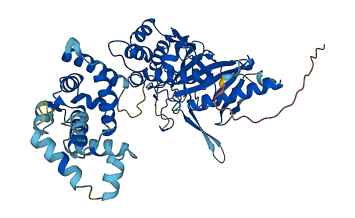
Descriptions
The autoinhibited protein was predicted that may have potential autoinhibitory elements via cis-regPred.
Autoinhibitory domains (AIDs)
Target domain |
|
Relief mechanism |
|
Assay |
cis-regPred |
Accessory elements
No accessory elements
Autoinhibited structure

Activated structure
1 structures for C7GK54
| Entry ID | Method | Resolution | Chain | Position | Source |
|---|---|---|---|---|---|
| AF-C7GK54-F1 | Predicted | AlphaFoldDB |
No variants for C7GK54
| Variant ID(s) | Position | Change | Description | Diseaes Association | Provenance |
|---|---|---|---|---|---|
| No variants for C7GK54 | |||||
No associated diseases with C7GK54
3 regional properties for C7GK54
2 GO annotations of cellular component
| Name | Definition |
|---|---|
| glutamyl-tRNA(Gln) amidotransferase complex | A protein complex that possesses glutamyl-tRNA(Gln) amidotransferase activity, and therefore creates Gln-tRNA by amidating Glu-tRNA; usually composed of 3 subunits: A, B, and C. Note that the C subunit may not be required in all organisms. |
| mitochondrion | A semiautonomous, self replicating organelle that occurs in varying numbers, shapes, and sizes in the cytoplasm of virtually all eukaryotic cells. It is notably the site of tissue respiration. |
2 GO annotations of molecular function
| Name | Definition |
|---|---|
| ATP binding | Binding to ATP, adenosine 5'-triphosphate, a universally important coenzyme and enzyme regulator. |
| glutaminyl-tRNA synthase (glutamine-hydrolyzing) activity | Catalysis of the reaction: L-glutamine + glutamyl-tRNA(Gln) + ATP = L-glutamate + glutaminyl-tRNA(Gln) + phosphate + ADP. |
2 GO annotations of biological process
| Name | Definition |
|---|---|
| glutaminyl-tRNAGln biosynthesis via transamidation | A tRNA aminoacylation process in which glutaminyl-tRNAGln is formed by a tRNA-dependent two-step pathway. In the first step a non-discriminating glutamyl-tRNAGlx synthetase generates the misacylated L-glutamyl-tRNAGln species, and in the second step it is amidated to the correctly charged L-glutaminyl-tRNAGln by a glutamyl-tRNAGln amidotransferase. |
| mitochondrial translation | The chemical reactions and pathways resulting in the formation of a protein in a mitochondrion. This is a ribosome-mediated process in which the information in messenger RNA (mRNA) is used to specify the sequence of amino acids in the protein; the mitochondrion has its own ribosomes and transfer RNAs, and uses a genetic code that differs from the nuclear code. |
No homologous proteins in AiPD
| UniProt AC | Gene Name | Protein Name | Species | Evidence Code |
|---|---|---|---|---|
| No homologous proteins | ||||
| 10 | 20 | 30 | 40 | 50 | 60 |
| MLQLARFYSL | ARTKAIHSHG | APFRPEYALK | CGLEIHTQLN | TKNKLFSQST | NSATSLVDAP |
| 70 | 80 | 90 | 100 | 110 | 120 |
| NHHTSYYDIA | LPGTQPVLNL | EAILFAMKLS | LALGSQVNSI | SQFDRKHYFY | GDQPQGYQLT |
| 130 | 140 | 150 | 160 | 170 | 180 |
| QHYRPFARGG | KINLSKELDD | IDESAKEIGI | LQLQIEQDTG | KSHYTETDKD | VITLVDLNRS |
| 190 | 200 | 210 | 220 | 230 | 240 |
| NVPLIELVTK | PDFSDIKQVR | AFIKKYQNLV | RHLHISSGDL | ETGAMRVDVN | LSINEYARVE |
| 250 | 260 | 270 | 280 | 290 | 300 |
| LKNLPNTSSI | INAIKYEYQR | QVELISVGDT | SSLMEPETRG | WTGSSTVKLR | SKETTIDYRY |
| 310 | 320 | 330 | 340 | 350 | 360 |
| MPDPELPYIN | LAQDVISGVR | GLMPQLPDDI | MRMLMKKPYQ | LSLKDAKILT | YNSNQNDMYN |
| 370 | 380 | 390 | 400 | 410 | 420 |
| HEALRSYYLD | TFREFSKLAG | ERSNAKLPTN | WIIHEFLGDL | NKLQIPLARA | KEILPPPVFA |
| 430 | 440 | 450 | 460 | 470 | 480 |
| QFLKLLHEEV | ISATSGKMLL | FHILENFKQS | NCQDLSIPDF | SKLIEKFELH | AINQVDPQEL |
| 490 | 500 | 510 | 520 | 530 | 540 |
| MDLCNDVIAQ | HTDDTFIRNL | VTGKKKSSLK | FLIGQGMRRS | QGRIKANEFE | KKFKEILNIQ |
| W |