C6HRP6
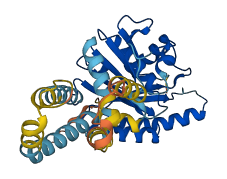
Descriptions
The autoinhibited protein was predicted that may have potential autoinhibitory elements via cis-regPred.
Autoinhibitory domains (AIDs)
Target domain |
|
Relief mechanism |
|
Assay |
cis-regPred |
Accessory elements
No accessory elements
Autoinhibited structure

Activated structure
1 structures for C6HRP6
| Entry ID | Method | Resolution | Chain | Position | Source |
|---|---|---|---|---|---|
| AF-C6HRP6-F1 | Predicted | AlphaFoldDB |
No variants for C6HRP6
| Variant ID(s) | Position | Change | Description | Diseaes Association | Provenance |
|---|---|---|---|---|---|
| No variants for C6HRP6 | |||||
No associated diseases with C6HRP6
1 regional properties for C6HRP6
| Type | Name | Position | InterPro Accession |
|---|---|---|---|
| domain | Anion-transporting ATPase-like domain | 27 - 333 | IPR025723 |
1 GO annotations of cellular component
| Name | Definition |
|---|---|
| endoplasmic reticulum | The irregular network of unit membranes, visible only by electron microscopy, that occurs in the cytoplasm of many eukaryotic cells. The membranes form a complex meshwork of tubular channels, which are often expanded into slitlike cavities called cisternae. The ER takes two forms, rough (or granular), with ribosomes adhering to the outer surface, and smooth (with no ribosomes attached). |
3 GO annotations of molecular function
| Name | Definition |
|---|---|
| ATP binding | Binding to ATP, adenosine 5'-triphosphate, a universally important coenzyme and enzyme regulator. |
| ATP hydrolysis activity | Catalysis of the reaction: ATP + H2O = ADP + H+ phosphate. ATP hydrolysis is used in some reactions as an energy source, for example to catalyze a reaction or drive transport against a concentration gradient. |
| metal ion binding | Binding to a metal ion. |
1 GO annotations of biological process
| Name | Definition |
|---|---|
| protein insertion into ER membrane | The process that results in incorporation of a protein into an endoplasmic reticulum (ER) membrane. It depends on specific topogenic sequences of amino acids that ensure that a protein acquires the proper orientation during its insertion into the ER membrane. |
No homologous proteins in AiPD
| UniProt AC | Gene Name | Protein Name | Species | Evidence Code |
|---|---|---|---|---|
| No homologous proteins | ||||
| 10 | 20 | 30 | 40 | 50 | 60 |
| MSSTAMVSGD | DSLEPTLQSL | LDQKTLRWVF | VGGKGGVGKT | TTSCSLAIQL | AKVRKSVLLI |
| 70 | 80 | 90 | 100 | 110 | 120 |
| STDPAHNLSD | AFGQKFGKEA | RLVDGFDNLS | AMEIDPNGSI | QDLLATGGDQ | ADDPMAGLGL |
| 130 | 140 | 150 | 160 | 170 | 180 |
| GGMMQDLAFS | IPGVDEAMSF | AEVLKQVKSL | SYEVIVFDTA | PTGHTLRFLQ | FPTVLEKALA |
| 190 | 200 | 210 | 220 | 230 | 240 |
| KLSQLSSQFG | PMLNSILGAR | GGLPGGQNLD | EILSKMESLR | ETIGEVNAQF | KDADLTTFVC |
| 250 | 260 | 270 | 280 | 290 | 300 |
| VCIAEFLSLY | ETERMIQELT | SYQIDTHCIV | VNQLLFPGKD | SSCEQCKARR | KMQKKYLNEI |
| 310 | 320 | 330 | 340 | ||
| EDLYEDFNVV | RMPMLVEEVR | GKEKLEKFSN | MLVNPYVPPE | E |