C1CXU5
Gene name |
atpD |
Protein name |
V-type ATP synthase subunit D |
Names |
V-ATPase subunit D |
Species |
Deinococcus deserti (strain DSM 17065 / CIP 109153 / LMG 22923 / VCD115) |
KEGG Pathway |
ddr:Deide_01010 |
EC number |
|
Protein Class |
|
Descriptions
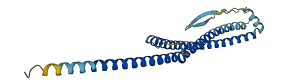
The autoinhibited protein was predicted that may have potential autoinhibitory elements via cis-regPred.
Autoinhibitory domains (AIDs)
Target domain |
|
Relief mechanism |
|
Assay |
cis-regPred |
Accessory elements
No accessory elements
Autoinhibited structure

Activated structure
1 structures for C1CXU5
| Entry ID | Method | Resolution | Chain | Position | Source |
|---|---|---|---|---|---|
| AF-C1CXU5-F1 | Predicted | AlphaFoldDB |
No variants for C1CXU5
| Variant ID(s) | Position | Change | Description | Diseaes Association | Provenance |
|---|---|---|---|---|---|
| No variants for C1CXU5 | |||||
No associated diseases with C1CXU5
4 regional properties for C1CXU5
| Type | Name | Position | InterPro Accession |
|---|---|---|---|
| domain | ATPase, F1/V1/A1 complex, alpha/beta subunit, nucleotide-binding domain | 179 - 398 | IPR000194 |
| domain | AAA+ ATPase domain | 191 - 375 | IPR003593 |
| domain | ATPase, F1/V1/A1 complex, alpha/beta subunit, N-terminal domain | 55 - 122 | IPR004100 |
| active_site | ATPase, alpha/beta subunit, nucleotide-binding domain, active site | 389 - 398 | IPR020003 |
No GO annotations of cellular component
| Name | Definition |
|---|---|
| No GO annotations for cellular component |
3 GO annotations of molecular function
| Name | Definition |
|---|---|
| ATP binding | Binding to ATP, adenosine 5'-triphosphate, a universally important coenzyme and enzyme regulator. |
| proton-transporting ATP synthase activity, rotational mechanism | Enables the synthesis of ATP from ADP and phosphate by the transfer of protons from one side of a membrane to the other by a rotational mechanism driven by a gradient according to the reaction: ADP + H2O + phosphate + H+(in) -> ATP + H+(out). |
| proton-transporting ATPase activity, rotational mechanism | Enables the transfer of protons from one side of a membrane to the other according to the reaction: ATP + H2O + H+(in) = ADP + phosphate + H+(out), by a rotational mechanism. |
1 GO annotations of biological process
| Name | Definition |
|---|---|
| proton motive force-driven plasma membrane ATP synthesis | The transport of protons across the plasma membrane to generate an electrochemical gradient (proton-motive force) that powers ATP synthesis. |
No homologous proteins in AiPD
| UniProt AC | Gene Name | Protein Name | Species | Evidence Code |
|---|---|---|---|---|
| No homologous proteins | ||||
| 10 | 20 | 30 | 40 | 50 | 60 |
| MAGQISPTRS | ALLASKASLK | TASGGADLLK | RKRDALIGEF | FALVKDALAA | REQLGGVSKG |
| 70 | 80 | 90 | 100 | 110 | 120 |
| AYTSLFGAKA | WDSPEAVESL | SLAGSGDYAV | NMQIESIYGV | KVPRINIPER | TQTTNFSPIN |
| 130 | 140 | 150 | 160 | 170 | 180 |
| VGARTIQAAT | DFGGVMEAIV | KVAATETKLR | RIGEEIKKTS | RRVNALEQVV | IPGIEDDIRF |
| 190 | 200 | 210 | 220 | ||
| IRSVLDQRER | EASYTQKKIK | AKIEAKAKQQ | RKDIQSGNHG | SAAD |