C1CAS7
Gene name |
tyrS |
Protein name |
Tyrosine--tRNA ligase |
Names |
Tyrosyl-tRNA synthetase, TyrRS |
Species |
Streptococcus pneumoniae (strain 70585) |
KEGG Pathway |
snm:SP70585_2206 |
EC number |
6.1.1.1: Ligases forming aminoacyl-tRNA and related compounds |
Protein Class |
|
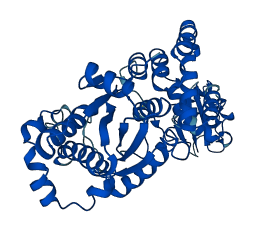
Descriptions
The autoinhibited protein was predicted that may have potential autoinhibitory elements via cis-regPred.
Autoinhibitory domains (AIDs)
Target domain |
|
Relief mechanism |
|
Assay |
cis-regPred |
Accessory elements
No accessory elements
Autoinhibited structure

Activated structure
1 structures for C1CAS7
| Entry ID | Method | Resolution | Chain | Position | Source |
|---|---|---|---|---|---|
| AF-C1CAS7-F1 | Predicted | AlphaFoldDB |
No variants for C1CAS7
| Variant ID(s) | Position | Change | Description | Diseaes Association | Provenance |
|---|---|---|---|---|---|
| No variants for C1CAS7 | |||||
No associated diseases with C1CAS7
Functions
| Description | ||
|---|---|---|
| EC Number | 6.1.1.1 | Ligases forming aminoacyl-tRNA and related compounds |
| Subcellular Localization |
|
|
| PANTHER Family | ||
| PANTHER Subfamily | ||
| PANTHER Protein Class | ||
| PANTHER Pathway Category | No pathway information available | |
1 GO annotations of cellular component
| Name | Definition |
|---|---|
| cytoplasm | The contents of a cell excluding the plasma membrane and nucleus, but including other subcellular structures. |
3 GO annotations of molecular function
| Name | Definition |
|---|---|
| ATP binding | Binding to ATP, adenosine 5'-triphosphate, a universally important coenzyme and enzyme regulator. |
| RNA binding | Binding to an RNA molecule or a portion thereof. |
| tyrosine-tRNA ligase activity | Catalysis of the reaction: L-tyrosine + ATP + tRNA(Tyr) = L-tyrosyl-tRNA(Tyr) + AMP + diphosphate + 2 H(+). |
1 GO annotations of biological process
| Name | Definition |
|---|---|
| tyrosyl-tRNA aminoacylation | The process of coupling tyrosine to tyrosyl-tRNA, catalyzed by tyrosyl-tRNA synthetase. The tyrosyl-tRNA synthetase is a class-I synthetase. The activated amino acid is transferred to the 2'-OH group of a tyrosine-accetping tRNA. The 2'-O-aminoacyl-tRNA will ultimately migrate to the 3' position via transesterification. |
No homologous proteins in AiPD
| UniProt AC | Gene Name | Protein Name | Species | Evidence Code |
|---|---|---|---|---|
| No homologous proteins | ||||
| 10 | 20 | 30 | 40 | 50 | 60 |
| MHIFDELKDR | GLIFQTTDEE | ALRKALEEGQ | VSYYTGYDPT | ADSLHLGHLV | AILTSRRLQL |
| 70 | 80 | 90 | 100 | 110 | 120 |
| AGHKPYALVG | GATGLIGDPS | FKDAERSLQT | KDTVDGWVKS | IQGQLSRFLD | FENGENKAVM |
| 130 | 140 | 150 | 160 | 170 | 180 |
| VNNYDWFGSI | SFIDFLRDIG | KYFTVNYMMS | KESVKKRIET | GISYTEFAYQ | IMQGYDFFVL |
| 190 | 200 | 210 | 220 | 230 | 240 |
| NQDHNVTLQI | GGSDQWGNMT | AGTELLRRKA | DKTGHVITVP | LITDATGKKF | GKSEGNAVWL |
| 250 | 260 | 270 | 280 | 290 | 300 |
| NPEKTSPYEM | YQFWMNVMDA | DAVRFLKIFT | FLSLDEIEDI | RKQFEAAPHE | RLAQKVLARE |
| 310 | 320 | 330 | 340 | 350 | 360 |
| VVTLVHGEEA | YKEALNITEQ | LFAGNIKNLS | VKELKQGLRG | VPNYQVQADE | HNNIVELLVS |
| 370 | 380 | 390 | 400 | 410 | |
| SGIVNSKRQA | REDVQNGAIY | VNGDRIQDLD | YVLSDADKLE | NELTVIRRGK | KKYFVLTY |