B9MJA6
Gene name |
bpt |
Protein name |
Aspartate/glutamate leucyltransferase |
Names |
|
Species |
Acidovorax ebreus (strain TPSY) (Diaphorobacter sp (strain TPSY)) |
KEGG Pathway |
dia:Dtpsy_1787 |
EC number |
2.3.2.29: Aminoacyltransferases |
Protein Class |
|
Descriptions
The autoinhibited protein was predicted that may have potential autoinhibitory elements via cis-regPred.
Autoinhibitory domains (AIDs)
Target domain |
|
Relief mechanism |
|
Assay |
cis-regPred |
Accessory elements
No accessory elements
Autoinhibited structure

Activated structure
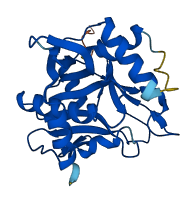
1 structures for B9MJA6
| Entry ID | Method | Resolution | Chain | Position | Source |
|---|---|---|---|---|---|
| AF-B9MJA6-F1 | Predicted | AlphaFoldDB |
No variants for B9MJA6
| Variant ID(s) | Position | Change | Description | Diseaes Association | Provenance |
|---|---|---|---|---|---|
| No variants for B9MJA6 | |||||
No associated diseases with B9MJA6
2 regional properties for B9MJA6
| Type | Name | Position | InterPro Accession |
|---|---|---|---|
| conserved_site | Aliphatic acid kinase, short-chain, conserved site | 4 - 15 | IPR023865-1 |
| conserved_site | Aliphatic acid kinase, short-chain, conserved site | 178 - 195 | IPR023865-2 |
Functions
| Description | ||
|---|---|---|
| EC Number | 2.3.2.29 | Aminoacyltransferases |
| Subcellular Localization |
|
|
| PANTHER Family | ||
| PANTHER Subfamily | ||
| PANTHER Protein Class | ||
| PANTHER Pathway Category | No pathway information available | |
1 GO annotations of cellular component
| Name | Definition |
|---|---|
| cytoplasm | The contents of a cell excluding the plasma membrane and nucleus, but including other subcellular structures. |
2 GO annotations of molecular function
| Name | Definition |
|---|---|
| arginyltransferase activity | Catalysis of the reaction: L-arginyl-tRNA + protein = tRNA + L-arginyl-protein. |
| leucyltransferase activity | Catalysis of the reaction: L-leucyl-tRNA + protein = tRNA + L-leucyl-protein. |
1 GO annotations of biological process
| Name | Definition |
|---|---|
| ubiquitin-dependent protein catabolic process via the N-end rule pathway | The chemical reactions and pathways resulting in the breakdown of a protein or peptide covalently tagged with ubiquitin, via the N-end rule pathway. In the N-end rule pathway, destabilizing N-terminal residues (N-degrons) in substrates are recognized by E3 ligases (N-recognins), whereupon the substrates are linked to ubiquitin and then delivered to the proteasome for degradation. |
No homologous proteins in AiPD
| UniProt AC | Gene Name | Protein Name | Species | Evidence Code |
|---|---|---|---|---|
| No homologous proteins | ||||
| 10 | 20 | 30 | 40 | 50 | 60 |
| MTQLNDLPLQ | SLQFYATAPY | PCSYLPERQA | RSQVATPSHL | IQNDVYSGLV | ARGFRRSGMF |
| 70 | 80 | 90 | 100 | 110 | 120 |
| TYRPYCDGCQ | ACTPLRVVVD | PFKPDRSQRR | AWKRHAGLQA | RVLRLCYLPE | HYQLYLRYQN |
| 130 | 140 | 150 | 160 | 170 | 180 |
| ARHAGGGMDQ | DSIDQYTQFL | LQSRVNSRLV | EFRETGADGQ | PGTLKMVSIL | DVLEDGLSAV |
| 190 | 200 | 210 | 220 | 230 | 240 |
| YTFYEPEPGA | SYGTYNVLWQ | VQQARTLGLP | YVYLGYWIEQ | SPKMNYKARF | MPHELRIDGR |
| WQRSKS |