B8ZRK7
Gene name |
argR |
Protein name |
Arginine repressor |
Names |
|
Species |
Mycobacterium leprae (strain Br4923) |
KEGG Pathway |
mlb:MLBr01411 |
EC number |
|
Protein Class |
|
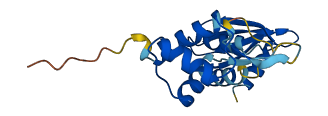
Descriptions
The autoinhibited protein was predicted that may have potential autoinhibitory elements via cis-regPred.
Autoinhibitory domains (AIDs)
Target domain |
|
Relief mechanism |
|
Assay |
cis-regPred |
Accessory elements
No accessory elements
Autoinhibited structure

Activated structure
1 structures for B8ZRK7
| Entry ID | Method | Resolution | Chain | Position | Source |
|---|---|---|---|---|---|
| AF-B8ZRK7-F1 | Predicted | AlphaFoldDB |
No variants for B8ZRK7
| Variant ID(s) | Position | Change | Description | Diseaes Association | Provenance |
|---|---|---|---|---|---|
| No variants for B8ZRK7 | |||||
No associated diseases with B8ZRK7
1 GO annotations of cellular component
| Name | Definition |
|---|---|
| cytoplasm | The contents of a cell excluding the plasma membrane and nucleus, but including other subcellular structures. |
3 GO annotations of molecular function
| Name | Definition |
|---|---|
| arginine binding | Binding to 2-amino-5-(carbamimidamido)pentanoic acid. |
| DNA binding | Any molecular function by which a gene product interacts selectively and non-covalently with DNA (deoxyribonucleic acid). |
| DNA-binding transcription factor activity | A transcription regulator activity that modulates transcription of gene sets via selective and non-covalent binding to a specific double-stranded genomic DNA sequence (sometimes referred to as a motif) within a cis-regulatory region. Regulatory regions include promoters (proximal and distal) and enhancers. Genes are transcriptional units, and include bacterial operons. |
2 GO annotations of biological process
| Name | Definition |
|---|---|
| arginine biosynthetic process | The chemical reactions and pathways resulting in the formation of arginine, 2-amino-5-(carbamimidamido)pentanoic acid. |
| protein complex oligomerization | The process of creating protein oligomers, compounds composed of a small number, usually between three and ten, of component monomers; protein oligomers may be composed of different or identical monomers. Oligomers may be formed by the polymerization of a number of monomers or the depolymerization of a large protein polymer. |
No homologous proteins in AiPD
| UniProt AC | Gene Name | Protein Name | Species | Evidence Code |
|---|---|---|---|---|
| No homologous proteins | ||||
| 10 | 20 | 30 | 40 | 50 | 60 |
| MTHGASKTTP | ETTRAGRQAR | IVAILSSTSV | RSQSELATLL | ADDGIDVTQA | TLSRDLEELG |
| 70 | 80 | 90 | 100 | 110 | 120 |
| AVKLRGADGG | VGVYVVPEDG | SPVRGVSGGT | ARLSRLLSEL | LVSADSSANL | AVLRTPPGAA |
| 130 | 140 | 150 | 160 | ||
| DYLASAIDRA | ALPYVVGTIA | GDDTVFVAAR | EPMTGSELAT | VLESLNR |