B8B7C5
Gene name |
GLO5 (OsI_24928) |
Protein name |
Glycolate oxidase 5 |
Names |
GOX 5, OsGLO5, Peroxisomal (S)-2-hydroxy-acid oxidase GLO5, Short chain alpha-hydroxy acid oxidase GLO5 |
Species |
Oryza sativa subsp indica (Rice) |
KEGG Pathway |
|
EC number |
1.1.3.15: With oxygen as acceptor |
Protein Class |
|
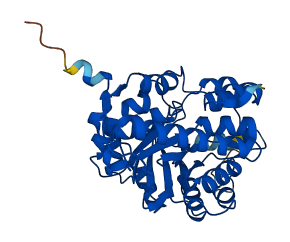
Descriptions
The autoinhibited protein was predicted that may have potential autoinhibitory elements via cis-regPred.
Autoinhibitory domains (AIDs)
Target domain |
|
Relief mechanism |
|
Assay |
cis-regPred |
Accessory elements
No accessory elements
Autoinhibited structure

Activated structure
1 structures for B8B7C5
| Entry ID | Method | Resolution | Chain | Position | Source |
|---|---|---|---|---|---|
| AF-B8B7C5-F1 | Predicted | AlphaFoldDB |
No variants for B8B7C5
| Variant ID(s) | Position | Change | Description | Diseaes Association | Provenance |
|---|---|---|---|---|---|
| No variants for B8B7C5 | |||||
No associated diseases with B8B7C5
Functions
| Description | ||
|---|---|---|
| EC Number | 1.1.3.15 | With oxygen as acceptor |
| Subcellular Localization |
|
|
| PANTHER Family | ||
| PANTHER Subfamily | ||
| PANTHER Protein Class | ||
| PANTHER Pathway Category | No pathway information available | |
1 GO annotations of cellular component
| Name | Definition |
|---|---|
| peroxisome | A small organelle enclosed by a single membrane, and found in most eukaryotic cells. Contains peroxidases and other enzymes involved in a variety of metabolic processes including free radical detoxification, lipid catabolism and biosynthesis, and hydrogen peroxide metabolism. |
2 GO annotations of molecular function
| Name | Definition |
|---|---|
| (S)-2-hydroxy-acid oxidase activity | Catalysis of the reaction: (S)-2-hydroxy-acid + O2 = 2-oxo acid + hydrogen peroxide. |
| FMN binding | Binding to flavin mono nucleotide. Flavin mono nucleotide (FMN) is the coenzyme or the prosthetic group of various flavoprotein oxidoreductase enzymes. |
4 GO annotations of biological process
| Name | Definition |
|---|---|
| cellular response to virus | Any process that results in a change in state or activity of a cell (in terms of movement, secretion, enzyme production, gene expression, etc.) as a result of a stimulus from a virus. |
| oxidative photosynthetic carbon pathway | The reactions of the C2 pathway bring about the metabolic conversion of two molecules of 2-phosphoglycolate to one molecule of 3-phosphoglycerate, which can be used by the C3 cycle, and one molecule of carbon dioxide (CO2). |
| photorespiration | A light-dependent catabolic process occurring concomitantly with photosynthesis in plants (especially C3 plants) whereby dioxygen (O2) is consumed and carbon dioxide (CO2) is evolved. The substrate is glycolate formed in large quantities in chloroplasts from 2-phosphoglycolate generated from ribulose 1,5-bisphosphate by the action of ribulose-bisphosphate carboxylase; the glycolate enters the peroxisomes where it is converted by glycolate oxidase to glyoxylate which undergoes transamination to glycine. This then passes into the mitochondria where it is decarboxylated forming one molecule of serine for every two molecules of glycine. This pathway also exists in photosynthetic bacteria. |
| regulation of photosynthesis | Any process that modulates the frequency, rate or extent of photosynthesis. |
No homologous proteins in AiPD
| UniProt AC | Gene Name | Protein Name | Species | Evidence Code |
|---|---|---|---|---|
| No homologous proteins | ||||
| 10 | 20 | 30 | 40 | 50 | 60 |
| MGEITNVTEY | QAIAKQKLPK | MIYDYYASGA | EDEWTLQENR | EAFARILFRP | RILIDVSKID |
| 70 | 80 | 90 | 100 | 110 | 120 |
| MATTVLGFKI | SMPIMIAPSA | MQKMAHPDGE | YATARAASAA | GTIMTLSSWA | TSSVEEVAST |
| 130 | 140 | 150 | 160 | 170 | 180 |
| GPGIRFFQLY | VYKDRRVVEQ | LVRRAERAGF | KAIALTVDTP | RLGRREADIK | NRFVLPPFLT |
| 190 | 200 | 210 | 220 | 230 | 240 |
| LKNFEGLELG | KMDQASDSGL | ASYVAGQIDR | TLSWKDVKWL | QTITTLPILV | KGVITAEDTR |
| 250 | 260 | 270 | 280 | 290 | 300 |
| LAVENGAAGI | IVSNHGARQL | DYVPATISAL | EEVVKAARGQ | LPVFLDGGVR | RGTDVFKALA |
| 310 | 320 | 330 | 340 | 350 | 360 |
| LGAAGVFIGR | PVVFSLAAAG | EAGVRNVLQM | LRDEFELTMA | LSGCTSLADI | TRNHVITEAD |
| KLGVMPSRL |