B7P877
Gene name |
Cbp20 (ISCW017479) |
Protein name |
Nuclear cap-binding protein subunit 2 |
Names |
20 kDa nuclear cap-binding protein, NCBP 20 kDa subunit, CBP20 |
Species |
Ixodes scapularis (Black-legged tick) (Deer tick) |
KEGG Pathway |
isc:IscW_ISCW017479 |
EC number |
|
Protein Class |
|
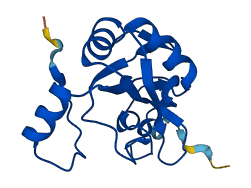
Descriptions
The autoinhibited protein was predicted that may have potential autoinhibitory elements via cis-regPred.
Autoinhibitory domains (AIDs)
Target domain |
|
Relief mechanism |
|
Assay |
cis-regPred |
Accessory elements
No accessory elements
Autoinhibited structure

Activated structure
1 structures for B7P877
| Entry ID | Method | Resolution | Chain | Position | Source |
|---|---|---|---|---|---|
| AF-B7P877-F1 | Predicted | AlphaFoldDB |
No variants for B7P877
| Variant ID(s) | Position | Change | Description | Diseaes Association | Provenance |
|---|---|---|---|---|---|
| No variants for B7P877 | |||||
No associated diseases with B7P877
2 GO annotations of cellular component
| Name | Definition |
|---|---|
| nuclear cap binding complex | A conserved heterodimeric protein complex that binds to the 5' terminal cap structure m7G(5')ppp(5')N of nascent eukaryotic RNA polymerase II transcripts such as pre-mRNA and U snRNA. The consists of proteins known as CBP20 and CBP80, binds to cap structures in the nucleus, and is involved in pre-mRNA splicing, 3'-end formation, and RNA nuclear export. |
| nucleus | A membrane-bounded organelle of eukaryotic cells in which chromosomes are housed and replicated. In most cells, the nucleus contains all of the cell's chromosomes except the organellar chromosomes, and is the site of RNA synthesis and processing. In some species, or in specialized cell types, RNA metabolism or DNA replication may be absent. |
1 GO annotations of molecular function
| Name | Definition |
|---|---|
| RNA cap binding | Binding to a 7-methylguanosine (m7G) group or derivative located at the 5' end of an RNA molecule. |
3 GO annotations of biological process
| Name | Definition |
|---|---|
| gene silencing by RNA | A process in which an RNA molecule reduces expression of target genes. This can occur pre-transcriptionally by assembly of heterochromatin and prevention of transcription or co- or post-transcriptionally by targeting RNAs for degradation or by interfering with splicing or translation. This process starts once the inhibitory RNA molecule has been transcribed, and includes processing of the RNA such as cleavage, modifications, transport from the nucleus to the cytoplasm, loading onto the RISC complex, and the effect on transcription or translation. |
| mRNA cis splicing, via spliceosome | The joining together, after removal of an intervening sequence composed of one or more introns, of two segments of the same RNA molecule via spliceosomal catalysis to produce an mRNA composed only of exon sequences that all came from the same primary transcript. |
| mRNA splicing, via spliceosome | The joining together of exons from one or more primary transcripts of messenger RNA (mRNA) and the excision of intron sequences, via a spliceosomal mechanism, so that mRNA consisting only of the joined exons is produced. |
No homologous proteins in AiPD
| UniProt AC | Gene Name | Protein Name | Species | Evidence Code |
|---|---|---|---|---|
| No homologous proteins | ||||
| 10 | 20 | 30 | 40 | 50 | 60 |
| MSVDLSSYRD | QHFKGSRSEQ | ERLLRLSTTL | YVGNMSFYTT | EEQIYELFSK | CGDVKKVIMG |
| 70 | 80 | 90 | 100 | 110 | 120 |
| LDRFHKTPCG | FCFVEYYTRE | DAENAIRYVN | GTKLDDRIIR | TDWDAGFVEG | RQFGRGKSGG |
| 130 | 140 | 150 | |||
| QVRDEYRTDY | DSGRGGYGKL | MAQRVVPPPA | VV |