B5YD88
Gene name |
lig |
Protein name |
Probable DNA ligase |
Names |
Polydeoxyribonucleotide synthase [ATP] |
Species |
Dictyoglomus thermophilum (strain ATCC 35947 / DSM 3960 / H-6-12) |
KEGG Pathway |
dth:DICTH_0616 |
EC number |
6.5.1.1: Forming phosphoric ester bonds |
Protein Class |
|
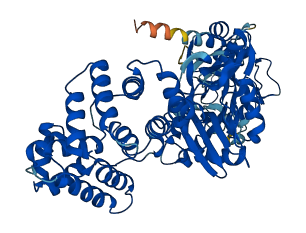
Descriptions
The autoinhibited protein was predicted that may have potential autoinhibitory elements via cis-regPred.
Autoinhibitory domains (AIDs)
Target domain |
|
Relief mechanism |
|
Assay |
cis-regPred |
Accessory elements
No accessory elements
Autoinhibited structure

Activated structure
1 structures for B5YD88
| Entry ID | Method | Resolution | Chain | Position | Source |
|---|---|---|---|---|---|
| AF-B5YD88-F1 | Predicted | AlphaFoldDB |
No variants for B5YD88
| Variant ID(s) | Position | Change | Description | Diseaes Association | Provenance |
|---|---|---|---|---|---|
| No variants for B5YD88 | |||||
No associated diseases with B5YD88
11 regional properties for B5YD88
| Type | Name | Position | InterPro Accession |
|---|---|---|---|
| domain | Protein kinase domain | 626 - 887 | IPR000719 |
| domain | Ephrin receptor ligand binding domain | 29 - 210 | IPR001090 |
| domain | Serine-threonine/tyrosine-protein kinase, catalytic domain | 626 - 883 | IPR001245 |
| conserved_site | Tyrosine-protein kinase, receptor class V, conserved site | 186 - 206 | IPR001426-1 |
| conserved_site | Tyrosine-protein kinase, receptor class V, conserved site | 247 - 267 | IPR001426-2 |
| domain | Sterile alpha motif domain | 907 - 974 | IPR001660 |
| domain | Fibronectin type III | 328 - 533 | IPR003961 |
| active_site | Tyrosine-protein kinase, active site | 747 - 759 | IPR008266 |
| binding_site | Protein kinase, ATP binding site | 632 - 658 | IPR017441 |
| domain | Tyrosine-protein kinase, catalytic domain | 626 - 883 | IPR020635 |
| domain | Ephrin receptor, transmembrane domain | 548 - 622 | IPR027936 |
Functions
| Description | ||
|---|---|---|
| EC Number | 6.5.1.1 | Forming phosphoric ester bonds |
| Subcellular Localization |
|
|
| PANTHER Family | ||
| PANTHER Subfamily | ||
| PANTHER Protein Class | ||
| PANTHER Pathway Category | No pathway information available | |
No GO annotations of cellular component
| Name | Definition |
|---|---|
| No GO annotations for cellular component |
4 GO annotations of molecular function
| Name | Definition |
|---|---|
| ATP binding | Binding to ATP, adenosine 5'-triphosphate, a universally important coenzyme and enzyme regulator. |
| DNA binding | Any molecular function by which a gene product interacts selectively and non-covalently with DNA (deoxyribonucleic acid). |
| DNA ligase (ATP) activity | Catalysis of the reaction: ATP + deoxyribonucleotide(n) + deoxyribonucleotide(m) = AMP + diphosphate + deoxyribonucleotide(n+m). |
| metal ion binding | Binding to a metal ion. |
6 GO annotations of biological process
| Name | Definition |
|---|---|
| cell cycle | The progression of biochemical and morphological phases and events that occur in a cell during successive cell replication or nuclear replication events. Canonically, the cell cycle comprises the replication and segregation of genetic material followed by the division of the cell, but in endocycles or syncytial cells nuclear replication or nuclear division may not be followed by cell division. |
| cell division | The process resulting in division and partitioning of components of a cell to form more cells; may or may not be accompanied by the physical separation of a cell into distinct, individually membrane-bounded daughter cells. |
| DNA biosynthetic process | The biosynthetic process resulting in the formation of DNA. |
| DNA recombination | Any process in which a new genotype is formed by reassortment of genes resulting in gene combinations different from those that were present in the parents. In eukaryotes genetic recombination can occur by chromosome assortment, intrachromosomal recombination, or nonreciprocal interchromosomal recombination. Interchromosomal recombination occurs by crossing over. In bacteria it may occur by genetic transformation, conjugation, transduction, or F-duction. |
| DNA repair | The process of restoring DNA after damage. Genomes are subject to damage by chemical and physical agents in the environment (e.g. UV and ionizing radiations, chemical mutagens, fungal and bacterial toxins, etc.) and by free radicals or alkylating agents endogenously generated in metabolism. DNA is also damaged because of errors during its replication. A variety of different DNA repair pathways have been reported that include direct reversal, base excision repair, nucleotide excision repair, photoreactivation, bypass, double-strand break repair pathway, and mismatch repair pathway. |
| DNA replication | The cellular metabolic process in which a cell duplicates one or more molecules of DNA. DNA replication begins when specific sequences, known as origins of replication, are recognized and bound by initiation proteins, and ends when the original DNA molecule has been completely duplicated and the copies topologically separated. The unit of replication usually corresponds to the genome of the cell, an organelle, or a virus. The template for replication can either be an existing DNA molecule or RNA. |
No homologous proteins in AiPD
| UniProt AC | Gene Name | Protein Name | Species | Evidence Code |
|---|---|---|---|---|
| No homologous proteins | ||||
| 10 | 20 | 30 | 40 | 50 | 60 |
| MLFGELAQYF | ERIEKTTKRN | EMMEILADLF | RKVDKEEIDK | IIYLLNGRVA | PDYEKIEFGM |
| 70 | 80 | 90 | 100 | 110 | 120 |
| SDKLVLRAMA | LALKIPLLEL | ERSYKEVGDL | GELVVKYSKN | EGKDLTVVET | FNTLYDIANL |
| 130 | 140 | 150 | 160 | 170 | 180 |
| SGEGSVDAKV | NRLAFLINSL | TPQGGKYLVR | IVLGKLRLGV | GEPTIMDALS | FAKVKDKGLR |
| 190 | 200 | 210 | 220 | 230 | 240 |
| PFIERAFNIT | SDLGYVAKVF | WEGGVEALKR | IKVQVGRPIR | MALAERVSRA | EEIIKRLGKC |
| 250 | 260 | 270 | 280 | 290 | 300 |
| AVEPKFDGFR | CQIHKKENSV | RIFSRNLEDN | TYMFPDLVEA | VLKQFPDRDV | IIEGEAISYN |
| 310 | 320 | 330 | 340 | 350 | 360 |
| PETGEFYPFQ | VTVQRKRKYN | ISEMVELYPL | QLFAFDILYL | DGEDTTSLPY | IRRRQKLEEA |
| 370 | 380 | 390 | 400 | 410 | 420 |
| LVEGEKISIT | KNIITNDPKE | IQSFFEECIT | EGLEGIVAKR | LDAPYQAGMR | NFNWIKLKRS |
| 430 | 440 | 450 | 460 | 470 | 480 |
| YQGHLADTVD | CVILGYFKGR | GHRAKFGIGA | LLVGVYDDER | DLFKTIAKIG | TGPTEEEWVK |
| 490 | 500 | 510 | 520 | 530 | 540 |
| FREILDEIKV | EKRPNNVESF | IEPDVWVEPK | YVVVVQADEI | TRSPVHTCGR | ELDGLGYALR |
| 550 | 560 | 570 | 580 | ||
| FPRVQGFVRE | DKGPYDATTV | KEILEMFRNQ | KKEKVEEDSD | LL |