B4STN9
Gene name |
hisB |
Protein name |
Histidine biosynthesis bifunctional protein HisB |
Names |
|
Species |
Stenotrophomonas maltophilia (strain R551-3) |
KEGG Pathway |
smt:Smal_1759 |
EC number |
3.1.3.15: Phosphoric monoester hydrolases |
Protein Class |
|
Descriptions
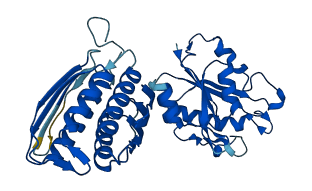
The autoinhibited protein was predicted that may have potential autoinhibitory elements via cis-regPred.
Autoinhibitory domains (AIDs)
Target domain |
|
Relief mechanism |
|
Assay |
cis-regPred |
Accessory elements
No accessory elements
Autoinhibited structure

Activated structure
1 structures for B4STN9
| Entry ID | Method | Resolution | Chain | Position | Source |
|---|---|---|---|---|---|
| AF-B4STN9-F1 | Predicted | AlphaFoldDB |
No variants for B4STN9
| Variant ID(s) | Position | Change | Description | Diseaes Association | Provenance |
|---|---|---|---|---|---|
| No variants for B4STN9 | |||||
No associated diseases with B4STN9
5 regional properties for B4STN9
| Type | Name | Position | InterPro Accession |
|---|---|---|---|
| domain | Histidine biosynthesis bifunctional protein, N-terminal histidinol-phosphatase domain | 3 - 164 | IPR005954 |
| domain | Histidinol-phosphate phosphatase | 4 - 143 | IPR006543 |
| domain | HAD-superfamily hydrolase,subfamily IIIA | 4 - 147 | IPR006549 |
| conserved_site | Imidazoleglycerol-phosphate dehydratase, conserved site | 228 - 241 | IPR020565-1 |
| conserved_site | Imidazoleglycerol-phosphate dehydratase, conserved site | 321 - 333 | IPR020565-2 |
Functions
| Description | ||
|---|---|---|
| EC Number | 3.1.3.15 | Phosphoric monoester hydrolases |
| Subcellular Localization |
|
|
| PANTHER Family | ||
| PANTHER Subfamily | ||
| PANTHER Protein Class | ||
| PANTHER Pathway Category | No pathway information available | |
1 GO annotations of cellular component
| Name | Definition |
|---|---|
| cytoplasm | The contents of a cell excluding the plasma membrane and nucleus, but including other subcellular structures. |
3 GO annotations of molecular function
| Name | Definition |
|---|---|
| histidinol-phosphatase activity | Catalysis of the reaction: L-histidinol phosphate + H(2)O = L-histidinol + phosphate. |
| imidazoleglycerol-phosphate dehydratase activity | Catalysis of the reaction: D-erythro-1-(imidazol-4-yl)glycerol 3-phosphate = 3-(imidazol-4-yl)-2-oxopropyl phosphate + H(2)O. |
| metal ion binding | Binding to a metal ion. |
1 GO annotations of biological process
| Name | Definition |
|---|---|
| histidine biosynthetic process | The chemical reactions and pathways resulting in the formation of histidine, 2-amino-3-(1H-imidazol-4-yl)propanoic acid. |
No homologous proteins in AiPD
| UniProt AC | Gene Name | Protein Name | Species | Evidence Code |
|---|---|---|---|---|
| No homologous proteins | ||||
| 10 | 20 | 30 | 40 | 50 | 60 |
| MTPILFIDRD | GTLIEEPSDF | QIDAYEKLRF | VPQVIPALLK | LRDAGYQFVI | VTNQDGLGSD |
| 70 | 80 | 90 | 100 | 110 | 120 |
| SYPRASFDGP | NELMLQIFES | QGITFRDVLI | DCSWPQDNAP | TRKPGIGLMT | AYLQDRSIDW |
| 130 | 140 | 150 | 160 | 170 | 180 |
| ARSGMVGDRI | TDLQFAENLN | IRGFQLRTEQ | FGGEWDWPGI | AHALADAPRI | AVVQRDTKET |
| 190 | 200 | 210 | 220 | 230 | 240 |
| KIRVELDLDR | AGDARIDTGL | PFFDHMLEQI | GKHGGFALDI | QAEGDLHIDE | HHTIEDTGLA |
| 250 | 260 | 270 | 280 | 290 | 300 |
| LGQALREALG | DKRGIGRYGF | TLPMDETLAS | AALDFSGRPY | FVFEGEFKRE | RVGDMPTELV |
| 310 | 320 | 330 | 340 | 350 | |
| PHFFRSLCDA | SGLNLNLQVR | GDNDHHKVEA | CFKALARALR | PALARQGTAL | PTTKGAL |