B4JG39
Gene name |
Snmp1 |
Protein name |
Sensory neuron membrane protein 1 |
Names |
|
Species |
Drosophila grimshawi (Hawaiian fruit fly) (Idiomyia grimshawi) |
KEGG Pathway |
dgr:6564449 |
EC number |
|
Protein Class |
|
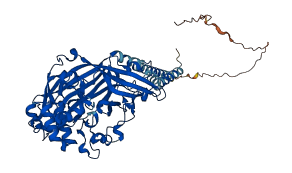
Descriptions
The autoinhibited protein was predicted that may have potential autoinhibitory elements via cis-regPred.
Autoinhibitory domains (AIDs)
Target domain |
|
Relief mechanism |
|
Assay |
cis-regPred |
Accessory elements
No accessory elements
Autoinhibited structure

Activated structure
1 structures for B4JG39
| Entry ID | Method | Resolution | Chain | Position | Source |
|---|---|---|---|---|---|
| AF-B4JG39-F1 | Predicted | AlphaFoldDB |
No variants for B4JG39
| Variant ID(s) | Position | Change | Description | Diseaes Association | Provenance |
|---|---|---|---|---|---|
| No variants for B4JG39 | |||||
No associated diseases with B4JG39
No regional properties for B4JG39
| Type | Name | Position | InterPro Accession |
|---|---|---|---|
| No domain, repeats, and functional sites for B4JG39 | |||
2 GO annotations of cellular component
| Name | Definition |
|---|---|
| integral component of membrane | The component of a membrane consisting of the gene products and protein complexes having at least some part of their peptide sequence embedded in the hydrophobic region of the membrane. |
| plasma membrane | The membrane surrounding a cell that separates the cell from its external environment. It consists of a phospholipid bilayer and associated proteins. |
No GO annotations of molecular function
| Name | Definition |
|---|---|
| No GO annotations for molecular function |
2 GO annotations of biological process
| Name | Definition |
|---|---|
| response to stimulus | Any process that results in a change in state or activity of a cell or an organism (in terms of movement, secretion, enzyme production, gene expression, etc.) as a result of a stimulus. The process begins with detection of the stimulus and ends with a change in state or activity or the cell or organism. |
| sensory perception of smell | The series of events required for an organism to receive an olfactory stimulus, convert it to a molecular signal, and recognize and characterize the signal. Olfaction involves the detection of chemical composition of an organism's ambient medium by chemoreceptors. This is a neurological process. |
No homologous proteins in AiPD
| UniProt AC | Gene Name | Protein Name | Species | Evidence Code |
|---|---|---|---|---|
| No homologous proteins | ||||
| 10 | 20 | 30 | 40 | 50 | 60 |
| MQVHRTKLLA | ASGGTLLFGI | LFGWVLFPQI | LKFMISKQVT | LKPGTDVREL | WSATPFPLHF |
| 70 | 80 | 90 | 100 | 110 | 120 |
| YIYVFNVTNP | DEVANGGKPR | VQEVGPFVFD | EWKDKYDLED | DVVEDTVSYN | MRNTFFFNEK |
| 130 | 140 | 150 | 160 | 170 | 180 |
| ASSPLTGEEV | ITLPHPLLQS | IGISVQRERA | AMMELIAKAL | AIILPDAKPF | LTAKFMDLFF |
| 190 | 200 | 210 | 220 | 230 | 240 |
| RGINVDCSSE | EFASKALCTV | FYTGDVKQAK | QVNQTHFLLS | FLGQSNHTDA | GRFTVCRGVK |
| 250 | 260 | 270 | 280 | 290 | 300 |
| NNKKLGMVVK | FADEPELDMW | LGDECNRFVG | TDSTVFAPGL | KREDGLWAFT | PDLCRSLGAV |
| 310 | 320 | 330 | 340 | 350 | 360 |
| YKHKSSYHGM | PSLRYTLDMG | DIRMDEKLHC | FCDDPEDLET | CPLKGTMNLN | RCVGGPLIAS |
| 370 | 380 | 390 | 400 | 410 | 420 |
| MPHFYNGDPK | LVQDVDGLNP | NQKQHEVFID | FEPISGTPFQ | AAKRMQFNMD | MEPVEGIEPL |
| 430 | 440 | 450 | 460 | 470 | 480 |
| RHQRKVIMPM | FWVEEGVQLN | KTYTNMVKHT | LFLGLKFNAG | LRWMLITFSL | IGLMSAGYLF |
| 490 | 500 | 510 | 520 | 530 | 540 |
| FKESDSLDVT | MPPKIIKESN | KVANQPTFAK | QQQHQDQQSQ | SQATAAPNVP | IPGVDLSNVK |
| VELRERF |