B4GGF2
Gene name |
GL17147 |
Protein name |
Putative N(4)-(beta-N-acetylglucosaminyl)-L-asparaginase GL17147 |
Names |
Aspartylglucosaminidase, AGA, Glycosylasparaginase, N4-(N-acetyl-beta-glucosaminyl)-L-asparagine amidase |
Species |
Drosophila persimilis (Fruit fly) |
KEGG Pathway |
dpe:6592696 |
EC number |
3.5.1.26: In linear amides |
Protein Class |
|
Descriptions
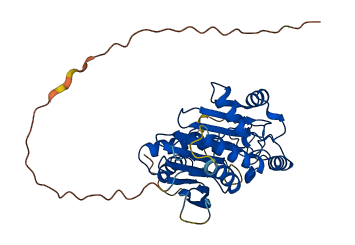
The autoinhibited protein was predicted that may have potential autoinhibitory elements via cis-regPred.
Autoinhibitory domains (AIDs)
Target domain |
|
Relief mechanism |
|
Assay |
cis-regPred |
Accessory elements
No accessory elements
Autoinhibited structure

Activated structure
1 structures for B4GGF2
| Entry ID | Method | Resolution | Chain | Position | Source |
|---|---|---|---|---|---|
| AF-B4GGF2-F1 | Predicted | AlphaFoldDB |
No variants for B4GGF2
| Variant ID(s) | Position | Change | Description | Diseaes Association | Provenance |
|---|---|---|---|---|---|
| No variants for B4GGF2 | |||||
No associated diseases with B4GGF2
No regional properties for B4GGF2
| Type | Name | Position | InterPro Accession |
|---|---|---|---|
| No domain, repeats, and functional sites for B4GGF2 | |||
Functions
| Description | ||
|---|---|---|
| EC Number | 3.5.1.26 | In linear amides |
| Subcellular Localization |
|
|
| PANTHER Family | ||
| PANTHER Subfamily | ||
| PANTHER Protein Class | ||
| PANTHER Pathway Category | No pathway information available | |
1 GO annotations of cellular component
| Name | Definition |
|---|---|
| lysosome | A small lytic vacuole that has cell cycle-independent morphology found in most animal cells and that contains a variety of hydrolases, most of which have their maximal activities in the pH range 5-6. The contained enzymes display latency if properly isolated. About 40 different lysosomal hydrolases are known and lysosomes have a great variety of morphologies and functions. |
2 GO annotations of molecular function
| Name | Definition |
|---|---|
| N4-(beta-N-acetylglucosaminyl)-L-asparaginase activity | Catalysis of the reaction: N(4)-(beta-N-acetyl-D-glucosaminyl)-L-asparagine + H(2)O = N-acetyl-beta-D-glucosaminylamine + L-aspartate + H(+). |
| peptidase activity | Catalysis of the hydrolysis of a peptide bond. A peptide bond is a covalent bond formed when the carbon atom from the carboxyl group of one amino acid shares electrons with the nitrogen atom from the amino group of a second amino acid. |
2 GO annotations of biological process
| Name | Definition |
|---|---|
| protein deglycosylation | The removal of sugar residues from a glycosylated protein. |
| proteolysis | The hydrolysis of proteins into smaller polypeptides and/or amino acids by cleavage of their peptide bonds. |
No homologous proteins in AiPD
| UniProt AC | Gene Name | Protein Name | Species | Evidence Code |
|---|---|---|---|---|
| No homologous proteins | ||||
| 10 | 20 | 30 | 40 | 50 | 60 |
| MYKAQYLWLF | GLVLISRSAT | ERTTPKINFT | TVVGLKTTPA | MRSSSASSLG | GSLPMVINTW |
| 70 | 80 | 90 | 100 | 110 | 120 |
| NFTDANFLAW | RILNVTQGGL | RQTRNAVVEG | CTRCEQQQCD | RTVGYGGSPD | ELGETTLDAM |
| 130 | 140 | 150 | 160 | 170 | 180 |
| IMDGSSMDVG | AVAGLRGIKD | AIRVARHVLE | HTKHSILVGD | LASQFAQAMG | FRSESLATPE |
| 190 | 200 | 210 | 220 | 230 | 240 |
| SKAMWMEWTA | ANCQPNFWRN | VHPDPSISCG | PYKPKATPLT | RWKEDRARTE | YSIGHLNHDT |
| 250 | 260 | 270 | 280 | 290 | 300 |
| IGMIAIDAAN | NIHAGTSSNG | ARHKIPGRVG | DSPIPGAGAY | ADNEVGAAVA | TGDGDIMMRF |
| 310 | 320 | 330 | 340 | 350 | 360 |
| LPTLLAVEAM | RAGKKPAEAA | EVGIRRISKH | YKDFSGAVIA | VDRLGQYGAA | CYGMTEFPFV |
| 370 | 380 | ||||
| VSNPSKTDIP | SRQESVKCIT | GKEAVNVV |