B3TPQ7
Gene name |
|
Protein name |
Alpha-terpineol synthase, chloroplastic |
Names |
Mg17 |
Species |
Magnolia grandiflora (Southern magnolia) |
KEGG Pathway |
|
EC number |
4.2.3.111: Acting on phosphates |
Protein Class |
|
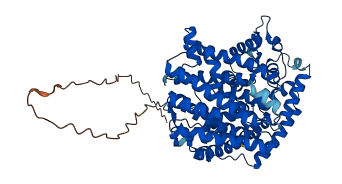
Descriptions
The autoinhibited protein was predicted that may have potential autoinhibitory elements via cis-regPred.
Autoinhibitory domains (AIDs)
Target domain |
|
Relief mechanism |
|
Assay |
cis-regPred |
Accessory elements
No accessory elements
Autoinhibited structure

Activated structure
1 structures for B3TPQ7
| Entry ID | Method | Resolution | Chain | Position | Source |
|---|---|---|---|---|---|
| AF-B3TPQ7-F1 | Predicted | AlphaFoldDB |
No variants for B3TPQ7
| Variant ID(s) | Position | Change | Description | Diseaes Association | Provenance |
|---|---|---|---|---|---|
| No variants for B3TPQ7 | |||||
No associated diseases with B3TPQ7
Functions
| Description | ||
|---|---|---|
| EC Number | 4.2.3.111 | Acting on phosphates |
| Subcellular Localization |
|
|
| PANTHER Family | ||
| PANTHER Subfamily | ||
| PANTHER Protein Class | ||
| PANTHER Pathway Category | No pathway information available | |
1 GO annotations of cellular component
| Name | Definition |
|---|---|
| chloroplast stroma | The space enclosed by the double membrane of a chloroplast but excluding the thylakoid space. It contains DNA, ribosomes and some temporary products of photosynthesis. |
2 GO annotations of molecular function
| Name | Definition |
|---|---|
| magnesium ion binding | Binding to a magnesium (Mg) ion. |
| terpene synthase activity | Catalysis of the formation of cyclic terpenes through the cyclization of linear terpenes (e.g. isopentenyl-PP, geranyl-PP, farnesyl-PP and geranylgeranyl-PP) containing varying numbers of isoprene units. |
3 GO annotations of biological process
| Name | Definition |
|---|---|
| diterpenoid biosynthetic process | The chemical reactions and pathways resulting in the formation of diterpenoid compounds, terpenoids with four isoprene units. |
| geranyl diphosphate metabolic process | The chemical reactions and pathways involving geranyl diphosphate, the universal precursor of the monoterpenes. |
| monoterpene biosynthetic process | The chemical reactions and pathways resulting in the formation of monoterpenes, terpenes with a C10 structure. |
No homologous proteins in AiPD
| UniProt AC | Gene Name | Protein Name | Species | Evidence Code |
|---|---|---|---|---|
| No homologous proteins | ||||
| 10 | 20 | 30 | 40 | 50 | 60 |
| MALKLLFQCS | PCSPSSLAPL | QPVLVLVRPP | SGAKARRNLR | CCASTQVTEL | MTARRSANYH |
| 70 | 80 | 90 | 100 | 110 | 120 |
| PNIWDYDSVQ | SLTSDYKAYT | YLERVEKLKE | DVRRTLQEAV | GLLDQLELVD | CIHRLGVGYH |
| 130 | 140 | 150 | 160 | 170 | 180 |
| FDKEIKEILK | TISTEPNNMG | LIDGDLYAMA | LYFRLLRQHG | YEVPQGVFNR | FMDDSSSFKA |
| 190 | 200 | 210 | 220 | 230 | 240 |
| SLCNDVKGML | SLYEASYLAL | EGETTLDEAK | AFTYRHLRGL | KGNIDSNLKG | LVEHALELPL |
| 250 | 260 | 270 | 280 | 290 | 300 |
| HWRVLRLEAR | WYIDTYERME | DMNPLLLELA | KLDFNIVQNV | YQGQVRKMSG | WWKDLGLGQK |
| 310 | 320 | 330 | 340 | 350 | 360 |
| LGFARDRLME | GFLWTIGVKF | EPQFAQCREV | LTKINQLITT | IDDVYDVYGS | LEELELFTKA |
| 370 | 380 | 390 | 400 | 410 | 420 |
| VDRWDTNAME | ELPEYMKICF | LALYNTVNEI | AYDTLKEQGV | DVIPYLQKSW | ADLCKAYLVE |
| 430 | 440 | 450 | 460 | 470 | 480 |
| ARWYYSGYTP | TLDEYLNNAW | ISIAGPVILV | HAYVSMIQMI | TKEALLDCVG | SYESIMQWSS |
| 490 | 500 | 510 | 520 | 530 | 540 |
| MILRLADDLA | TSTDELERGD | VPKSIQCYMH | ENTASEVVAR | EQMRARISDI | WKKMNKDVAL |
| 550 | 560 | 570 | 580 | 590 | |
| SPLPQPFKAA | AVNLARMAQC | MYQHGDGHGN | PHRESKDHIL | SLVVEPIQLM | ES |