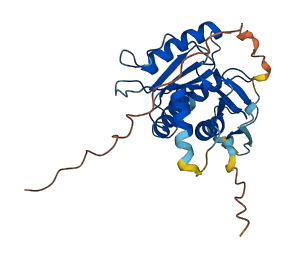
Descriptions
The autoinhibited protein was predicted that may have potential autoinhibitory elements via cis-regPred.
Autoinhibitory domains (AIDs)
Target domain |
|
Relief mechanism |
|
Assay |
cis-regPred |
Accessory elements
No accessory elements
Autoinhibited structure

Activated structure
1 structures for B3STP1
| Entry ID | Method | Resolution | Chain | Position | Source |
|---|---|---|---|---|---|
| AF-B3STP1-F1 | Predicted | AlphaFoldDB |
No variants for B3STP1
| Variant ID(s) | Position | Change | Description | Diseaes Association | Provenance |
|---|---|---|---|---|---|
| No variants for B3STP1 | |||||
No associated diseases with B3STP1
No regional properties for B3STP1
| Type | Name | Position | InterPro Accession |
|---|---|---|---|
| No domain, repeats, and functional sites for B3STP1 | |||
Functions
3 GO annotations of cellular component
| Name | Definition |
|---|---|
| cytoplasm | The contents of a cell excluding the plasma membrane and nucleus, but including other subcellular structures. |
| polar tube | A highly specialized structure unique to microsporidia that is required for host cell invasion. In the spore, the polar tube is connected at the anterior end, and then coils around the sporoplasm. Upon appropriate environmental stimulation, the polar tube rapidly discharges out of the spore, pierces a cell membrane and serves as a conduit for sporoplasm passage into the new host cell. |
| spore wall | The specialized envelope lying outside the cell membrane of a spore. |
No GO annotations of molecular function
| Name | Definition |
|---|---|
| No GO annotations for molecular function |
2 GO annotations of biological process
| Name | Definition |
|---|---|
| adhesion of symbiont spore to host | The attachment of a spore of the symbiont to its host via adhesion molecules, general stickiness etc. The host is defined as the larger of the organisms involved in a symbiotic interaction. |
| cell adhesion | The attachment of a cell, either to another cell or to an underlying substrate such as the extracellular matrix, via cell adhesion molecules. |
No homologous proteins in AiPD
| UniProt AC | Gene Name | Protein Name | Species | Evidence Code |
|---|---|---|---|---|
| No homologous proteins | ||||
| 10 | 20 | 30 | 40 | 50 | 60 |
| MIKGLIYLFL | FRCLEGRLAD | YEEESSDLGD | YSLNGQTDEE | YGKFPSHVLT | EKETGPMDEI |
| 70 | 80 | 90 | 100 | 110 | 120 |
| RCTNDDYTYN | IKLNVHLQNY | AIQAIADAAK | PKLGMNLKER | DAILSYFGTI | ANELNADLAR |
| 130 | 140 | 150 | 160 | 170 | 180 |
| LGAQIVIGLK | HYKAEDFIDT | NSFDTSCEIR | DPVMDRLDST | FKQLKDVYQD | SMGLRLFVWT |
| 190 | 200 | 210 | 220 | 230 | 240 |
| CPQLTSSFET | MKIMSNLNCG | RIMGVLWQGA | DATRTSIKST | ILEAISGVSE | LYLDGALPVD |
| 250 | 260 | 270 | 280 | ||
| RVFSNVCRFC | SKCVGVEPGV | IGWKHPDVVK | LIHAIPEEDT | HEHGYDH |