B3NY19
Gene name |
mal |
Protein name |
Molybdenum cofactor sulfurase |
Names |
MCS, MOS, MoCo sulfurase, Molybdenum cofactor sulfurtransferase, Protein maroon-like, Ma-l |
Species |
Drosophila erecta (Fruit fly) |
KEGG Pathway |
der:6549751 |
EC number |
2.8.1.9: Sulfurtransferases |
Protein Class |
|
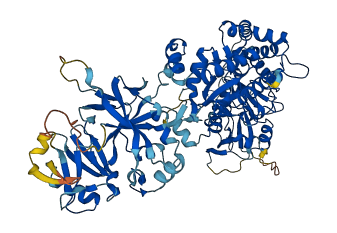
Descriptions
The autoinhibited protein was predicted that may have potential autoinhibitory elements via cis-regPred.
Autoinhibitory domains (AIDs)
Target domain |
|
Relief mechanism |
|
Assay |
cis-regPred |
Accessory elements
No accessory elements
Autoinhibited structure

Activated structure
1 structures for B3NY19
| Entry ID | Method | Resolution | Chain | Position | Source |
|---|---|---|---|---|---|
| AF-B3NY19-F1 | Predicted | AlphaFoldDB |
No variants for B3NY19
| Variant ID(s) | Position | Change | Description | Diseaes Association | Provenance |
|---|---|---|---|---|---|
| No variants for B3NY19 | |||||
No associated diseases with B3NY19
4 regional properties for B3NY19
| Type | Name | Position | InterPro Accession |
|---|---|---|---|
| domain | Aminotransferase class V domain | 29 - 188 | IPR000192-1 |
| domain | Aminotransferase class V domain | 213 - 471 | IPR000192-2 |
| domain | Molybdenum cofactor sulfurase, C-terminal | 619 - 781 | IPR005302 |
| domain | Molybdenum cofactor sulfurase, middle domain | 513 - 631 | IPR005303 |
Functions
| Description | ||
|---|---|---|
| EC Number | 2.8.1.9 | Sulfurtransferases |
| Subcellular Localization |
|
|
| PANTHER Family | ||
| PANTHER Subfamily | ||
| PANTHER Protein Class | ||
| PANTHER Pathway Category | No pathway information available | |
No GO annotations of cellular component
| Name | Definition |
|---|---|
| No GO annotations for cellular component |
5 GO annotations of molecular function
| Name | Definition |
|---|---|
| lyase activity | Catalysis of the cleavage of C-C, C-O, C-N and other bonds by other means than by hydrolysis or oxidation, or conversely adding a group to a double bond. They differ from other enzymes in that two substrates are involved in one reaction direction, but only one in the other direction. When acting on the single substrate, a molecule is eliminated and this generates either a new double bond or a new ring. |
| Mo-molybdopterin cofactor sulfurase activity | Catalysis of the sulfurylation of the desulfo form of molybdenum cofactor (MoCo), a cofactor required for the activity of some enzymes, such as aldehyde oxidase. |
| molybdenum cofactor sulfurtransferase activity | Catalysis of the reaction: 2 H+ + MoO2-molybdopterin cofactor(2-) + L-cysteine <=> thio-molybdenum cofactor + L-alanine + H2O. |
| molybdenum ion binding | Binding to a molybdenum ion (Mo). |
| pyridoxal phosphate binding | Binding to pyridoxal 5' phosphate, 3-hydroxy-5-(hydroxymethyl)-2-methyl4-pyridine carboxaldehyde 5' phosphate, the biologically active form of vitamin B6. |
4 GO annotations of biological process
| Name | Definition |
|---|---|
| Mo-molybdopterin cofactor biosynthetic process | The chemical reactions and pathways resulting in the formation of the Mo-molybdopterin cofactor, essential for the catalytic activity of some enzymes. The cofactor consists of a mononuclear molybdenum (Mo) ion coordinated by one or two molybdopterin ligands. |
| molybdopterin cofactor biosynthetic process | The chemical reactions and pathways resulting in the formation of the molybdopterin cofactor (Moco), essential for the catalytic activity of some enzymes, e.g. sulfite oxidase, xanthine dehydrogenase, and aldehyde oxidase. The cofactor consists of a mononuclear molybdenum (Mo-molybdopterin) or tungsten ion (W-molybdopterin) coordinated by one or two molybdopterin ligands. |
| molybdopterin cofactor metabolic process | The chemical reactions and pathways involving the molybdopterin cofactor (Moco), essential for the catalytic activity of some enzymes, e.g. sulfite oxidase, xanthine dehydrogenase, and aldehyde oxidase. The cofactor consists of a mononuclear molybdenum (Mo-molybdopterin) or tungsten ion (W-molybdopterin) coordinated by one or two molybdopterin ligands. |
| ommochrome biosynthetic process | The chemical reactions and pathways resulting in the formation of ommochromes, any of a large group of natural polycyclic pigments commonly found in the Arthropoda, particularly in the ommatidia of the compound eye. |
No homologous proteins in AiPD
| UniProt AC | Gene Name | Protein Name | Species | Evidence Code |
|---|---|---|---|---|
| No homologous proteins | ||||
| 10 | 20 | 30 | 40 | 50 | 60 |
| MTPYRPEFSA | AEQSRIDAEF | SRLARNKTVY | LDHAGTTLYA | ENQVTAAAEQ | LQRNVICNPH |
| 70 | 80 | 90 | 100 | 110 | 120 |
| TCRLTGDFVD | QVRFKILEFF | NTTAEDYHVI | FTANATAALS | LVAENFDFGS | SGDFHFCQEN |
| 130 | 140 | 150 | 160 | 170 | 180 |
| HTSVLGMRER | VRANGIYMLR | EKEISGGGAK | ENGTVHQVSG | KTGNSLVTFS | AQCNFSGYKI |
| 190 | 200 | 210 | 220 | 230 | 240 |
| PLDSIEKIQN | YGLSKPGKQL | WSALGDKKEH | THNDYYICLD | AASFVATSPL | DLRKYRPDYV |
| 250 | 260 | 270 | 280 | 290 | 300 |
| CLSFYKIFGY | PTGVGALLVS | RRGAEVFQKR | RFFGGGTINY | AFPHAMDYQL | RETFHQRYED |
| 310 | 320 | 330 | 340 | 350 | 360 |
| GTLPFLSIVG | LLEGFRTLER | LVPKTDEFST | MERISRHVFG | LAKYVEDQLR | QLQHPNGEPL |
| 370 | 380 | 390 | 400 | 410 | 420 |
| VELYNKVGYQ | DKARQGGIVA | FNVRTESGSF | VGFGEIACVA | ALHGILLRTG | CFCNIGACQY |
| 430 | 440 | 450 | 460 | 470 | 480 |
| YLGLDEDALD | SIYKRAGRIC | GDYFDLVDGQ | PTGAVRVSFG | YMTTIQDVEQ | LLQMLRSSYL |
| 490 | 500 | 510 | 520 | 530 | 540 |
| ATKPLQRIQF | IEEQAEQLPP | LLKERVQLLR | PKLLQMAIYP | VKSCAAFKIE | SPGSWPLTDQ |
| 550 | 560 | 570 | 580 | 590 | 600 |
| GLKYDREWMI | VDMNGMALTQ | KRCTELCLIR | PVIKVDQLEL | QFGDNSHFSV | PLSLEDQAAD |
| 610 | 620 | 630 | 640 | 650 | 660 |
| SAKCVSKVCR | QPVEGLDCGD | AVAQWLSENL | GLEGLRLLRQ | SGQRNSSKDQ | QKLSLVNQAQ |
| 670 | 680 | 690 | 700 | 710 | 720 |
| FLLLNRSSVR | SLQFEEPLDE | TVDRFRANII | IDTGSAFEEL | TYKALSIGGI | QFQVEGPCQR |
| 730 | 740 | 750 | 760 | 770 | 780 |
| CDMICINQRT | GERSPETLTT | ISRLQKGRMR | FGIYITRIPP | DTKDLEPKEQ | HMTCGDVVIV |
| E |