B3MIV9
Gene name |
calypso (GF12763) |
Protein name |
Ubiquitin carboxyl-terminal hydrolase calypso |
Names |
BAP1 homolog |
Species |
Drosophila ananassae (Fruit fly) |
KEGG Pathway |
dan:6495610 |
EC number |
3.4.19.12: Omega peptidases |
Protein Class |
|
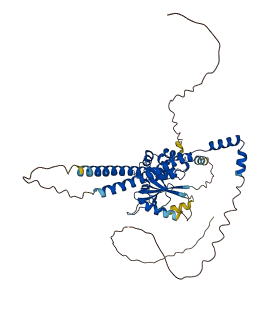
Descriptions
The autoinhibited protein was predicted that may have potential autoinhibitory elements via cis-regPred.
Autoinhibitory domains (AIDs)
Target domain |
|
Relief mechanism |
|
Assay |
cis-regPred |
Accessory elements
No accessory elements
Autoinhibited structure

Activated structure
1 structures for B3MIV9
| Entry ID | Method | Resolution | Chain | Position | Source |
|---|---|---|---|---|---|
| AF-B3MIV9-F1 | Predicted | AlphaFoldDB |
No variants for B3MIV9
| Variant ID(s) | Position | Change | Description | Diseaes Association | Provenance |
|---|---|---|---|---|---|
| No variants for B3MIV9 | |||||
No associated diseases with B3MIV9
Functions
| Description | ||
|---|---|---|
| EC Number | 3.4.19.12 | Omega peptidases |
| Subcellular Localization |
|
|
| PANTHER Family | ||
| PANTHER Subfamily | ||
| PANTHER Protein Class | ||
| PANTHER Pathway Category | No pathway information available | |
2 GO annotations of cellular component
| Name | Definition |
|---|---|
| chromatin | The ordered and organized complex of DNA, protein, and sometimes RNA, that forms the chromosome. |
| PR-DUB complex | A multimeric protein complex that removes monoubiquitin from histone H2A. In Drosophila and mammals, the core of the complex is composed of Calypso/BAP1 and Asx/ASXL1, respectively. |
2 GO annotations of molecular function
| Name | Definition |
|---|---|
| chromatin binding | Binding to chromatin, the network of fibers of DNA, protein, and sometimes RNA, that make up the chromosomes of the eukaryotic nucleus during interphase. |
| cysteine-type deubiquitinase activity | An thiol-dependent isopeptidase activity that cleaves ubiquitin from a target protein to which it is conjugated. |
3 GO annotations of biological process
| Name | Definition |
|---|---|
| heterochromatin assembly | An epigenetic gene silencing mechanism in which chromatin is compacted into heterochromatin, resulting in a chromatin conformation refractory to transcription. This process starts with heterochromatin nucleation, its spreading, and ends with heterochromatin boundary formation. |
| monoubiquitinated histone H2A deubiquitination | The removal of the ubiquitin group from a monoubiquitinated histone H2A protein. |
| ubiquitin-dependent protein catabolic process | The chemical reactions and pathways resulting in the breakdown of a protein or peptide by hydrolysis of its peptide bonds, initiated by the covalent attachment of a ubiquitin group, or multiple ubiquitin groups, to the protein. |
No homologous proteins in AiPD
| UniProt AC | Gene Name | Protein Name | Species | Evidence Code |
|---|---|---|---|---|
| No homologous proteins | ||||
| 10 | 20 | 30 | 40 | 50 | 60 |
| MNMTGGGAGP | QAGPNSSCNI | PNSSLLATAP | VAATMPIAQL | ADGWLELESD | PGLFTLLLED |
| 70 | 80 | 90 | 100 | 110 | 120 |
| FGCHDVQVEE | VYDLQKPIES | PYGFIFLFRW | IEERRARRKI | VETTAEIFVK | DEEAISSIFF |
| 130 | 140 | 150 | 160 | 170 | 180 |
| AQQVVPNSCA | THALLSVLLN | CNENNLQLGD | TLSRLKAHTK | GMSPENKGLA | IGNTPELACA |
| 190 | 200 | 210 | 220 | 230 | 240 |
| HNSHAMPQAR | RRLERTGAGV | SSCRFTGEAF | HFVSFVPING | QLFELDGLKP | YPMNHGGWED |
| 250 | 260 | 270 | 280 | 290 | 300 |
| HEDWTDKFRR | VMTERLGIAT | GEQDIRFNLM | AVVPDRRIAI | THKLKMLRTN | QAIVSGTLQK |
| 310 | 320 | 330 | 340 | 350 | 360 |
| LLKADEQGEG | GNGDPQRPDT | PSTLLEPSAF | TARDLQSLLK | NLDTEIAINE | QHLADENDRR |
| 370 | 380 | 390 | 400 | 410 | 420 |
| HKFKVDASRR | THNYDKFICT | FLSMLAHQGV | LGELVSQHLL | PSKKISGQSA | ANRLNKQSNA |
| 430 | 440 | 450 | 460 | ||
| TANAGATAAG | AAGAAPKSQQ | QQAAAAKNGK | SPSKTPGRRR | KGRNKCKKRK |