B2ZZS9
Gene name |
wdr55 |
Protein name |
WD repeat-containing protein 55 |
Names |
Protein hokecha |
Species |
Oryzias latipes (Japanese rice fish) (Japanese killifish) |
KEGG Pathway |
ola:100192344 |
EC number |
|
Protein Class |
|
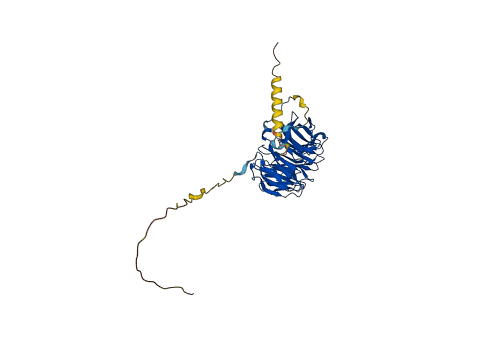
Descriptions
The autoinhibited protein was predicted that may have potential autoinhibitory elements via cis-regPred.
Autoinhibitory domains (AIDs)
Target domain |
|
Relief mechanism |
|
Assay |
cis-regPred |
Accessory elements
No accessory elements
Autoinhibited structure

Activated structure
1 structures for B2ZZS9
| Entry ID | Method | Resolution | Chain | Position | Source |
|---|---|---|---|---|---|
| AF-B2ZZS9-F1 | Predicted | AlphaFoldDB |
No variants for B2ZZS9
| Variant ID(s) | Position | Change | Description | Diseaes Association | Provenance |
|---|---|---|---|---|---|
| No variants for B2ZZS9 | |||||
No associated diseases with B2ZZS9
5 regional properties for B2ZZS9
| Type | Name | Position | InterPro Accession |
|---|---|---|---|
| repeat | WD40 repeat | 47 - 82 | IPR001680-1 |
| repeat | WD40 repeat | 89 - 128 | IPR001680-2 |
| repeat | WD40 repeat | 131 - 212 | IPR001680-3 |
| repeat | WD40 repeat | 217 - 254 | IPR001680-4 |
| repeat | WD40 repeat | 299 - 339 | IPR001680-5 |
1 GO annotations of cellular component
| Name | Definition |
|---|---|
| nucleolus | A small, dense body one or more of which are present in the nucleus of eukaryotic cells. It is rich in RNA and protein, is not bounded by a limiting membrane, and is not seen during mitosis. Its prime function is the transcription of the nucleolar DNA into 45S ribosomal-precursor RNA, the processing of this RNA into 5.8S, 18S, and 28S components of ribosomal RNA, and the association of these components with 5S RNA and proteins synthesized outside the nucleolus. This association results in the formation of ribonucleoprotein precursors; these pass into the cytoplasm and mature into the 40S and 60S subunits of the ribosome. |
No GO annotations of molecular function
| Name | Definition |
|---|---|
| No GO annotations for molecular function |
7 GO annotations of biological process
| Name | Definition |
|---|---|
| eye development | The process whose specific outcome is the progression of the eye over time, from its formation to the mature structure. The eye is the organ of sight. |
| head development | The biological process whose specific outcome is the progression of a head from an initial condition to its mature state. The head is the anterior-most division of the body. |
| liver development | The process whose specific outcome is the progression of the liver over time, from its formation to the mature structure. The liver is an exocrine gland which secretes bile and functions in metabolism of protein and carbohydrate and fat, synthesizes substances involved in the clotting of the blood, synthesizes vitamin A, detoxifies poisonous substances, stores glycogen, and breaks down worn-out erythrocytes. |
| pharynx development | The biological process whose specific outcome is the progression of a pharynx from an initial condition to its mature state. The pharynx is the part of the digestive system immediately posterior to the mouth. |
| rRNA processing | Any process involved in the conversion of a primary ribosomal RNA (rRNA) transcript into one or more mature rRNA molecules. |
| spleen development | The process whose specific outcome is the progression of the spleen over time, from its formation to the mature structure. The spleen is a large vascular lymphatic organ composed of white and red pulp, involved both in hemopoietic and immune system functions. |
| thymus development | The process whose specific outcome is the progression of the thymus over time, from its formation to the mature structure. The thymus is a symmetric bi-lobed organ involved primarily in the differentiation of immature to mature T cells, with unique vascular, nervous, epithelial, and lymphoid cell components. |
No homologous proteins in AiPD
| UniProt AC | Gene Name | Protein Name | Species | Evidence Code |
|---|---|---|---|---|
| No homologous proteins | ||||
| 10 | 20 | 30 | 40 | 50 | 60 |
| MAAPPEHAAT | GSEQTDPPET | NSEPDLSQPE | PADSDADEPV | GPKIRETPED | IRLEAIANTV |
| 70 | 80 | 90 | 100 | 110 | 120 |
| ALHPSRDVLV | CGDVDGDVYA | YAYSCTEGET | RELWSSGHHL | KSCRQVRFSA | DGLKLYSVSR |
| 130 | 140 | 150 | 160 | 170 | 180 |
| DKAVHQLDVE | RGQLVSRIRG | AHAAAINSLL | LVDENILATG | DDRGTLKVWD | MRKGEAFMDL |
| 190 | 200 | 210 | 220 | 230 | 240 |
| KHHDDYISDI | AVDQAKRILL | TTSGDGTMGV | FNIKRRRFEL | LSEFQSGDLT | SVALMKRGKK |
| 250 | 260 | 270 | 280 | 290 | 300 |
| VVCGSSEGTV | YIFNWNGFGA | TSDRFAVKAE | SVDCIVPITD | SIMCTASMDG | YIRAINLLPN |
| 310 | 320 | 330 | 340 | 350 | 360 |
| RVIGCIGQHV | GEPIEEINKS | WDSRFLVSCA | HDQLIKFWEI | SNLQKTTVSD | YRKRKKKDGR |
| 370 | 380 | 390 | |||
| MKSLTKKALG | DNDFFSGLVE | ETEKKEEEEE | EEEDSDSDSD |