Descriptions
The autoinhibited protein was predicted that may have potential autoinhibitory elements via cis-regPred.
Autoinhibitory domains (AIDs)
Target domain |
|
Relief mechanism |
|
Assay |
cis-regPred |
Accessory elements
No accessory elements
Autoinhibited structure

Activated structure
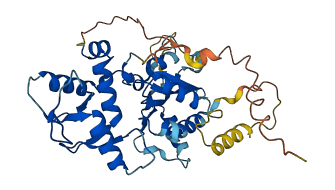
1 structures for B2WM34
| Entry ID | Method | Resolution | Chain | Position | Source |
|---|---|---|---|---|---|
| AF-B2WM34-F1 | Predicted | AlphaFoldDB |
No variants for B2WM34
| Variant ID(s) | Position | Change | Description | Diseaes Association | Provenance |
|---|---|---|---|---|---|
| No variants for B2WM34 | |||||
No associated diseases with B2WM34
1 regional properties for B2WM34
| Type | Name | Position | InterPro Accession |
|---|---|---|---|
| domain | GIY-YIG endonuclease | 14 - 95 | IPR000305 |
1 GO annotations of cellular component
| Name | Definition |
|---|---|
| Slx1-Slx4 complex | A heterodimeric protein complex that possesses an endonuclease activity that specifically cleaves certain types of branched DNA structures; because such structures often form during the replication ribosomal DNA (rDNA) repeats, the complex plays a role in the maintenance of rDNA. The subunits are known as Slx1 and Slx 4 in budding and fission yeasts, and are conserved in eukaryotes. |
2 GO annotations of molecular function
| Name | Definition |
|---|---|
| 5'-flap endonuclease activity | Catalysis of the cleavage of a 5' flap structure in DNA, but not other DNA structures; processes the 5' ends of Okazaki fragments in lagging strand DNA synthesis. |
| metal ion binding | Binding to a metal ion. |
2 GO annotations of biological process
| Name | Definition |
|---|---|
| DNA recombination | Any process in which a new genotype is formed by reassortment of genes resulting in gene combinations different from those that were present in the parents. In eukaryotes genetic recombination can occur by chromosome assortment, intrachromosomal recombination, or nonreciprocal interchromosomal recombination. Interchromosomal recombination occurs by crossing over. In bacteria it may occur by genetic transformation, conjugation, transduction, or F-duction. |
| DNA repair | The process of restoring DNA after damage. Genomes are subject to damage by chemical and physical agents in the environment (e.g. UV and ionizing radiations, chemical mutagens, fungal and bacterial toxins, etc.) and by free radicals or alkylating agents endogenously generated in metabolism. DNA is also damaged because of errors during its replication. A variety of different DNA repair pathways have been reported that include direct reversal, base excision repair, nucleotide excision repair, photoreactivation, bypass, double-strand break repair pathway, and mismatch repair pathway. |
No homologous proteins in AiPD
| UniProt AC | Gene Name | Protein Name | Species | Evidence Code |
|---|---|---|---|---|
| No homologous proteins | ||||
| 10 | 20 | 30 | 40 | 50 | 60 |
| MTDGLKIDSR | PLPAFYCCYL | LRSKNRKAFY | IGSTPNPARR | LGQHNGSSKG | GAKRTSMQGK |
| 70 | 80 | 90 | 100 | 110 | 120 |
| RPWEMTCIVT | GFPSRFAALQ | FEWAWQNTHA | TRHIERDVRE | ARKDELEKGR | KNASPVKRSR |
| 130 | 140 | 150 | 160 | 170 | 180 |
| PPMSLEARLK | NLHHLLGVGS | FSRWPLHVRF | FAPDVFSQWE | KHISKMNTSL | RKSITIRLTP |
| 190 | 200 | 210 | 220 | 230 | 240 |
| AELPKLAPDV | SSEMRTHFIP | EVIRAIPVAY | EDIKPYVEKS | MSTLRDGKTR | DCGVCKKDVN |
| 250 | 260 | 270 | 280 | 290 | 300 |
| VDRSLVLICP | NETCCSVSHM | SCLSQRFLAE | EANKEAFIPI | EGTCPSCHSP | IKWSDMIKEL |
| 310 | 320 | 330 | 340 | 350 | 360 |
| SLRMRGEDEL | KTLFKTKRKK | KQVDTTEDDT | DEYPDIDDLN | ADLDEDLDET | WMENVNEEDD |
| KPRS |