B2W340
Gene name |
kex1 (PTRG_03838) |
Protein name |
Pheromone-processing carboxypeptidase kex1 |
Names |
Carboxypeptidase D |
Species |
Pyrenophora tritici-repentis (strain Pt-1C-BFP) (Wheat tan spot fungus) (Drechslera tritici-repentis) |
KEGG Pathway |
|
EC number |
3.4.16.6: Serine-type carboxypeptidases |
Protein Class |
|
Descriptions
The autoinhibited protein was predicted that may have potential autoinhibitory elements via cis-regPred.
Autoinhibitory domains (AIDs)
Target domain |
|
Relief mechanism |
|
Assay |
cis-regPred |
Accessory elements
No accessory elements
Autoinhibited structure

Activated structure
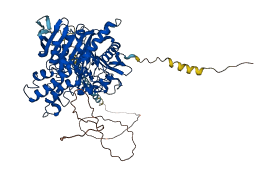
1 structures for B2W340
| Entry ID | Method | Resolution | Chain | Position | Source |
|---|---|---|---|---|---|
| AF-B2W340-F1 | Predicted | AlphaFoldDB |
No variants for B2W340
| Variant ID(s) | Position | Change | Description | Diseaes Association | Provenance |
|---|---|---|---|---|---|
| No variants for B2W340 | |||||
No associated diseases with B2W340
Functions
| Description | ||
|---|---|---|
| EC Number | 3.4.16.6 | Serine-type carboxypeptidases |
| Subcellular Localization |
|
|
| PANTHER Family | ||
| PANTHER Subfamily | ||
| PANTHER Protein Class | ||
| PANTHER Pathway Category | No pathway information available | |
2 GO annotations of cellular component
| Name | Definition |
|---|---|
| Golgi apparatus | A membrane-bound cytoplasmic organelle of the endomembrane system that further processes the core oligosaccharides (e.g. N-glycans) added to proteins in the endoplasmic reticulum and packages them into membrane-bound vesicles. The Golgi apparatus operates at the intersection of the secretory, lysosomal, and endocytic pathways. |
| integral component of membrane | The component of a membrane consisting of the gene products and protein complexes having at least some part of their peptide sequence embedded in the hydrophobic region of the membrane. |
1 GO annotations of molecular function
| Name | Definition |
|---|---|
| serine-type carboxypeptidase activity | Catalysis of the hydrolysis of a single C-terminal amino acid residue from the C-terminus of a polypeptide chain by a catalytic mechanism that involves a catalytic triad consisting of a serine nucleophile that is activated by a proton relay involving an acidic residue (e.g. aspartate or glutamate) and a basic residue (usually histidine). |
2 GO annotations of biological process
| Name | Definition |
|---|---|
| apoptotic process | A programmed cell death process which begins when a cell receives an internal (e.g. DNA damage) or external signal (e.g. an extracellular death ligand), and proceeds through a series of biochemical events (signaling pathway phase) which trigger an execution phase. The execution phase is the last step of an apoptotic process, and is typically characterized by rounding-up of the cell, retraction of pseudopodes, reduction of cellular volume (pyknosis), chromatin condensation, nuclear fragmentation (karyorrhexis), plasma membrane blebbing and fragmentation of the cell into apoptotic bodies. When the execution phase is completed, the cell has died. |
| proteolysis | The hydrolysis of proteins into smaller polypeptides and/or amino acids by cleavage of their peptide bonds. |
No homologous proteins in AiPD
| UniProt AC | Gene Name | Protein Name | Species | Evidence Code |
|---|---|---|---|---|
| No homologous proteins | ||||
| 10 | 20 | 30 | 40 | 50 | 60 |
| MAFSHAPSGW | RTALLAGLIA | TVAWLPAIVA | QEKTQADYFI | HDLPGAPKPL | LKMHAGHIEV |
| 70 | 80 | 90 | 100 | 110 | 120 |
| DAEHNGNLFF | WHYQNRHIAD | RQRTVLWLNG | GPGCSSMDGA | MMEIGPYRVR | EGGKLEYNNG |
| 130 | 140 | 150 | 160 | 170 | 180 |
| SWDEFANLLF | VDQPVGTGFS | YVNTDSYLTE | LDQMAAHMVI | FLEKWFALFP | EYENDDLYIA |
| 190 | 200 | 210 | 220 | 230 | 240 |
| GESYAGQHIP | YIARAILDRN | KKNQAKSPWP | LKGLLIGNGW | MSPVDQYLSY | IPFAYQNGLM |
| 250 | 260 | 270 | 280 | 290 | 300 |
| RSGTDMAKRV | EEQQRICVQK | LEAGGMDAVD | TRDCEQIMVR | ILQETKNENA | DPMNQCLNMY |
| 310 | 320 | 330 | 340 | 350 | 360 |
| DIRLRDDSSC | GMNWPPDLAQ | VTPYLRRADV | VQALHINTDK | KTGWQECNGA | VSSHFRAKNS |
| 370 | 380 | 390 | 400 | 410 | 420 |
| KPSVKFLPEV | IEQVPVLLFS | GDKDFICNHV | GTEAMIQNLQ | WNGGKGFEAS | PGVQNAKQDW |
| 430 | 440 | 450 | 460 | 470 | 480 |
| MFEGEAAGTW | QEARNLTYVV | FYNSSHMVPF | DYPRRTRDML | DRFMGVNIEA | IGGAPADSLI |
| 490 | 500 | 510 | 520 | 530 | 540 |
| DGEKGPLTSV | GDHPNSTKAE | EDKSKELKAA | EWKAYTRSGE | VALVIAVIVA | CICGFLLCRS |
| 550 | 560 | 570 | 580 | 590 | 600 |
| RRAKSAYKGD | DSDEGRESLL | TGMGLDNFRR | KERRQDVEAA | DFDERELDEV | PKKSGKGYGQ |
| 610 | 620 | 630 | |||
| ISSEKGRVPH | NDSSFSLGVD | SDDDEAGSSD | RGRRKEESR |