B2KBU4
Gene name |
gpmA |
Protein name |
2,3-bisphosphoglycerate-dependent phosphoglycerate mutase |
Names |
BPG-dependent PGAM, PGAM, Phosphoglyceromutase, dPGM |
Species |
Elusimicrobium minutum (strain Pei191) |
KEGG Pathway |
emi:Emin_0287 |
EC number |
5.4.2.11: Phosphotransferases (phosphomutases) |
Protein Class |
|
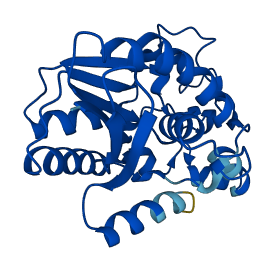
Descriptions
The autoinhibited protein was predicted that may have potential autoinhibitory elements via cis-regPred.
Autoinhibitory domains (AIDs)
Target domain |
|
Relief mechanism |
|
Assay |
cis-regPred |
Accessory elements
No accessory elements
Autoinhibited structure

Activated structure
1 structures for B2KBU4
| Entry ID | Method | Resolution | Chain | Position | Source |
|---|---|---|---|---|---|
| AF-B2KBU4-F1 | Predicted | AlphaFoldDB |
No variants for B2KBU4
| Variant ID(s) | Position | Change | Description | Diseaes Association | Provenance |
|---|---|---|---|---|---|
| No variants for B2KBU4 | |||||
No associated diseases with B2KBU4
1 regional properties for B2KBU4
| Type | Name | Position | InterPro Accession |
|---|---|---|---|
| active_site | Phosphoglycerate/bisphosphoglycerate mutase, active site | 6 - 15 | IPR001345 |
Functions
| Description | ||
|---|---|---|
| EC Number | 5.4.2.11 | Phosphotransferases (phosphomutases) |
| Subcellular Localization |
|
|
| PANTHER Family | ||
| PANTHER Subfamily | ||
| PANTHER Protein Class | ||
| PANTHER Pathway Category | No pathway information available | |
No GO annotations of cellular component
| Name | Definition |
|---|---|
| No GO annotations for cellular component |
1 GO annotations of molecular function
| Name | Definition |
|---|---|
| 2,3-bisphosphoglycerate-dependent phosphoglycerate mutase activity | Catalysis of the reaction: 2-phospho-D-glycerate = 3-phospho-D-glycerate; this reaction requires the cofactor 2,3-bisphosphoglycerate. |
2 GO annotations of biological process
| Name | Definition |
|---|---|
| gluconeogenesis | The formation of glucose from noncarbohydrate precursors, such as pyruvate, amino acids and glycerol. |
| glycolytic process | The chemical reactions and pathways resulting in the breakdown of a carbohydrate into pyruvate, with the concomitant production of a small amount of ATP and the reduction of NAD(P) to NAD(P)H. Glycolysis begins with the metabolism of a carbohydrate to generate products that can enter the pathway and ends with the production of pyruvate. Pyruvate may be converted to acetyl-coenzyme A, ethanol, lactate, or other small molecules. |
No homologous proteins in AiPD
| UniProt AC | Gene Name | Protein Name | Species | Evidence Code |
|---|---|---|---|---|
| No homologous proteins | ||||
| 10 | 20 | 30 | 40 | 50 | 60 |
| MKKIVLLRHG | ESTWNKENRF | TGWTDVDLTE | KGVAEAAKAG | EILKKEGFIF | DKAYTSYLKR |
| 70 | 80 | 90 | 100 | 110 | 120 |
| AVKTLNCVLD | KMDLDWINVE | KTWRLNEKHY | GTLQGLNKAE | TAEKYGAEQV | QLWRRSFDIA |
| 130 | 140 | 150 | 160 | 170 | 180 |
| PDPIPEDDPR | NPRKDIRYKN | VTNADLPATE | SLKDTIARTM | PYWTDVIMKQ | LKTSNQLIVV |
| 190 | 200 | 210 | 220 | 230 | 240 |
| AHGNSLRGVI | KHLKNISDED | IVNLNLPTAV | PYVFEFDDNL | NMTRDYFLGD | PEEVKKLMEA |
| VANQAKKK |