B2FQV2
Gene name |
flgH |
Protein name |
Flagellar L-ring protein |
Names |
Basal body L-ring protein |
Species |
Stenotrophomonas maltophilia (strain K279a) |
KEGG Pathway |
sml:Smlt2311 |
EC number |
|
Protein Class |
|
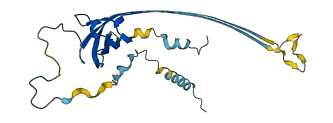
Descriptions
The autoinhibited protein was predicted that may have potential autoinhibitory elements via cis-regPred.
Autoinhibitory domains (AIDs)
Target domain |
|
Relief mechanism |
|
Assay |
cis-regPred |
Accessory elements
No accessory elements
Autoinhibited structure

Activated structure
1 structures for B2FQV2
| Entry ID | Method | Resolution | Chain | Position | Source |
|---|---|---|---|---|---|
| AF-B2FQV2-F1 | Predicted | AlphaFoldDB |
No variants for B2FQV2
| Variant ID(s) | Position | Change | Description | Diseaes Association | Provenance |
|---|---|---|---|---|---|
| No variants for B2FQV2 | |||||
No associated diseases with B2FQV2
No regional properties for B2FQV2
| Type | Name | Position | InterPro Accession |
|---|---|---|---|
| No domain, repeats, and functional sites for B2FQV2 | |||
2 GO annotations of cellular component
| Name | Definition |
|---|---|
| bacterial-type flagellum basal body, distal rod, L ring | One of the rings of the bacterial-type flagellar basal body; anchors the basal body to the outer membrane. |
| cell outer membrane | A lipid bilayer that forms the outermost membrane of the cell envelope; enriched in polysaccharide and protein; the outer leaflet of the membrane contains specific lipopolysaccharide structures. |
1 GO annotations of molecular function
| Name | Definition |
|---|---|
| cytoskeletal motor activity | Generation of force resulting in movement, for example along a microfilament or microtubule, or in torque resulting in membrane scission or rotation of a flagellum. The energy required is obtained either from the hydrolysis of a nucleoside triphosphate or by an electrochemical proton gradient (proton-motive force). |
1 GO annotations of biological process
| Name | Definition |
|---|---|
| bacterial-type flagellum-dependent cell motility | Cell motility due to the motion of one or more bacterial-type flagella. A bacterial-type flagellum is a motor complex composed of an extracellular helical protein filament coupled to a rotary motor embedded in the cell envelope. |
No homologous proteins in AiPD
| UniProt AC | Gene Name | Protein Name | Species | Evidence Code |
|---|---|---|---|---|
| No homologous proteins | ||||
| 10 | 20 | 30 | 40 | 50 | 60 |
| MSPISNFARI | ALACTVAALL | GGCVIAGDVR | PYPAMAPIQP | IMPPQAEPTA | GAIYAAGPTL |
| 70 | 80 | 90 | 100 | 110 | 120 |
| QLYSDRRARD | VGDLLTITLL | ENTTAQTSAN | TATNKESNLS | LGTPSILGAP | VTLGGKDILS |
| 130 | 140 | 150 | 160 | 170 | 180 |
| ATAKGARDFT | GKGNSAQSNR | LQGSVTVTVI | QRLPNGNLVV | QGQKNLRLNQ | GDELVQVQGI |
| 190 | 200 | 210 | 220 | ||
| VRPGDISQDN | TIPSSRVAEA | RIVYGGRGPV | AQSNAMGWLS | RFFNSGLTPF |