B1WAX6
Gene name |
tigar |
Protein name |
Fructose-2,6-bisphosphatase TIGAR |
Names |
TP53-induced glycolysis and apoptosis regulator |
Species |
Xenopus tropicalis (Western clawed frog) (Silurana tropicalis) |
KEGG Pathway |
xtr:100145723 |
EC number |
3.1.3.46: Phosphoric monoester hydrolases |
Protein Class |
|
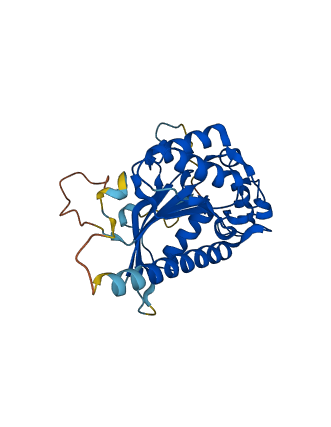
Descriptions
The autoinhibited protein was predicted that may have potential autoinhibitory elements via cis-regPred.
Autoinhibitory domains (AIDs)
Target domain |
|
Relief mechanism |
|
Assay |
cis-regPred |
Accessory elements
No accessory elements
Autoinhibited structure

Activated structure
1 structures for B1WAX6
| Entry ID | Method | Resolution | Chain | Position | Source |
|---|---|---|---|---|---|
| AF-B1WAX6-F1 | Predicted | AlphaFoldDB |
No variants for B1WAX6
| Variant ID(s) | Position | Change | Description | Diseaes Association | Provenance |
|---|---|---|---|---|---|
| No variants for B1WAX6 | |||||
No associated diseases with B1WAX6
Functions
| Description | ||
|---|---|---|
| EC Number | 3.1.3.46 | Phosphoric monoester hydrolases |
| Subcellular Localization |
|
|
| PANTHER Family | ||
| PANTHER Subfamily | ||
| PANTHER Protein Class | ||
| PANTHER Pathway Category | No pathway information available | |
5 GO annotations of cellular component
| Name | Definition |
|---|---|
| cytoplasm | The contents of a cell excluding the plasma membrane and nucleus, but including other subcellular structures. |
| cytosol | The part of the cytoplasm that does not contain organelles but which does contain other particulate matter, such as protein complexes. |
| mitochondrial outer membrane | The outer, i.e. cytoplasm-facing, lipid bilayer of the mitochondrial envelope. |
| mitochondrion | A semiautonomous, self replicating organelle that occurs in varying numbers, shapes, and sizes in the cytoplasm of virtually all eukaryotic cells. It is notably the site of tissue respiration. |
| nucleus | A membrane-bounded organelle of eukaryotic cells in which chromosomes are housed and replicated. In most cells, the nucleus contains all of the cell's chromosomes except the organellar chromosomes, and is the site of RNA synthesis and processing. In some species, or in specialized cell types, RNA metabolism or DNA replication may be absent. |
2 GO annotations of molecular function
| Name | Definition |
|---|---|
| bisphosphoglycerate 2-phosphatase activity | Catalysis of the reaction: 2,3-bisphospho-D-glycerate + H(2)O = 3-phospho-D-glycerate + phosphate. |
| fructose-2,6-bisphosphate 2-phosphatase activity | Catalysis of the reaction: D-fructose 2,6-bisphosphate + H2O = D-fructose-6-phosphate + phosphate. |
8 GO annotations of biological process
| Name | Definition |
|---|---|
| apoptotic process | A programmed cell death process which begins when a cell receives an internal (e.g. DNA damage) or external signal (e.g. an extracellular death ligand), and proceeds through a series of biochemical events (signaling pathway phase) which trigger an execution phase. The execution phase is the last step of an apoptotic process, and is typically characterized by rounding-up of the cell, retraction of pseudopodes, reduction of cellular volume (pyknosis), chromatin condensation, nuclear fragmentation (karyorrhexis), plasma membrane blebbing and fragmentation of the cell into apoptotic bodies. When the execution phase is completed, the cell has died. |
| autophagy | The cellular catabolic process in which cells digest parts of their own cytoplasm; allows for both recycling of macromolecular constituents under conditions of cellular stress and remodeling the intracellular structure for cell differentiation. |
| fructose 1,6-bisphosphate metabolic process | The chemical reactions and pathways involving fructose 1,6-bisphosphate, also known as FBP. The D enantiomer is a metabolic intermediate in glycolysis and gluconeogenesis. |
| fructose 2,6-bisphosphate metabolic process | The chemical reactions and pathways involving fructose 2,6-bisphosphate. The D enantiomer is an important regulator of the glycolytic and gluconeogenic pathways. It inhibits fructose 1,6-bisphosphatase and activates phosphofructokinase. |
| negative regulation of glycolytic process | Any process that stops, prevents, or reduces the frequency, rate or extent of glycolysis. |
| negative regulation of programmed cell death | Any process that stops, prevents, or reduces the frequency, rate or extent of programmed cell death, cell death resulting from activation of endogenous cellular processes. |
| positive regulation of DNA repair | Any process that activates or increases the frequency, rate or extent of DNA repair. |
| regulation of pentose-phosphate shunt | Any process that modulates the frequency, rate or extent of the pentose-phosphate shunt, the process in which glucose is oxidized, coupled to NADPH synthesis. |
1 homologous proteins in AiPD
| UniProt AC | Gene Name | Protein Name | Species | Evidence Code |
|---|---|---|---|---|
| Q3T014 | BPGM | Bisphosphoglycerate mutase | Bos taurus (Bovine) | PR |
| 10 | 20 | 30 | 40 | 50 | 60 |
| MARFALTIVR | HGETRYNKEK | LLQGQGIDEP | LSEIGFKQAD | AVGRFLSNVR | FTHVFSSDLI |
| 70 | 80 | 90 | 100 | 110 | 120 |
| RAKQTACAIM | ENNKISEDIK | IIYDRRLRER | KYGDAEGRPL | SELKVMAKKA | GDQCPSYTPP |
| 130 | 140 | 150 | 160 | 170 | 180 |
| GGETLEQVRA | RAKDFFEYLC | RLVLEESSAK | EQSELGASGM | GGVTSADLGP | FVNHNKEPAE |
| 190 | 200 | 210 | 220 | 230 | 240 |
| LGESRDVTVH | ASVLLVSHGA | YMRNWIKYLV | EDLQFTFPPE | LKKSRELPVS | PNTGISHFIV |
| 250 | 260 | 270 | |||
| TVSSATPRKP | EIQCVCINLH | SHLSDINADT | SHYQV |