B1H069
Gene name |
pgi |
Protein name |
Glucose-6-phosphate isomerase |
Names |
GPI, Phosphoglucose isomerase, PGI, Phosphohexose isomerase, PHI |
Species |
Endomicrobium trichonymphae |
KEGG Pathway |
rsd:TGRD_418 |
EC number |
5.3.1.9: Interconverting aldoses and ketoses |
Protein Class |
|
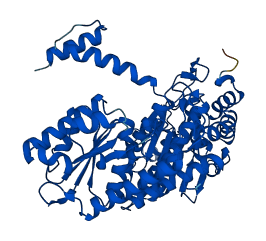
Descriptions
The autoinhibited protein was predicted that may have potential autoinhibitory elements via cis-regPred.
Autoinhibitory domains (AIDs)
Target domain |
|
Relief mechanism |
|
Assay |
cis-regPred |
Accessory elements
No accessory elements
Autoinhibited structure

Activated structure
1 structures for B1H069
| Entry ID | Method | Resolution | Chain | Position | Source |
|---|---|---|---|---|---|
| AF-B1H069-F1 | Predicted | AlphaFoldDB |
No variants for B1H069
| Variant ID(s) | Position | Change | Description | Diseaes Association | Provenance |
|---|---|---|---|---|---|
| No variants for B1H069 | |||||
No associated diseases with B1H069
4 regional properties for B1H069
| Type | Name | Position | InterPro Accession |
|---|---|---|---|
| conserved_site | Phosphoglucose isomerase, conserved site | 264 - 277 | IPR018189-1 |
| conserved_site | Phosphoglucose isomerase, conserved site | 496 - 513 | IPR018189-2 |
| domain | Phosphoglucose isomerase, SIS domain 1 | 121 - 283 | IPR035476 |
| domain | Phosphoglucose isomerase, SIS domain 2 | 330 - 519 | IPR035482 |
Functions
| Description | ||
|---|---|---|
| EC Number | 5.3.1.9 | Interconverting aldoses and ketoses |
| Subcellular Localization |
|
|
| PANTHER Family | ||
| PANTHER Subfamily | ||
| PANTHER Protein Class | ||
| PANTHER Pathway Category | No pathway information available | |
1 GO annotations of cellular component
| Name | Definition |
|---|---|
| cytoplasm | The contents of a cell excluding the plasma membrane and nucleus, but including other subcellular structures. |
2 GO annotations of molecular function
| Name | Definition |
|---|---|
| carbohydrate derivative binding | Binding to a carbohydrate derivative. |
| glucose-6-phosphate isomerase activity | Catalysis of the reaction: D-glucose 6-phosphate = D-fructose 6-phosphate. |
2 GO annotations of biological process
| Name | Definition |
|---|---|
| gluconeogenesis | The formation of glucose from noncarbohydrate precursors, such as pyruvate, amino acids and glycerol. |
| glycolytic process | The chemical reactions and pathways resulting in the breakdown of a carbohydrate into pyruvate, with the concomitant production of a small amount of ATP and the reduction of NAD(P) to NAD(P)H. Glycolysis begins with the metabolism of a carbohydrate to generate products that can enter the pathway and ends with the production of pyruvate. Pyruvate may be converted to acetyl-coenzyme A, ethanol, lactate, or other small molecules. |
No homologous proteins in AiPD
| UniProt AC | Gene Name | Protein Name | Species | Evidence Code |
|---|---|---|---|---|
| No homologous proteins | ||||
| 10 | 20 | 30 | 40 | 50 | 60 |
| MSKFGLKNTP | QWQGLEKNYR | EIKKIHLREL | FKDENRFNKF | SIRDNDLGIT | FDYSKNIINS |
| 70 | 80 | 90 | 100 | 110 | 120 |
| DTFKLLIEFV | KAAKVTEYAK | KMFSGEKINW | TEKRAVLHTA | LRNRSNMPIY | VNGKDVMPEI |
| 130 | 140 | 150 | 160 | 170 | 180 |
| KAVLKKMENF | SNDLRSGKWV | GATGKKVTDV | VNIGIGGSDL | GPKMVCESLK | YYADGPNVYF |
| 190 | 200 | 210 | 220 | 230 | 240 |
| VSNIDGADIY | EVLKKLNPGT | TLFIVASKTF | TTLETITNAL | TARKWLTDKL | GDKAVANHFV |
| 250 | 260 | 270 | 280 | 290 | 300 |
| ALSTNVKKVK | EFGIDENNMF | EFWSFVGGRY | SLWSAIGLPI | ACYVGFDKFI | ELLDGAYYID |
| 310 | 320 | 330 | 340 | 350 | 360 |
| QHFLNAPYEK | NIPVIMAALG | VWYNNFWGAS | SHAVLPYSQY | LNKFPAYLQQ | GDMESNGKTI |
| 370 | 380 | 390 | 400 | 410 | 420 |
| NFEGRRVDYG | TGPIIWGESG | TNGQHSFYQL | IHQGTKFIPC | DFIGFVNPPE | KIGDHHEKLM |
| 430 | 440 | 450 | 460 | 470 | 480 |
| ANYFAQTEAL | AFGLTKEEVA | KNLKKAGISP | ADIKILTPHK | IFEGNKPTNS | ILFDELTPRT |
| 490 | 500 | 510 | 520 | 530 | 540 |
| LGALIALYEH | KIFTQGIMWR | INSFDQWGVE | LGKVLANVIL | PELKGQTDNK | HDNSTKNLIK |
| IFNSNKK |