B1A193
Gene name |
rassf10 |
Protein name |
Ras association domain-containing protein 10 |
Names |
|
Species |
Xenopus laevis (African clawed frog) |
KEGG Pathway |
xla:100141316 |
EC number |
|
Protein Class |
|
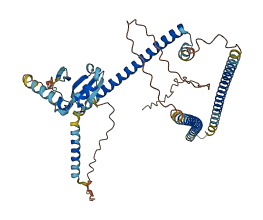
Descriptions
The autoinhibited protein was predicted that may have potential autoinhibitory elements via cis-regPred.
Autoinhibitory domains (AIDs)
Target domain |
|
Relief mechanism |
|
Assay |
cis-regPred |
Accessory elements
No accessory elements
Autoinhibited structure

Activated structure
1 structures for B1A193
| Entry ID | Method | Resolution | Chain | Position | Source |
|---|---|---|---|---|---|
| AF-B1A193-F1 | Predicted | AlphaFoldDB |
No variants for B1A193
| Variant ID(s) | Position | Change | Description | Diseaes Association | Provenance |
|---|---|---|---|---|---|
| No variants for B1A193 | |||||
No associated diseases with B1A193
3 GO annotations of cellular component
| Name | Definition |
|---|---|
| cytosol | The part of the cytoplasm that does not contain organelles but which does contain other particulate matter, such as protein complexes. |
| microtubule organizing center | An intracellular structure that can catalyze gamma-tubulin-dependent microtubule nucleation and that can anchor microtubules by interacting with their minus ends, plus ends or sides. |
| spindle pole | Either of the ends of a spindle, where spindle microtubules are organized; usually contains a microtubule organizing center and accessory molecules, spindle microtubules and astral microtubules. |
No GO annotations of molecular function
| Name | Definition |
|---|---|
| No GO annotations for molecular function |
4 GO annotations of biological process
| Name | Definition |
|---|---|
| nervous system development | The process whose specific outcome is the progression of nervous tissue over time, from its formation to its mature state. |
| positive regulation of neural precursor cell proliferation | Any process that activates or increases the frequency, rate or extent of neural precursor cell proliferation. |
| positive regulation of neurogenesis | Any process that activates or increases the frequency, rate or extent of neurogenesis, the generation of cells within the nervous system. |
| signal transduction | The cellular process in which a signal is conveyed to trigger a change in the activity or state of a cell. Signal transduction begins with reception of a signal (e.g. a ligand binding to a receptor or receptor activation by a stimulus such as light), or for signal transduction in the absence of ligand, signal-withdrawal or the activity of a constitutively active receptor. Signal transduction ends with regulation of a downstream cellular process, e.g. regulation of transcription or regulation of a metabolic process. Signal transduction covers signaling from receptors located on the surface of the cell and signaling via molecules located within the cell. For signaling between cells, signal transduction is restricted to events at and within the receiving cell. |
No homologous proteins in AiPD
| UniProt AC | Gene Name | Protein Name | Species | Evidence Code |
|---|---|---|---|---|
| No homologous proteins | ||||
| 10 | 20 | 30 | 40 | 50 | 60 |
| MENEEWKVSV | WICQEEKLVS | GLTRRTTCAD | VVRVLLADHN | EKQAEEGSML | MGEEGSMLLG |
| 70 | 80 | 90 | 100 | 110 | 120 |
| PPQCYCIVEK | WRGFERILPN | KTKILRLWTA | WGEEQDNVKF | VLVRSEASLP | NIGPRSAEAK |
| 130 | 140 | 150 | 160 | 170 | 180 |
| VVLSKESPCH | QRTLSKTSTG | PTQDKQRRVV | RKAFRKLAKI | NRKRHETLPK | ESSSVEKMET |
| 190 | 200 | 210 | 220 | 230 | 240 |
| LVHLVLSQDH | TIRQQVQRIM | ELDREIERFE | ARTHFDRMKM | HGVNYVQETY | LVGTVSEKGS |
| 250 | 260 | 270 | 280 | 290 | 300 |
| ASDSNPPSDQ | SSQEELFADY | AQKCDEVLLL | QEQISRQEEA | MEQMTVQIQE | ELNKRWMERR |
| 310 | 320 | 330 | 340 | 350 | 360 |
| QEELSSKEQE | SSLSDSGADQ | GGDESQLLLE | QEQVKTELSA | SLYIGLRLNT | DLEAIKADLD |
| 370 | 380 | 390 | 400 | 410 | 420 |
| YTQKMWDDKE | QELQSLLHSL | NDLETSGCQD | LAEISCEDTS | LGVTTTGSPT | DSWVEKDLGR |
| 430 | 440 | 450 | |||
| PTNCEANDED | SDTGLSSMHS | QDSDSGPVCE | SLV |