B0UUK3
Gene name |
mltF |
Protein name |
Membrane-bound lytic murein transglycosylase F |
Names |
Murein lyase F |
Species |
Histophilus somni (strain 2336) (Haemophilus somnus) |
KEGG Pathway |
hsm:HSM_1482 |
EC number |
4.2.2.n1: Acting on polysaccharides |
Protein Class |
|
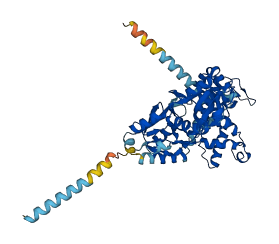
Descriptions
The autoinhibited protein was predicted that may have potential autoinhibitory elements via cis-regPred.
Autoinhibitory domains (AIDs)
Target domain |
|
Relief mechanism |
|
Assay |
cis-regPred |
Accessory elements
No accessory elements
Autoinhibited structure

Activated structure
1 structures for B0UUK3
| Entry ID | Method | Resolution | Chain | Position | Source |
|---|---|---|---|---|---|
| AF-B0UUK3-F1 | Predicted | AlphaFoldDB |
No variants for B0UUK3
| Variant ID(s) | Position | Change | Description | Diseaes Association | Provenance |
|---|---|---|---|---|---|
| No variants for B0UUK3 | |||||
No associated diseases with B0UUK3
Functions
| Description | ||
|---|---|---|
| EC Number | 4.2.2.n1 | Acting on polysaccharides |
| Subcellular Localization |
|
|
| PANTHER Family | ||
| PANTHER Subfamily | ||
| PANTHER Protein Class | ||
| PANTHER Pathway Category | No pathway information available | |
1 GO annotations of cellular component
| Name | Definition |
|---|---|
| cell outer membrane | A lipid bilayer that forms the outermost membrane of the cell envelope; enriched in polysaccharide and protein; the outer leaflet of the membrane contains specific lipopolysaccharide structures. |
2 GO annotations of molecular function
| Name | Definition |
|---|---|
| carbon-oxygen lyase activity, acting on polysaccharides | Catalysis of the cleavage of a carbon-oxygen bond by the elimination of an alcohol from a polysaccharide. |
| lytic transglycosylase activity | Catalysis of the specific cleavage of the beta-(1->4) glycosidic linkage between N-acetylmuramyl and N-acetylglucosaminyl residues in peptidoglycan, with the concomitant formation of 1,6-anhydro-N-acetylmuramyl residues. |
3 GO annotations of biological process
| Name | Definition |
|---|---|
| cell wall macromolecule catabolic process | The chemical reactions and pathways resulting in the breakdown of macromolecules that form part of a cell wall. |
| cell wall organization | A process that results in the assembly, arrangement of constituent parts, or disassembly of the cell wall, the rigid or semi-rigid envelope lying outside the cell membrane of plant, fungal and most prokaryotic cells, maintaining their shape and protecting them from osmotic lysis. |
| peptidoglycan metabolic process | The chemical reactions and pathways involving peptidoglycans, any of a class of glycoconjugates found only in bacterial cell walls and consisting of strands of glycosaminoglycan cross-linked by oligopeptides to form a huge and rigid network. |
No homologous proteins in AiPD
| UniProt AC | Gene Name | Protein Name | Species | Evidence Code |
|---|---|---|---|---|
| No homologous proteins | ||||
| 10 | 20 | 30 | 40 | 50 | 60 |
| MKGLFIRIVL | AICLSLWAID | MVFPWQQIVR | SKQNYHTTIQ | ERQKLIVGTI | NNPVSYFIGT |
| 70 | 80 | 90 | 100 | 110 | 120 |
| NGETGLEYEL | SKAFANYLNV | DLEMFPLNSA | DALFQALAQG | KIDIAAASLF | YQQDRSEKFK |
| 130 | 140 | 150 | 160 | 170 | 180 |
| LGPAYHAASW | QLTYRKGERR | PITLENLSGK | LVIPANSALN | NILLAKKEKY | PSLTWETSEL |
| 190 | 200 | 210 | 220 | 230 | 240 |
| SQEELLFQVA | EGKIDYTIAT | STEVSVNQQI | KPQIAIAFNV | TDEFTVHWYL | SDKGASELQA |
| 250 | 260 | 270 | 280 | 290 | 300 |
| ALLDFMNSAI | ENGLIARIEE | KYFNHLNQFD | YVDTRSYLNA | IETVLPKYAP | LFEKYKGDLD |
| 310 | 320 | 330 | 340 | 350 | 360 |
| WHLLAAISYQ | ESHWNPEATS | PTGVRGMMML | TKATADRMNI | TNRLDPEQSI | KAGSEYLHLL |
| 370 | 380 | 390 | 400 | 410 | 420 |
| LKQMPDTILK | EDRIWFALAA | YNMGLGHLLD | VRRLTKQLGG | NPDNWLEVKK | NLPLLAQKRY |
| 430 | 440 | 450 | 460 | 470 | |
| FTHLKYGYAR | GYEAFQYVEN | IRRYMNSIMN | YYRLQQNQQD | RYENENNDVI | STQTQQEQR |