B0KWT6
Gene name |
UBL4A |
Protein name |
Ubiquitin-like protein 4A |
Names |
|
Species |
Callithrix jacchus (White-tufted-ear marmoset) |
KEGG Pathway |
cjc:100387252 |
EC number |
|
Protein Class |
|
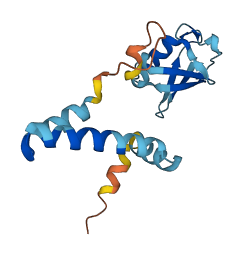
Descriptions
The autoinhibited protein was predicted that may have potential autoinhibitory elements via cis-regPred.
Autoinhibitory domains (AIDs)
Target domain |
|
Relief mechanism |
|
Assay |
cis-regPred |
Accessory elements
No accessory elements
Autoinhibited structure

Activated structure
1 structures for B0KWT6
| Entry ID | Method | Resolution | Chain | Position | Source |
|---|---|---|---|---|---|
| AF-B0KWT6-F1 | Predicted | AlphaFoldDB |
No variants for B0KWT6
| Variant ID(s) | Position | Change | Description | Diseaes Association | Provenance |
|---|---|---|---|---|---|
| No variants for B0KWT6 | |||||
No associated diseases with B0KWT6
7 regional properties for B0KWT6
| Type | Name | Position | InterPro Accession |
|---|---|---|---|
| domain | Ubiquitin-like domain | 1 - 73 | IPR000626 |
| conserved_site | Ubiquitin conserved site | 27 - 52 | IPR019954 |
| domain | Ubiquitin domain | 11 - 31 | IPR019956-1 |
| domain | Ubiquitin domain | 32 - 52 | IPR019956-2 |
| domain | Ubiquitin domain | 53 - 74 | IPR019956-3 |
| domain | Ubl4, C-terminal TUGS domain | 96 - 142 | IPR041421 |
| domain | UBL4A-like, ubiquitin-like domain | 1 - 72 | IPR044724 |
4 GO annotations of cellular component
| Name | Definition |
|---|---|
| BAT3 complex | A protein complex found in mammals that transfers tail-anchored (TA) proteins from SGTA to GET3 (ASNA1/TRC4) for targeting to the endoplasmic reticulum membrane. Also chaperones polypeptides from the endoplasmic reticulum retrotranslocation machinery to the proteasome, maintaining the solubility of substrates to improve ER-associated protein degradation (ERAD). Consists of BAG6 (BAT3) and its cofactors GET4 (TRC35) and UBL4A. |
| cytosol | The part of the cytoplasm that does not contain organelles but which does contain other particulate matter, such as protein complexes. |
| membrane | A lipid bilayer along with all the proteins and protein complexes embedded in it an attached to it. |
| nucleoplasm | That part of the nuclear content other than the chromosomes or the nucleolus. |
1 GO annotations of molecular function
| Name | Definition |
|---|---|
| chaperone binding | Binding to a chaperone protein, a class of proteins that bind to nascent or unfolded polypeptides and ensure correct folding or transport. |
4 GO annotations of biological process
| Name | Definition |
|---|---|
| post-translational protein targeting to endoplasmic reticulum membrane | The targeting of proteins to a membrane that occurs after their translation. Some secretory proteins exhibit posttranslational transport into the endoplasmic reticulum (ER) lumen: they are synthesized in their entirety on free cytosolic ribosomes and then released into the cytosol, where they are bound by chaperones which keep them in an unfolded state, and subsequently are translocated across the ER membrane. |
| regulation of protein stability | Any process that affects the structure and integrity of a protein, altering the likelihood of its degradation or aggregation. |
| tail-anchored membrane protein insertion into ER membrane | A process of protein insertion into the endoplasmic reticulum (ER) membrane in which a tail-anchored (TA) transmembrane protein is incorporated into an endoplasmic reticulum (ER) membrane. TA transmembrane protein, also named type II transmembrane proteins, contain a single C- terminal transmembrane region. |
| ubiquitin-dependent protein catabolic process | The chemical reactions and pathways resulting in the breakdown of a protein or peptide by hydrolysis of its peptide bonds, initiated by the covalent attachment of a ubiquitin group, or multiple ubiquitin groups, to the protein. |
No homologous proteins in AiPD
| UniProt AC | Gene Name | Protein Name | Species | Evidence Code |
|---|---|---|---|---|
| No homologous proteins | ||||
| 10 | 20 | 30 | 40 | 50 | 60 |
| MQLTVKALQG | RDCSLQVPED | ELVSTLKQLV | SEKLNVPVRQ | QRLLFKGKAL | ADGKRLSDYS |
| 70 | 80 | 90 | 100 | 110 | 120 |
| IGPNSKLNLV | VKPLEKVLLE | EGTGRRLADS | PPPQVWQLIS | KVLARHFSAA | DASRVLEQLQ |
| 130 | 140 | 150 | |||
| RDYERSLSRL | TLDDIERLAG | RFLHPEVTET | MEKGFSK |