A9N8H1
Gene name |
dnaJ |
Protein name |
Chaperone protein DnaJ |
Names |
|
Species |
Coxiella burnetii (strain RSA 331 / Henzerling II) |
KEGG Pathway |
cbs:COXBURSA331_A1438 |
EC number |
|
Protein Class |
|
Descriptions
The autoinhibited protein was predicted that may have potential autoinhibitory elements via cis-regPred.
Autoinhibitory domains (AIDs)
Target domain |
|
Relief mechanism |
|
Assay |
cis-regPred |
Accessory elements
No accessory elements
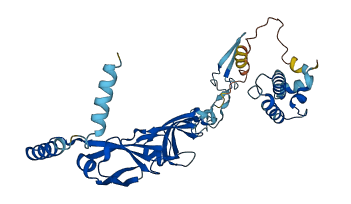
Autoinhibited structure

Activated structure
1 structures for A9N8H1
| Entry ID | Method | Resolution | Chain | Position | Source |
|---|---|---|---|---|---|
| AF-A9N8H1-F1 | Predicted | AlphaFoldDB |
No variants for A9N8H1
| Variant ID(s) | Position | Change | Description | Diseaes Association | Provenance |
|---|---|---|---|---|---|
| No variants for A9N8H1 | |||||
No associated diseases with A9N8H1
5 regional properties for A9N8H1
| Type | Name | Position | InterPro Accession |
|---|---|---|---|
| domain | Zinc finger, CHC2-type | 4 - 97 | IPR002694 |
| domain | TOPRIM domain | 251 - 331 | IPR006171 |
| domain | DNA primase, DnaG | 3 - 408 | IPR006295 |
| domain | DNA primase, catalytic core, N-terminal | 125 - 241 | IPR013264 |
| domain | Bacterial DnaG primase, TOPRIM domain | 251 - 330 | IPR034151 |
1 GO annotations of cellular component
| Name | Definition |
|---|---|
| cytoplasm | The contents of a cell excluding the plasma membrane and nucleus, but including other subcellular structures. |
4 GO annotations of molecular function
| Name | Definition |
|---|---|
| ATP binding | Binding to ATP, adenosine 5'-triphosphate, a universally important coenzyme and enzyme regulator. |
| heat shock protein binding | Binding to a heat shock protein, a protein synthesized or activated in response to heat shock. |
| unfolded protein binding | Binding to an unfolded protein. |
| zinc ion binding | Binding to a zinc ion (Zn). |
3 GO annotations of biological process
| Name | Definition |
|---|---|
| DNA replication | The cellular metabolic process in which a cell duplicates one or more molecules of DNA. DNA replication begins when specific sequences, known as origins of replication, are recognized and bound by initiation proteins, and ends when the original DNA molecule has been completely duplicated and the copies topologically separated. The unit of replication usually corresponds to the genome of the cell, an organelle, or a virus. The template for replication can either be an existing DNA molecule or RNA. |
| protein folding | The process of assisting in the covalent and noncovalent assembly of single chain polypeptides or multisubunit complexes into the correct tertiary structure. |
| response to heat | Any process that results in a change in state or activity of a cell or an organism (in terms of movement, secretion, enzyme production, gene expression, etc.) as a result of a heat stimulus, a temperature stimulus above the optimal temperature for that organism. |
No homologous proteins in AiPD
| UniProt AC | Gene Name | Protein Name | Species | Evidence Code |
|---|---|---|---|---|
| No homologous proteins | ||||
| 10 | 20 | 30 | 40 | 50 | 60 |
| MAKRDYYEVL | GVNLNATEAE | VKKAFRRLAM | KYHPDRNPGD | KDAEVKFKEA | REAYEVLCDS |
| 70 | 80 | 90 | 100 | 110 | 120 |
| RKRASYDQFG | HAGVEQTFGG | AGAGGFGFGD | LGDIFGDIFG | DIFSGARGGQ | AREQRGADLA |
| 130 | 140 | 150 | 160 | 170 | 180 |
| YELVLSLEEA | VHGLSRTIKV | PTWINCKTCN | GSGAKGSSPA | TCPRCNGSGQ | MRMQHGFLQV |
| 190 | 200 | 210 | 220 | 230 | 240 |
| QQTCSVCRGR | GQVIKDPCTD | CHGQGRQQQT | KTLSVKIPPG | IDTGDRIRLA | GEGEAGLFGA |
| 250 | 260 | 270 | 280 | 290 | 300 |
| PPGDLYVQVR | VKPHPLFHRE | GNDLHSEVPI | DFTTAALGGE | MEIPTLDGSV | RLTIPPETQG |
| 310 | 320 | 330 | 340 | 350 | 360 |
| GKQFRLRGKG | VKALRSGAVG | DLICHIVVET | PVKLSPEQKD | YLKQFAELLK | KDEKNHSPRT |
| 370 | |||||
| RNWFDSVKDF | FTSK |