Descriptions
The autoinhibited protein was predicted that may have potential autoinhibitory elements via cis-regPred.
Autoinhibitory domains (AIDs)
Target domain |
|
Relief mechanism |
|
Assay |
cis-regPred |
Accessory elements
171-194 (Activation loop from InterPro)
Target domain |
35-286 (Protein kinase domain) |
Relief mechanism |
|
Assay |
|
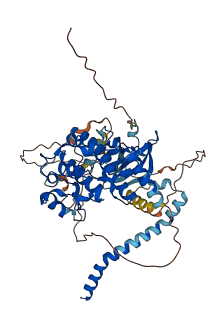
Autoinhibited structure

Activated structure
1 structures for A8XJW8
| Entry ID | Method | Resolution | Chain | Position | Source |
|---|---|---|---|---|---|
| AF-A8XJW8-F1 | Predicted | AlphaFoldDB |
No variants for A8XJW8
| Variant ID(s) | Position | Change | Description | Diseaes Association | Provenance |
|---|---|---|---|---|---|
| No variants for A8XJW8 | |||||
No associated diseases with A8XJW8
1 GO annotations of cellular component
| Name | Definition |
|---|---|
| cytoplasm | The contents of a cell excluding the plasma membrane and nucleus, but including other subcellular structures. |
3 GO annotations of molecular function
| Name | Definition |
|---|---|
| ATP binding | Binding to ATP, adenosine 5'-triphosphate, a universally important coenzyme and enzyme regulator. |
| protein serine kinase activity | Catalysis of the reactions: ATP + protein serine = ADP + protein serine phosphate. |
| protein serine/threonine kinase activity | Catalysis of the reactions: ATP + protein serine = ADP + protein serine phosphate, and ATP + protein threonine = ADP + protein threonine phosphate. |
6 GO annotations of biological process
| Name | Definition |
|---|---|
| determination of adult lifespan | The pathways that regulate the duration of the adult phase of the life-cycle of an animal. |
| intracellular signal transduction | The process in which a signal is passed on to downstream components within the cell, which become activated themselves to further propagate the signal and finally trigger a change in the function or state of the cell. |
| muscle cell development | The process whose specific outcome is the progression of a muscle cell over time, from its formation to the mature structure. Muscle cell development does not include the steps involved in committing an unspecified cell to the muscle cell fate. |
| protein phosphorylation | The process of introducing a phosphate group on to a protein. |
| protein tetramerization | The formation of a protein tetramer, a macromolecular structure consisting of four noncovalently associated identical or nonidentical subunits. |
| regulation of MAPK cascade | Any process that modulates the frequency, rate or extent of signal transduction mediated by the MAP kinase (MAPK) cascade. |
No homologous proteins in AiPD
| UniProt AC | Gene Name | Protein Name | Species | Evidence Code |
|---|---|---|---|---|
| No homologous proteins | ||||
| 10 | 20 | 30 | 40 | 50 | 60 |
| MPPSTDSSRR | NSEEGFSDGF | KLDSSALNKP | PEEVFDIVGK | LGEGSYGSVH | KAIHKESGHV |
| 70 | 80 | 90 | 100 | 110 | 120 |
| LAIKKVPVDT | DLQEIIKEIS | IMQQCKSKYV | VKYYGSYFKN | SDLWIVMEYC | GAGSISDIMR |
| 130 | 140 | 150 | 160 | 170 | 180 |
| ARRKPLSEKE | ISAVLRDTLK | GLQYLHDLKK | IHRDIKAGNI | LLNTDGIAKL | ADFGVAGQLT |
| 190 | 200 | 210 | 220 | 230 | 240 |
| DTMAKRNTVI | GTPFWMAPEV | IEEIGYDTKA | DIWSLGITAI | EMAEGRPPYS | DIHPMRAIFM |
| 250 | 260 | 270 | 280 | 290 | 300 |
| IPTKPPPTFK | KPEEWSSEFN | DFIRCCLIKK | PEERKTALRL | CEHTFIENAP | GCDVLQAMIL |
| 310 | 320 | 330 | 340 | 350 | 360 |
| DAQEKVLLGQ | APVAVAGADA | TLLSEGMSTM | IDGGDATLVQ | YKDNYVTAQS | LRSQMESLKI |
| 370 | 380 | 390 | 400 | 410 | 420 |
| GGEIPKSAYG | SSRNNGSPRV | QPPGHTASAC | DPSNNPPFAE | EGTGPNFQIG | TSESSYKDAS |
| 430 | 440 | 450 | 460 | 470 | 480 |
| YNMMNTEAEY | ENRFQRAVCD | GDFEFLRNIT | LDELIRRKES | LDSEMEEEIR | ELQRRYKTKR |
| 490 | |||||
| QPILDVIEIK | KRLN |