A8WPF0
Gene name |
sdhb-1 |
Protein name |
Succinate dehydrogenase [ubiquinone] iron-sulfur subunit, mitochondrial |
Names |
Iron-sulfur subunit of complex II, Ip |
Species |
Caenorhabditis briggsae |
KEGG Pathway |
|
EC number |
1.3.5.1: With a quinone or related compound as acceptor |
Protein Class |
|
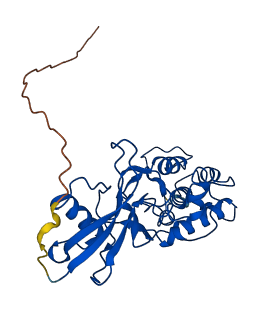
Descriptions
The autoinhibited protein was predicted that may have potential autoinhibitory elements via cis-regPred.
Autoinhibitory domains (AIDs)
Target domain |
|
Relief mechanism |
|
Assay |
cis-regPred |
Accessory elements
No accessory elements
Autoinhibited structure

Activated structure
1 structures for A8WPF0
| Entry ID | Method | Resolution | Chain | Position | Source |
|---|---|---|---|---|---|
| AF-A8WPF0-F1 | Predicted | AlphaFoldDB |
No variants for A8WPF0
| Variant ID(s) | Position | Change | Description | Diseaes Association | Provenance |
|---|---|---|---|---|---|
| No variants for A8WPF0 | |||||
No associated diseases with A8WPF0
5 regional properties for A8WPF0
| Type | Name | Position | InterPro Accession |
|---|---|---|---|
| domain | 2Fe-2S ferredoxin-type iron-sulfur binding domain | 43 - 131 | IPR001041 |
| binding_site | 2Fe-2S ferredoxin, iron-sulphur binding site | 91 - 99 | IPR006058 |
| domain | 4Fe-4S ferredoxin-type, iron-sulphur binding domain | 174 - 204 | IPR017896 |
| conserved_site | 4Fe-4S ferredoxin, iron-sulphur binding, conserved site | 184 - 195 | IPR017900 |
| domain | Succinate dehydogenase/fumarate reductase N-terminal | 39 - 144 | IPR025192 |
Functions
| Description | ||
|---|---|---|
| EC Number | 1.3.5.1 | With a quinone or related compound as acceptor |
| Subcellular Localization |
|
|
| PANTHER Family | ||
| PANTHER Subfamily | ||
| PANTHER Protein Class | ||
| PANTHER Pathway Category | No pathway information available | |
3 GO annotations of cellular component
| Name | Definition |
|---|---|
| mitochondrial inner membrane | The inner, i.e. lumen-facing, lipid bilayer of the mitochondrial envelope. It is highly folded to form cristae. |
| mitochondrial membrane | Either of the lipid bilayers that surround the mitochondrion and form the mitochondrial envelope. |
| mitochondrial respiratory chain complex II, succinate dehydrogenase complex (ubiquinone) | A protein complex located in the mitochondrial inner membrane that forms part of the mitochondrial respiratory chain. Contains the four polypeptide subunits of succinate dehydrogenase, flavin-adenine dinucleotide and iron-sulfur. Catalyzes the oxidation of succinate by ubiquinone. Connects the TCA cycle with the respiratory chain. |
7 GO annotations of molecular function
| Name | Definition |
|---|---|
| 2 iron, 2 sulfur cluster binding | Binding to a 2 iron, 2 sulfur (2Fe-2S) cluster; this cluster consists of two iron atoms, with two inorganic sulfur atoms found between the irons and acting as bridging ligands. |
| 3 iron, 4 sulfur cluster binding | Binding to a 3 iron, 4 sulfur (3Fe-4S) cluster; this cluster consists of three iron atoms, with the inorganic sulfur atoms found between the irons and acting as bridging ligands. It is essentially a 4Fe-4S cluster with one iron missing. |
| 4 iron, 4 sulfur cluster binding | Binding to a 4 iron, 4 sulfur (4Fe-4S) cluster; this cluster consists of four iron atoms, with the inorganic sulfur atoms found between the irons and acting as bridging ligands. |
| electron transfer activity | Any molecular entity that serves as an electron acceptor and electron donor in an electron transport chain. An electron transport chain is a process in which a series of electron carriers operate together to transfer electrons from donors to any of several different terminal electron acceptors to generate a transmembrane electrochemical gradient. |
| metal ion binding | Binding to a metal ion. |
| succinate dehydrogenase (ubiquinone) activity | Catalysis of the reaction: succinate + ubiquinone = fumarate + ubiquinol. |
| ubiquinone binding | Binding to ubiquinone, a quinone derivative with a tail of isoprene units. |
3 GO annotations of biological process
| Name | Definition |
|---|---|
| aerobic respiration | The enzymatic release of energy from inorganic and organic compounds (especially carbohydrates and fats) which requires oxygen as the terminal electron acceptor. |
| respiratory electron transport chain | A process in which a series of electron carriers operate together to transfer electrons from donors such as NADH and FADH2 to any of several different terminal electron acceptors to generate a transmembrane electrochemical gradient. |
| tricarboxylic acid cycle | A nearly universal metabolic pathway in which the acetyl group of acetyl coenzyme A is effectively oxidized to two CO2 and four pairs of electrons are transferred to coenzymes. The acetyl group combines with oxaloacetate to form citrate, which undergoes successive transformations to isocitrate, 2-oxoglutarate, succinyl-CoA, succinate, fumarate, malate, and oxaloacetate again, thus completing the cycle. In eukaryotes the tricarboxylic acid is confined to the mitochondria. See also glyoxylate cycle. |
No homologous proteins in AiPD
| UniProt AC | Gene Name | Protein Name | Species | Evidence Code |
|---|---|---|---|---|
| No homologous proteins | ||||
| 10 | 20 | 30 | 40 | 50 | 60 |
| MLARSALFVH | SAELAANAAR | AASGAAAAQP | KKTGNRIKTF | EIYRFNPEAP | GAKPTIQKFD |
| 70 | 80 | 90 | 100 | 110 | 120 |
| VDLDQCGTMI | LDALIKIKNE | VDPTLTFRRS | CREGICGSCA | MNIGGENTLA | CICKIDADTS |
| 130 | 140 | 150 | 160 | 170 | 180 |
| KSTKIYPLPH | MFVVKDLVPD | MNLFYAQYAS | IQPWIQKKTP | LTLGEKQMHQ | SVAERDRLDG |
| 190 | 200 | 210 | 220 | 230 | 240 |
| LYECILCACC | STSCPSYWWN | ADKYLGPAVL | MQAYRWVIDS | RDDYAQERLH | RMHDSFSAFK |
| 250 | 260 | 270 | 280 | ||
| CHTIMNCTKT | CPKHLNPAKA | IGEIKSLLTG | FKSKPAAEPS | AF |