A7THL9
Gene name |
MDM32 (Kpol_543p14) |
Protein name |
Mitochondrial distribution and morphology protein 32 |
Names |
|
Species |
Vanderwaltozyma polyspora (strain ATCC 22028 / DSM 70294 / BCRC 21397 / CBS 2163 / NBRC 10782 / NRRL Y-8283 / UCD 57-17) (Kluyveromyces polysporus) |
KEGG Pathway |
vpo:Kpol_543p14 |
EC number |
|
Protein Class |
|
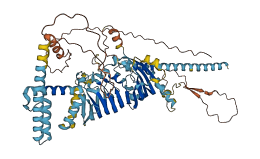
Descriptions
The autoinhibited protein was predicted that may have potential autoinhibitory elements via cis-regPred.
Autoinhibitory domains (AIDs)
Target domain |
|
Relief mechanism |
|
Assay |
cis-regPred |
Accessory elements
No accessory elements
Autoinhibited structure

Activated structure
1 structures for A7THL9
| Entry ID | Method | Resolution | Chain | Position | Source |
|---|---|---|---|---|---|
| AF-A7THL9-F1 | Predicted | AlphaFoldDB |
No variants for A7THL9
| Variant ID(s) | Position | Change | Description | Diseaes Association | Provenance |
|---|---|---|---|---|---|
| No variants for A7THL9 | |||||
No associated diseases with A7THL9
4 regional properties for A7THL9
| Type | Name | Position | InterPro Accession |
|---|---|---|---|
| domain | Xylulose 5-phosphate/Fructose 6-phosphate phosphoketolase, C-terminal | 608 - 809 | IPR018969 |
| domain | Xylulose 5-phosphate/Fructose 6-phosphate phosphoketolase, N-terminal | 30 - 390 | IPR018970 |
| binding_site | Xylulose 5-phosphate/Fructose 6-phosphate phosphoketolase, thiamine diphosphate binding site | 178 - 196 | IPR019789 |
| conserved_site | Xylulose 5-phosphate/Fructose 6-phosphate phosphoketolase, conserved site | 165 - 171 | IPR019790 |
2 GO annotations of cellular component
| Name | Definition |
|---|---|
| integral component of membrane | The component of a membrane consisting of the gene products and protein complexes having at least some part of their peptide sequence embedded in the hydrophobic region of the membrane. |
| mitochondrial inner membrane | The inner, i.e. lumen-facing, lipid bilayer of the mitochondrial envelope. It is highly folded to form cristae. |
No GO annotations of molecular function
| Name | Definition |
|---|---|
| No GO annotations for molecular function |
1 GO annotations of biological process
| Name | Definition |
|---|---|
| mitochondrion inheritance | The distribution of mitochondria, including the mitochondrial genome, into daughter cells after mitosis or meiosis, mediated by interactions between mitochondria and the cytoskeleton. |
No homologous proteins in AiPD
| UniProt AC | Gene Name | Protein Name | Species | Evidence Code |
|---|---|---|---|---|
| No homologous proteins | ||||
| 10 | 20 | 30 | 40 | 50 | 60 |
| MAGLLPRAYG | GVLRRSYIYL | GSQCSNSVSR | LTVGSTFRLV | RMKSWGTSKF | HTNGSPVLNE |
| 70 | 80 | 90 | 100 | 110 | 120 |
| IKKISKSNGI | TIINPLVNKV | TTNNVSTSSN | GKAAVAAATA | ATAVSLGSTG | QDDALSRNTD |
| 130 | 140 | 150 | 160 | 170 | 180 |
| FLHIQNILLQ | KNQDRMNKQK | LLSEATNFYE | RFKINTKWLL | IRGNRPFSAD | EIGTLFSWII |
| 190 | 200 | 210 | 220 | 230 | 240 |
| LSQILWIILG | TTTFVSILLI | IFNTVFAKEM | VGNVVGKLLN | IFLDGIDVKF | QDALVPEWRK |
| 250 | 260 | 270 | 280 | 290 | 300 |
| GCIRFNNVQL | RTHPLQASEP | ENINDYNELV | NNMIEFDLKL | HQIELSLSLK | KWLLGNGLIQ |
| 310 | 320 | 330 | 340 | 350 | 360 |
| DLTIMGMRGN | ITVTPVSLEN | KIDDNQRVNL | IDWFSNPYYH | LGNVKVTDSS | IILHDNQLSK |
| 370 | 380 | 390 | 400 | 410 | 420 |
| DFKVSIYNLD | MPQLRFQWII | NDFLSSNVVD | GSINHSLFNI | HKRQHKLAYI | KDLENDLSDW |
| 430 | 440 | 450 | 460 | 470 | 480 |
| KRITRIRLDS | IDVKKLGLNN | SNAFNWMDDG | QLDIIADVML | PNEQENEPDF | DFTRNKKEHM |
| 490 | 500 | 510 | 520 | 530 | 540 |
| SKSNNKYVVL | DLKFRFKDLK | AIFPDRAPRL | SNGEEILSLD | ELKQIILFIN | RKYDLYHSYA |
| 550 | 560 | 570 | 580 | 590 | 600 |
| NSSYKNTLWD | APNIAINKAK | SFPVTTVFQS | KKDFSNEDSD | EEDRKLKKQI | IRFHDDISTP |
| 610 | 620 | 630 | 640 | 650 | 660 |
| NNELVLSCKV | VKNINELKNM | VLFWETGIYD | SLSMELYIDL | MKMVEEWEYK | KKTNWMTDWG |
| 670 | |||||
| SSVASQLIIV | GFGAMV |