A7TG13
Gene name |
ATG15 (Kpol_1028p44) |
Protein name |
Putative lipase ATG15 |
Names |
Autophagy-related protein 15 |
Species |
Vanderwaltozyma polyspora (strain ATCC 22028 / DSM 70294 / BCRC 21397 / CBS 2163 / NBRC 10782 / NRRL Y-8283 / UCD 57-17) (Kluyveromyces polysporus) |
KEGG Pathway |
vpo:Kpol_1028p44 |
EC number |
3.1.1.3: Carboxylic ester hydrolases |
Protein Class |
|
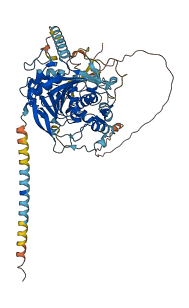
Descriptions
The autoinhibited protein was predicted that may have potential autoinhibitory elements via cis-regPred.
Autoinhibitory domains (AIDs)
Target domain |
|
Relief mechanism |
|
Assay |
cis-regPred |
Accessory elements
No accessory elements
Autoinhibited structure

Activated structure
1 structures for A7TG13
| Entry ID | Method | Resolution | Chain | Position | Source |
|---|---|---|---|---|---|
| AF-A7TG13-F1 | Predicted | AlphaFoldDB |
No variants for A7TG13
| Variant ID(s) | Position | Change | Description | Diseaes Association | Provenance |
|---|---|---|---|---|---|
| No variants for A7TG13 | |||||
No associated diseases with A7TG13
Functions
| Description | ||
|---|---|---|
| EC Number | 3.1.1.3 | Carboxylic ester hydrolases |
| Subcellular Localization |
|
|
| PANTHER Family | ||
| PANTHER Subfamily | ||
| PANTHER Protein Class | ||
| PANTHER Pathway Category | No pathway information available | |
2 GO annotations of cellular component
| Name | Definition |
|---|---|
| integral component of membrane | The component of a membrane consisting of the gene products and protein complexes having at least some part of their peptide sequence embedded in the hydrophobic region of the membrane. |
| multivesicular body membrane | The lipid bilayer surrounding a multivesicular body. |
1 GO annotations of molecular function
| Name | Definition |
|---|---|
| triglyceride lipase activity | Catalysis of the reaction: triacylglycerol + H2O = diacylglycerol + a carboxylate. |
2 GO annotations of biological process
| Name | Definition |
|---|---|
| autophagy | The cellular catabolic process in which cells digest parts of their own cytoplasm; allows for both recycling of macromolecular constituents under conditions of cellular stress and remodeling the intracellular structure for cell differentiation. |
| lipid catabolic process | The chemical reactions and pathways resulting in the breakdown of lipids, compounds soluble in an organic solvent but not, or sparingly, in an aqueous solvent. |
No homologous proteins in AiPD
| UniProt AC | Gene Name | Protein Name | Species | Evidence Code |
|---|---|---|---|---|
| No homologous proteins | ||||
| 10 | 20 | 30 | 40 | 50 | 60 |
| MISNDYTKFS | SKRRSLRYSN | RILLLMGTIL | LIVVYFYSDI | LVDKSIIMFR | NENKGQMLSG |
| 70 | 80 | 90 | 100 | 110 | 120 |
| SFTLRHIYRH | GVDKGHRTQE | VLDITKQNED | AFGRYFKREL | DEFNANAVGL | NTDDPLRELW |
| 130 | 140 | 150 | 160 | 170 | 180 |
| TSDKQFITDN | PFNFKFGLKG | NKQILHRMVD | RDPSFIEPYL | DFARESPDMA | AKVTIDWVEG |
| 190 | 200 | 210 | 220 | 230 | 240 |
| GEVVVVPDIT | DKNTVVSLAL | MSSNAYVRLP | YTDDWRNVSL | PWDSNDTPGY | GWESNGIRGH |
| 250 | 260 | 270 | 280 | 290 | 300 |
| VFVNDLENIV | VISIKGTSAQ | GLPGSGEDET | TGNDKLNDNL | LFSCCCARVS | YLWTTVCDCY |
| 310 | 320 | 330 | 340 | 350 | 360 |
| LKSYTCDETC | LEQAIKEKDH | YYQAAMDIYK | DTLRQYPHAT | IWLTGHSLGG | ALASLVGRTY |
| 370 | 380 | 390 | 400 | 410 | 420 |
| GLPTVAFESP | GELLAAKRLH | LPFPPGLPSY | DEGIWHIGHT | ADPIYMGTCN | GASSTCSIAG |
| 430 | 440 | 450 | 460 | 470 | 480 |
| YAMETGCHSG | KQCVYDVVRD | KGWHVNMLNH | RIHTVIDGIL | TKYDKVATCH | EPDPCVDCYN |
| 490 | 500 | 510 | 520 | 530 | 540 |
| WNFMPHGKKP | KKQTTSSSSE | KVDTSTTKSI | DRTTITTRTN | EKKWHPNPKD | PSTTTTDDKT |
| 550 | 560 | ||||
| LMSSCLHRNW | VGICTEYTTF | TKRLI |