A7T395
Gene name |
v1g144095 |
Protein name |
Spastin |
Names |
|
Species |
Nematostella vectensis (Starlet sea anemone) |
KEGG Pathway |
|
EC number |
5.6.1.1: Enzymes altering polypeptide conformation or assembly |
Protein Class |
|
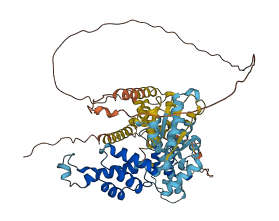
Descriptions
The autoinhibited protein was predicted that may have potential autoinhibitory elements via cis-regPred.
Autoinhibitory domains (AIDs)
Target domain |
|
Relief mechanism |
|
Assay |
cis-regPred |
Accessory elements
No accessory elements
Autoinhibited structure

Activated structure
1 structures for A7T395
| Entry ID | Method | Resolution | Chain | Position | Source |
|---|---|---|---|---|---|
| AF-A7T395-F1 | Predicted | AlphaFoldDB |
No variants for A7T395
| Variant ID(s) | Position | Change | Description | Diseaes Association | Provenance |
|---|---|---|---|---|---|
| No variants for A7T395 | |||||
No associated diseases with A7T395
5 regional properties for A7T395
Functions
| Description | ||
|---|---|---|
| EC Number | 5.6.1.1 | Enzymes altering polypeptide conformation or assembly |
| Subcellular Localization |
|
|
| PANTHER Family | ||
| PANTHER Subfamily | ||
| PANTHER Protein Class | ||
| PANTHER Pathway Category | No pathway information available | |
6 GO annotations of cellular component
| Name | Definition |
|---|---|
| centrosome | A structure comprised of a core structure (in most organisms, a pair of centrioles) and peripheral material from which a microtubule-based structure, such as a spindle apparatus, is organized. Centrosomes occur close to the nucleus during interphase in many eukaryotic cells, though in animal cells it changes continually during the cell-division cycle. |
| cytoplasm | The contents of a cell excluding the plasma membrane and nucleus, but including other subcellular structures. |
| integral component of membrane | The component of a membrane consisting of the gene products and protein complexes having at least some part of their peptide sequence embedded in the hydrophobic region of the membrane. |
| microtubule | Any of the long, generally straight, hollow tubes of internal diameter 12-15 nm and external diameter 24 nm found in a wide variety of eukaryotic cells; each consists (usually) of 13 protofilaments of polymeric tubulin, staggered in such a manner that the tubulin monomers are arranged in a helical pattern on the microtubular surface, and with the alpha/beta axes of the tubulin subunits parallel to the long axis of the tubule; exist in equilibrium with pool of tubulin monomers and can be rapidly assembled or disassembled in response to physiological stimuli; concerned with force generation, e.g. in the spindle. |
| microtubule cytoskeleton | The part of the cytoskeleton (the internal framework of a cell) composed of microtubules and associated proteins. |
| spindle | The array of microtubules and associated molecules that forms between opposite poles of a eukaryotic cell during mitosis or meiosis and serves to move the duplicated chromosomes apart. |
5 GO annotations of molecular function
| Name | Definition |
|---|---|
| ATP binding | Binding to ATP, adenosine 5'-triphosphate, a universally important coenzyme and enzyme regulator. |
| ATP hydrolysis activity | Catalysis of the reaction: ATP + H2O = ADP + H+ phosphate. ATP hydrolysis is used in some reactions as an energy source, for example to catalyze a reaction or drive transport against a concentration gradient. |
| isomerase activity | Catalysis of the geometric or structural changes within one molecule. Isomerase is the systematic name for any enzyme of EC class 5. |
| microtubule binding | Binding to a microtubule, a filament composed of tubulin monomers. |
| microtubule severing ATPase activity | Catalysis of the reaction: ATP + H2O = ADP + phosphate. Catalysis of the severing of a microtubule at a specific spot along its length, coupled to the hydrolysis of ATP. |
3 GO annotations of biological process
| Name | Definition |
|---|---|
| microtubule severing | The process in which a microtubule is broken down into smaller segments. Severing enzymes remove dimers from the middle of the filament to create new ends, unlike depolymerizing kinesins that use ATP to uncap microtubules at their ends. |
| positive regulation of microtubule depolymerization | Any process that activates or increases the frequency, rate or extent of microtubule depolymerization. |
| protein hexamerization | The formation of a protein hexamer, a macromolecular structure consisting of six noncovalently associated identical or nonidentical subunits. |
No homologous proteins in AiPD
| UniProt AC | Gene Name | Protein Name | Species | Evidence Code |
|---|---|---|---|---|
| No homologous proteins | ||||
| 10 | 20 | 30 | 40 | 50 | 60 |
| MPNNDILRPL | AIPAKYVGSF | LVFLYNGLYF | VFVVNLWSRL | FGKATKTEVP | PLPKIRKLGK |
| 70 | 80 | 90 | 100 | 110 | 120 |
| DMASRAPPRR | GQSSEDNEDG | LPAEIFNVRR | HHKQAYAYIA | RALEVDEGQG | SLETKKRAVE |
| 130 | 140 | 150 | 160 | 170 | 180 |
| FYNRGIEEME | AGLLIPCIDE | GEEWDKARRL | QEKMEANLEN | TRERMDELVI | IFFIIVVALL |
| 190 | 200 | 210 | 220 | 230 | 240 |
| VSAGMMDDQP | LLSARKTSSE | PSQAWDVSKP | TGPSYKQSKS | YKNSTTVTTK | RSQASPSFSS |
| 250 | 260 | 270 | 280 | 290 | 300 |
| SSSSVNSTAG | SSRTKPAKPA | PMAAPRRYNP | QVRRTKSTKP | AMMAKQSCVD | EQKKKISHLK |
| 310 | 320 | 330 | 340 | 350 | 360 |
| GIDPKLANII | MDEILESGPA | VHFSDIAGVD | NAKKALQEIV | ILPSLRPELW | RGDPTLVLFQ |
| 370 | 380 | 390 | 400 | 410 | 420 |
| VLPYPPGSSH | ITLPRASTAT | SFTSCFFSIS | KRSSLVHPVV | ASFFVKSLED | LASILTTSLF |
| 430 | 440 | 450 | 460 | 470 | 480 |
| TIDEVDSLLT | ERREGEHEHS | RRLKTEFLVS | FDGVVADPEE | RILVMGATNR | PQELDDAALR |
| 490 | 500 | 510 | 520 | 530 | 540 |
| RMVKRIHIPL | PDKETRKVLL | TKLLAKHHNP | LSGAEIDRLA | RMTEHYSGSD | LTALARDAAL |
| 550 | 560 | 570 | 580 | 590 | |
| GPIRDLNSDQ | LKSMAANEVR | NITFQDFVNS | LQIIRPSVGP | ETLKAYDDWN | RLYGSNA |